How to Slide in Baseball: Every Type of Slide Explained

Knowing how to slide in baseball is one of the fundamental skills that separates confident baserunners from hesitant ones. We have watched countless runners get thrown out simply because they stopped short or slid awkwardly — not because they lacked speed. A clean, well-timed slide keeps your momentum working for you, protects you from tags, and in many situations, saves you from injury.
In this guide, we cover every type of slide, the mechanics to make each one work, and the situations where each slide gives you the best chance of being safe.
- The feet-first slide is the safest and most common type — it is what we teach youth players first.
- The pop-up slide uses your momentum to spring back to your feet immediately after touching the base, letting you read the play and advance if possible.
- Head-first slides can reach the base faster than feet-first on straight runs but carry higher injury risk to fingers, wrists, and shoulders.
- Begin your slide 6–8 feet before the base — starting too late is the leading cause of awkward, injury-prone slides.
- Never slide directly into the fielder’s legs on a force play — use the outside corner of the bag or the hook slide to avoid collisions.
- Consistent sliding practice on a tarp or grass before game conditions builds the muscle memory you need when it counts.
Why Sliding Technique Matters
The Physics of a Slide
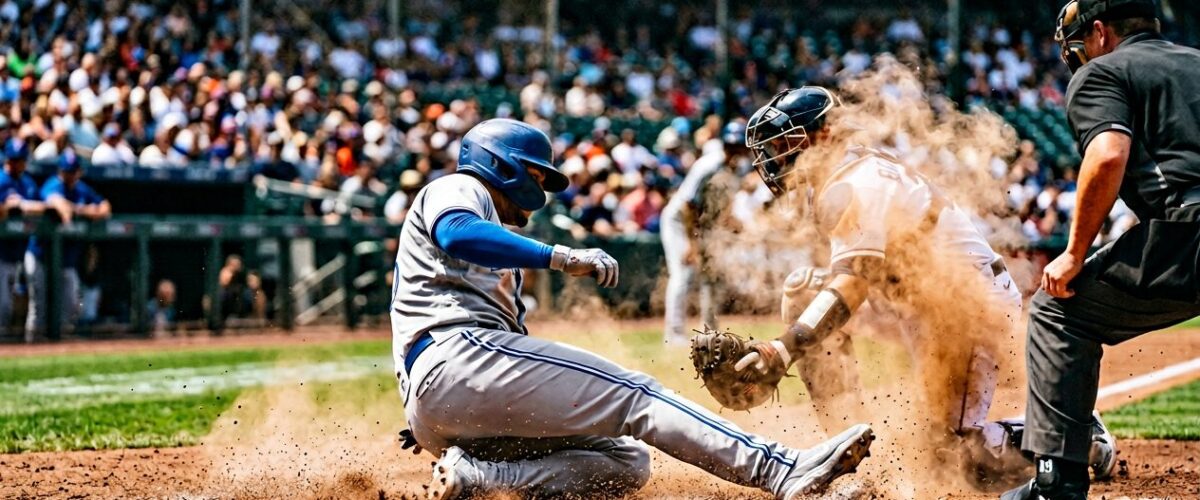
When you slide, you convert forward running momentum into horizontal ground contact. The goal is to drop your body below the fielder’s glove while maintaining enough forward momentum to reach the bag. A clean slide minimizes the time between the moment your body contacts the ground and the moment your foot touches the base — that window is where tags happen.
A runner who starts too late, lands too steeply, or braces with outstretched hands loses both speed and control. The result is either a jarring stop-and-reach, which leaves them reaching upward into the tag, or a collision that strains joints not built for impact from that angle.
When Do You Slide?
We slide in three situations:
1. When a close play at a base requires you to get under a tag
2. When you need to slow down to avoid overrunning a base (second and third base)
3. When league rules require a slide to avoid a collision with the fielder
You do not slide at first base on a force play — running through the bag is always faster on a straight shot to first.
Types of Baseball Slides
1. The Feet-First Slide (Straight-In)
This is the foundation. The feet-first slide is the safest technique and the most appropriate starting point for any player learning to slide.
How to execute:
- Begin your slide 6–8 feet before the base. Do not wait until you are on top of the bag.
- Drop to the ground by bending your dominant (back) leg under your body. Your shin and upper thigh go to the ground, creating a figure-4 shape: one leg bent under you, one leg extended toward the base.
- Keep your extended leg slightly off the ground — it should touch the base with the heel or the bottom of the foot, not slam down hard.
- Keep both hands up and balled into fists to protect your fingers. Never reach back with your hands to catch yourself — this is how wrists break.
- Lean slightly back as you drop, keeping your head and shoulders off the ground by engaging your core.
- Eyes stay on the fielder and the base throughout.
Best used for: Force plays, any base on a straightaway approach, learning fundamentals.
2. The Pop-Up Slide
The pop-up slide is an advanced variation of the feet-first slide. Instead of staying low after contact, the runner uses the momentum of the slide to spring back to their feet immediately, allowing them to read the next play and potentially advance.
How to execute:
- Begin exactly like a feet-first slide — drop into the figure-4 position 6–8 feet from the base.
- As your foot contacts the base, simultaneously push off with your bent leg and drive your upper body forward and upward.
- The motion is fluid — you are essentially bouncing off the base. Your bent leg provides the spring.
- Come up to your feet already in a balanced athletic stance, eyes on the outfield and the next base.
This slide is ideal for second base when an outfield single might send you to third. You need to read the play in real time, and standing up instantly gives you that option.
3. The Head-First Slide
The head-first slide is the most aggressive option. When done correctly, it does get the runner’s hand to the base slightly faster than feet-first on a direct approach. Many professional baserunners prefer it because it keeps momentum moving forward and makes the trailing tag more difficult.
How to execute:
- Begin your dive 6–8 feet from the base. Do not shorten your run-up.
- Drive off your dominant foot and extend your body nearly parallel to the ground, arms reaching toward the base.
- Hands should be flat and open — palms face down, fingers spread, reaching for the edge of the bag.
- Land on your chest and stomach, not on your elbows or forearms. The chest absorbs the impact across a wider surface area.
- Keep your head up — do not bury your face in the dirt. Eyes on the base and the fielder’s glove.
- Reach the corner of the bag, not the top surface, to make the tag more difficult.
Injury risks: Fingers, wrists, shoulders, and the collarbone are all vulnerable in head-first slides. Many youth leagues prohibit head-first slides for this reason. We recommend mastering the feet-first slide before attempting head-first slides, and always practicing on soft ground or a tarp first.
4. The Hook Slide
The hook slide is used specifically to avoid a tag. Instead of sliding directly into the base, the runner slides to one side and reaches back to the bag with the trailing hand or foot.
How to execute:
- Begin your slide as normal, but angle your body to one side of the base — typically toward the outfield side to go away from the fielder.
- As you slide past the base, hook the bag with your trailing foot as you pass by. Your body slides past the side of the bag, and your toe drags it into contact.
- Alternatively, use the outside corner of the bag: slide to the right of the bag (away from the fielder stationed on the left), and make contact with your left hand or left foot on the far edge.
The hook slide is particularly effective at home plate and at second base on a steal. It gives the fielder the minimum possible tag zone.
Slide Timing: The Most Common Mistake
Starting Too Late
Players who start their slide too late end up slamming into the base from directly above rather than approaching it at a low angle. This causes the knees and legs to take direct impact instead of distributing force across the thigh and shin. We see this constantly at the youth level.
The cue we give: begin your slide before you think you need to. At game speed, 6–8 feet feels much closer than it looks. If you are sliding at the right time, you should feel like you started early.
Starting Too Early
Starting too early bleeds speed and can leave a runner short of the bag. The correct launch point depends on speed and surface. On a wet or slippery infield, earlier slides are necessary. On a dry, hard infield, 6–7 feet is typically right.
Slide Type Comparison
| Slide Type | Speed to Base | Tag Avoidance | Injury Risk | Best Situation |
|---|---|---|---|---|
| Feet-First (Straight) | Good | Moderate | Low | Force plays, learning |
| Pop-Up | Good | Moderate | Low | 2B when advancing to 3B possible |
| Head-First | Best | High (hard to tag hands) | High | Returning to base, close plays |
| Hook Slide | Good | Best | Moderate | Avoiding tags at home, steals |
How to Practice Sliding Safely
Tarp or Wet Grass Drill
Lay a water-soaked tarp on grass. The wet surface reduces friction so you can practice the motion at lower speeds without abrasion. Start by sitting and scooting into position, then walking through the movement, then jogging, then at full speed. Most of the technique problems players have — starting too late, reaching back with hands — show up clearly at slow speed and are much easier to correct before game conditions.
The Breakdown Drill
Practice the figure-4 leg position from a standing start. Simply drop into the position in slow motion repeatedly. Focus on which leg bends and where. Many youth players have the wrong leg bending or both legs going out in front. The bent leg under the body is what creates the low angle to the ground.
Building Speed Progressively
Walk-through → jog → three-quarter speed → full speed. Never go directly from standing still to game-speed sliding on hard ground. Your body needs to rehearse the movement pattern before adding full velocity.
Sliding Rules and Safety Considerations
Interference and Collision Rules
MLB and most amateur leagues prohibit slides that are designed to injure fielders or that go outside the baseline to break up a double play (implemented after rule changes in 2016). Runners at second base on a force play must slide within the base path and not intentionally contact the fielder outside of that path.
At home plate, the collision rule (Rule 6.01(i)) requires runners to slide or avoid contact with the catcher rather than run through them. The hook slide toward the outside of the plate is the standard technique for these situations.
Youth League Restrictions
Many youth leagues prohibit head-first slides entirely. Check your specific league rules before teaching or allowing head-first slides in practices or games. The feet-first and pop-up slides cover the vast majority of game situations safely.
Learning to slide is inseparable from learning to read the basepaths. We highly recommend pairing sliding practice with our guide on how to steal a base in baseball — understanding when and how to run aggressively changes what type of slide you need before you even reach the bag.
Position on the Base After Sliding
Staying on the Bag
After your foot or hand contacts the base, keep contact. An overslide — where your momentum carries you past the bag and you lose contact — results in an out if you are tagged while off the base. Keep your body compact and do not over-extend your reaching leg past the bag surface.
Reading the Play After Contact
As soon as you touch the base, find the ball with your eyes. This is especially critical on a pop-up slide. Know whether the ball was bobbled, where the fielder is, and whether the next base is open. MLB.com’s baserunning technique resources show how professional coaches teach body position awareness during and after slides. For general baserunning principles at the amateur level, USA Baseball’s coaching resources are an excellent reference.
Our baseball drills guide includes baserunning drills that pair well with sliding practice — combining the two in the same session is the most efficient way to build game-ready skills.
Frequently Asked Questions
How do you slide in baseball without getting hurt?
Keep your hands up and in fists, never reach back to break your fall, start your slide 6–8 feet before the base, and practice on wet grass or a tarp before doing it at full speed on a hard infield. The feet-first slide has the lowest injury risk for beginners.
Is it better to slide head-first or feet-first?
For most situations, feet-first is safer and gets the job done. Head-first can be marginally faster at reaching the base but carries significantly higher injury risk to fingers, wrists, and shoulders. Many youth leagues prohibit head-first slides. Most experienced coaches recommend mastering feet-first before attempting head-first.
When should you not slide in baseball?
Do not slide at first base on a force play — running through the bag is faster. Also avoid sliding when you have significant distance left to run; slides are for the final approach to the base, not mid-path stumbles.
What is a pop-up slide?
A pop-up slide is a feet-first slide where the runner uses the momentum of the slide and pushes off with their bent leg to spring back to their feet immediately upon contacting the base. It allows the runner to immediately read the play and advance if the opportunity exists.
How do you hook slide in baseball?
Angle your approach to one side of the base — away from the fielder. Slide past the side of the bag and hook it with your trailing foot or hand as you pass. Your body slides to the outside, making it significantly harder for the fielder to apply the tag.
Why do runners slide at second base differently than other bases?
Second base is the most common steal target and also the base where double-play attempts begin. The hook slide at second is designed to avoid the fielder’s pivot motion and is the most effective tag-avoidance technique. Pop-up slides at second are also common because runners often need to read whether to advance to third.
How early should you start your slide?
Begin your slide 6–8 feet before the base. Most players start too late, which causes the steep-angle problem. On a wet or slippery surface, you may need to start slightly earlier to account for increased sliding distance.