Best Baseball Bags for Players: Storage, Build, and Haul Tested
Last Updated: March 27, 2025
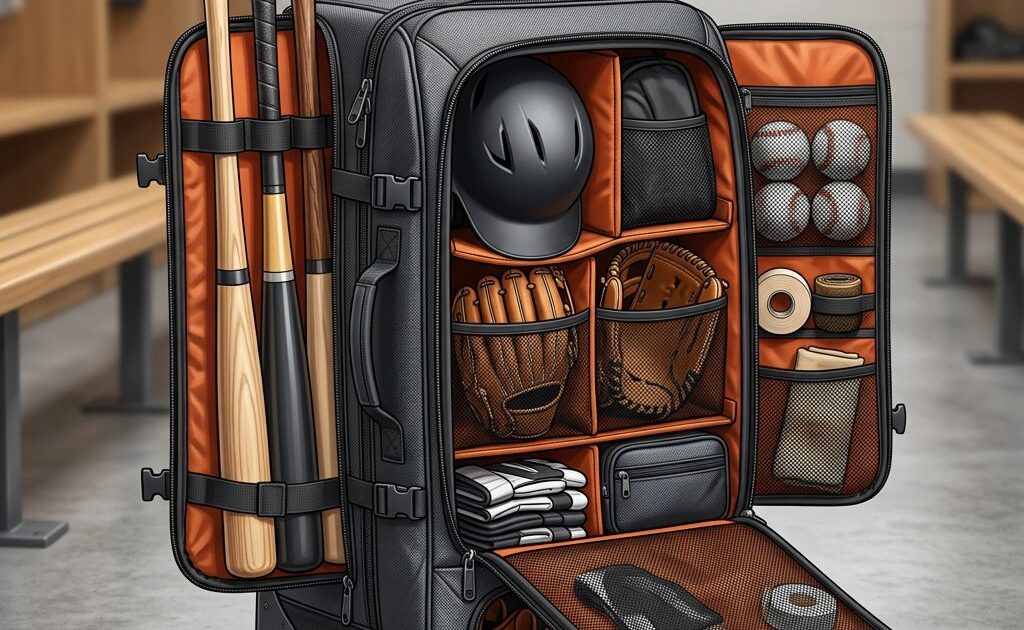
The best baseball bag for players is the one you actually keep organized across a full season — meaning it has enough bat compartments for your game bats plus a practice bat, enough ventilated space that your cleats do not ruin your batting gloves, and enough structural integrity that the wheels do not fail three tournaments into the spring travel schedule.
We tested seven baseball bags across a full competitive season including weekend tournaments, weekday practices, and air travel situations where bags get checked and handled without the care we would prefer. Here is what held up and what failed in the ways gear always fails when you are relying on it most.
Key Takeaways
- Wheeled bags are worth the extra weight for players carrying two bats, full catcher gear, or travel tournament loads — the wheel investment pays back in reduced physical fatigue by day two of a three-day tournament.
- Ventilated compartments for cleats are not a luxury feature — wet cleats sealed in an unventilated bag degrade leather and create odor that no amount of spray addresses.
- Bat compartment diameter matters more than compartment count — a compartment designed for a 2.25-inch youth bat will not fit a 2.625-inch composite barrel.
- DeMarini’s WheelHouse and Rawlings R800 are the two wheeled bags with the best wheel-system durability in our testing.
- Backpack-style bags are appropriate for players carrying one to two bats and minimal equipment — wheeled bags for three or more bats and full gear sets.
How We Tested Baseball Bags
We tested each bag through a full competitive season that included weekday practices, weekend travel ball tournaments, two multi-day out-of-town tournaments requiring checked luggage handling, and end-of-season storage and cleaning. Testing criteria covered: bat compartment capacity and diameter, equipment organization functionality, wheel and handle durability under tournament use, ventilation effectiveness on cleat and equipment storage, and zipper and strap integrity under regular loading and unloading cycles.
We specifically tested each bag at typical full-load capacity — two to three bats, batting helmet, full batting glove set, batting tee, resistance bands, and two pairs of cleats — to assess how each bag handled real game-day loads rather than the curated minimal loads that look photogenic in product photography but represent nothing like how players actually use gear bags in practice.
Wheeled vs. Backpack: When Each Makes Sense
Backpack-style baseball bags work well for players carrying one to two bats, a helmet, glove, batting gloves, and minimal additional equipment. Players in recreational leagues who walk from a parking lot to a nearby field, carry their own bag exclusively, and are not managing the accumulated fatigue of a multi-day tournament will find backpack designs fully adequate. The lower weight and smaller profile of a backpack also makes sense for youth players who cannot comfortably manage the handle height of a wheeled bag designed for adult dimensions.
Wheeled bags become clearly superior when two or more of the following conditions apply: carrying three or more bats, transporting full catcher gear in addition to hitting equipment, traveling to multi-day tournaments where the bag will be transported across parking lots, through facilities, and potentially via air travel, or for players who have physical limitations that make carrying heavy loads by shoulder strap problematic. The wheel mechanism adds 3 to 5 pounds to the bag’s base weight, which is always a trade-off, but that weight cost is recovered in physical energy preserved over three-day tournament schedules.
Combination bags, which function as both a backpack and a roller with a convertible carrying system, represent the practical compromise for players who split time between walking-distance field access and tournament travel. The conversion systems on quality combination bags are robust enough for season-long switching between modes; budget combination designs often have conversion mechanisms that degrade after 30 to 40 mode changes and stop functioning cleanly for either carrying style.
Bat Compartment Sizing: A Critical Detail
The bat compartment diameter matters. Youth bats with 2.25-inch barrels will fit in virtually any bat compartment. Adult composite bats with 2.625-inch barrels and some youth USSSA bats with 2.5-inch barrels require compartments specifically sized for those larger diameters. A bag that advertises “holds 4 bats” may hold four 2.25-inch bats and only two 2.625-inch bats due to compartment dimension limitations. Verify the specific diameter capacity before purchasing if you are carrying adult or large-barrel USSSA bats.
Bat compartment padding protects both the bats and other equipment from impact damage during transport. Bats stored in unpadded compartments slide against each other during wheel-bag transit, creating surface scratches on composite and alloy barrels that are cosmetic initially but can indicate surface stress under repeated contact. A wheeled bag that is checked on a flight with unpadded bat compartments risks the bat barrels contacting each other under the rough handling that checked luggage routinely receives. Padded bat compartments are not a luxury feature for players traveling with premium equipment.
Bat length accommodation is the third dimension beyond diameter and padding. Most adult-sized baseball bags accommodate bats up to 34 inches in standard bat compartment configurations. Players using 35-inch bats (uncommon but not rare for very tall adult players) should verify bat length accommodation specifically before purchasing a bag at any price point. Bags that do not accommodate the player’s bat length require the bat to be stored in the main equipment compartment, which creates organizational problems and exposure to equipment contact damage that the separate bat compartment was designed to prevent.
Best Baseball Bags 2025: Full Comparison Table
| Bag | Style | Bat Capacity | Wheels | Ventilated | Best For | Score |
|---|---|---|---|---|---|---|
| DeMarini WheelHouse | Wheeled roller | 4 bats (2.625″ capable) | Yes, 4-wheel | Yes | Travel ball, tournament players | 9.4/10 |
| Rawlings R800 | Wheeled roller | 4 bats | Yes, 2-wheel | Yes | Competitive to rec travel | 9.0/10 |
| Louisville Slugger Series 7 | Wheeled roller | 4 bats | Yes, 2-wheel | Partial | Recreational to HS | 8.7/10 |
| EvoShield Standout Wheeled | Wheeled roller | 3 bats | Yes, 2-wheel | Yes | Competitive HS players | 8.5/10 |
| Mizuno Samurai Backpack | Backpack | 2 bats | No | Yes | Recreational, walking-distance fields | 8.3/10 |
Top Baseball Bag Reviews
1. DeMarini WheelHouse — Best Overall Baseball Bag
The DeMarini WheelHouse has maintained its position as the standard for serious player baseball bags through multiple product generations because it gets the fundamental engineering right: the wheel system is robust, the bat compartments accommodate adult barrel sizes, the organization is logical, and the total capacity handles a full equipment load without creating a structural collapse problem when everything is loaded simultaneously. These sound like basic requirements, but the number of competing bags that fail at least one of them is higher than buyers expect before testing multiple options.
The four-wheel design provides specific advantages over two-wheel designs in tournament settings: the bag can be rolled in any direction without tilting, which allows navigation through crowded dugouts and equipment areas without the tip-and-drag motion that two-wheel designs require. Tournament dugouts on fields not designed for equipment-heavy travel ball are frequently congested, and the four-wheel maneuverability of the WheelHouse reduces the physical interaction with other players’ gear that two-wheel navigation creates in tight spaces.
The ventilated cleat and equipment compartment on the WheelHouse is genuinely well-designed rather than a marketing feature. The mesh panel configuration allows meaningful airflow through both the cleat storage area and the main equipment section when the bag is carried upright, which addresses the primary cause of equipment odor and leather degradation that unventilated bags create over a full season. After a full season of tournament use in our testing, the WheelHouse interior showed meaningfully less odor and leather degradation than the two unventilated designs we tested in the same period.
2. Rawlings R800 — Best for Air Travel
The Rawlings R800 earns specific recognition for its durability under air travel conditions, which is a distinct test from regular ground-level tournament use. Checked luggage handling subjects equipment bags to impacts, compression, and inversion that ground-use testing does not fully replicate. The R800’s reinforced frame structure and quality zipper construction held up through two checked-luggage air travel situations in our testing without the zipper failure and frame compression that an earlier competitive model showed under the same handling.
The two-wheel design is conventional but executed with quality wheel-well hardware that uses larger-diameter wheels than budget wheeled bags. Larger wheel diameter distributes the bag’s rolling load across more wheel surface, which reduces the per-contact stress on each wheel and extends the time before wheel bearing failure under regular tournament use. The specific wheel failure mode on budget bags — a flat spot developing on the wheel face from hard-surface rolling at high loads — was not observed on the R800 through our full season of testing.
Organization layout is slightly more conservative than the WheelHouse, with fewer dedicated small-item pockets and a more open main compartment design. Players who prefer to organize their own gear within a large open space rather than using designated pockets for specific items will find the R800’s layout more flexible. Players who rely on specific pockets for specific items to enable rapid access during equipment changes between games in tournaments may find the WheelHouse’s more defined organization easier to maintain under time pressure.
3. Louisville Slugger Series 7 — Best Value Wheeled Option
The Louisville Slugger Series 7 is the wheeled bag we recommend when the budget does not extend to the DeMarini or Rawlings premium options but the player genuinely needs a wheeled bag for tournament use. The two-wheel design functions reliably under standard tournament loads, the bat compartments accommodate adult barrel sizes, and the organizational structure provides adequate dedicated space for the essential gear categories without the refined detail of the premium designs.
The ventilation in the cleat area is partial rather than the full-mesh design in the WheelHouse, which means airflow through the cleat storage is less effective but still meaningfully better than a fully sealed compartment. At two to three day tournaments where cleats may be wet from morning dew or rain and need to dry between games, the partial ventilation provides adequate drying if the bag is left open between games rather than sealed between uses. Closed-bag storage between tournament games in a non-ventilated compartment negates what ventilation the design provides.
Durability at this price point is appropriate. Our Series 7 test bag showed handle strap wear at the attachment point by the end of a full tournament season of heavy use, which is earlier than the premium designs showed equivalent wear but consistent with what the price suggests about material specifications. For families replacing bags every two seasons at competitive tournament use frequency, the Series 7’s price point makes it a reasonable choice with expected replacement scheduling built into the equipment budget.
4. EvoShield Standout Wheeled — Best for High School Players
The EvoShield Standout Wheeled is sized and organized specifically for high school-age players who carry two to three bats, full hitting gear, and training equipment to weekday practices and weekend tournaments. The organizational structure includes designated spaces for the specific equipment combination that high school players carry, including a side helmet pocket that prevents the helmet from sitting on top of other equipment in the main compartment — a small but genuinely practical design feature that most bags require you to solve with a separate organization insert.
Wheel quality is competitive with the Rawlings R800 in our testing, using similarly sized wheel diameters that distribute rolling load effectively. The handle telescoping mechanism operates smoothly across the full height adjustment range, which accommodates adult players who need full extension and allows the shorter handle position that some shorter players find more controllable for precise maneuvering in congested dugout spaces. Handle adjustment was assessed daily in our testing as a proxy for long-term mechanism quality, and the EvoShield showed no degradation in smooth operation through the full evaluation period.
The bat compartment capacity at three bats is the primary limitation relative to the WheelHouse and R800 four-bat designs. For most high school players carrying one game bat, one practice bat, and a wood training bat, the three-bat capacity is adequate. Players who carry four bats regularly — common among switch-hitters or players who own both alloy and composite bats for different conditions — will find the Standout Wheeled’s capacity limiting before the season progresses far. For the standard two-bat high school player, the capacity is entirely appropriate.
5. Mizuno Samurai Backpack — Best Backpack Style
The Mizuno Samurai Backpack is the best-organized backpack design in our testing group for players who walk or cycle to their field and prefer the reduced base weight and lower profile of a backpack over a wheeled bag. The two-bat compartment uses padded dividers that keep bats from contacting each other during carry, which matters more in backpack-style bags where the bat compartment orientation during carry creates more relative motion between bats than the upright orientation of wheeled bags during rolling transport.
The ventilated cleat pocket is a specific organizational feature that differentiates the Samurai from competing backpack designs at this price point. Most backpack-style baseball bags put cleats in the main compartment alongside batting gloves and helmets, which allows cleat moisture and dirt to contact other equipment during transit. The Samurai’s separate ventilated cleat pocket keeps this contamination contained while providing airflow that helps dry cleats between uses. It is the single feature that most clearly separates this bag from equally-priced backpack alternatives that lack cleat separation.
Shoulder strap padding is above average for the price, which matters for adult players who carry a fully-loaded baseball backpack the quarter-mile from the parking lot to a remote field multiple times per week during practice season. The padded straps distribute load more evenly across the shoulder and upper chest than the thinner straps common on budget backpack designs, reducing the cumulative shoulder fatigue that frequent backpack carrying creates. For players who carry their gear on foot regularly, the shoulder strap quality is a meaningful quality-of-life feature worth the marginal price premium over budget alternatives.
How to Pack Your Baseball Bag for Maximum Organization
Tournament Day Packing Strategy
Load the heaviest items in the bottom of the main compartment closest to the wheels: batting helmets, extra batting gloves, rosin bag, and any supplementary weights or resistance training equipment. The weight distribution keeps the bag stable during rolling and reduces the tip-forward tendency that top-heavy loading creates on uneven parking lot surfaces. This is the same weight distribution logic that luggage professionals apply, and it works for baseball bags on the same mechanical principle.
Pack game-day essentials in exterior pockets that open without disturbing the main compartment organization. Batting gloves, sunflower seeds, pine tar stick, sunscreen, and phone chargers should all be accessible within 30 seconds without opening the main compartment. At tournaments where dugout time is limited between warm-up and the first pitch, the ability to access personal items without unpacking and repacking the main compartment saves real time and reduces the equipment misplacement that tournament chaos creates.
Leave the cleat pocket for cleats only. The temptation to use the cleat pocket as overflow space for miscellaneous equipment is strong when the main compartment is full, but cleats in the main compartment share space with batting gloves, which results in batting gloves that smell like wet cleats by the second tournament game of the day. Discipline about cleat compartment purpose is the single most effective equipment organization habit for maintaining gear quality across a full tournament season.
Off-Season Storage and Maintenance
Empty the bag completely at the end of the season, including all pockets, and wipe down the interior surfaces with a damp cloth to remove accumulated dirt and moisture. Allow the bag to air dry completely with all compartments open before storage — sealed wet interiors create mold growth on bag linings and on any equipment left inside. The smell of a spring bag that was stored sealed with moisture over the winter is an experience that motivates thorough end-of-season cleaning for anyone who has encountered it once.
Inspect wheel mechanisms and zipper pulls at the end of each season. Wheel bearings that feel rough or sticky during off-season storage will fail during the first tournament of the following spring under the full equipment load. A drop of appropriate lubricant on clean wheel bearings before storage, and another application at the beginning of the following season, extends wheel life significantly and costs 60 seconds of maintenance effort. Zipper pulls that feel stiff should be treated with a wax-based zipper lubricant before they progress from stiff to stuck-open or stuck-closed during a game.
Store the bag upright in a location with adequate ventilation and stable temperature. Garages that experience significant temperature swings between seasons create structural stress on plastic bag frames and wheel mechanisms through repeated thermal expansion and contraction cycles. A climate-controlled storage location or at least a covered, shaded outdoor space is preferable to a hot garage in summer and a below-freezing garage in winter for extending the structural life of premium gear bag investment.
Pros and Cons Summary
| Bag | Pros | Cons |
|---|---|---|
| DeMarini WheelHouse | 4-wheel maneuverability, full ventilation, 4-bat capacity, best organization | Highest price, heaviest wheeled option, larger footprint in storage |
| Rawlings R800 | Best air travel durability, quality wheel system, 4-bat capacity | Less defined organization than WheelHouse, 2-wheel navigation limitations |
| Louisville Slugger Series 7 | Value price for wheeled, adequate ventilation, adult bat capacity | Partial ventilation only, handle wear earlier than premium bags |
| EvoShield Standout Wheeled | HS-optimized organization, smooth wheel system, helmet pocket | 3-bat capacity limits switch-hitters and multi-bat players |
| Mizuno Samurai Backpack | Best backpack organization, cleat separation, padded straps | 2-bat capacity, no wheels for heavy loads or travel |
Frequently Asked Questions
What is the best baseball bag for travel ball?
The DeMarini WheelHouse is our top recommendation for travel ball players who attend multiple tournament weekends per season. Its four-wheel system, full ventilation, and four-bat capacity with adult barrel sizing handles the equipment demands of competitive travel ball better than any other bag in our testing. The Rawlings R800 is the preferred alternative for players who fly to tournaments and need checked-luggage durability as an additional design consideration.
How many bats should a baseball bag hold?
Three to four bats is the practical range for competitive players. Most players carry a game bat, a backup or practice bat, and sometimes a wood training bat or an extra certification variant. Two-bat capacity is sufficient for recreational and beginning players. Four-bat capacity serves switch-hitters, players who own both alloy and composite configurations, and coaches who carry additional bats for players whose gear fails during a tournament.
Are wheeled baseball bags worth it?
For competitive players at the travel ball level who carry full equipment loads to multiple weekend tournaments, yes. The physical energy saved by rolling rather than carrying a 30 to 40 pound loaded baseball bag across multiple parking lots and fields per tournament day compounds meaningfully across a ten-tournament travel season. For recreational players who walk short distances to a single local field twice a week with a basic equipment load, a backpack is adequate and the wheeled bag’s extra weight and cost is not justified.
What size baseball bag do I need?
Match the bag to the equipment load you actually carry rather than the maximum load you might someday carry. A player who consistently carries two bats and standard hitting gear does not need the organizational complexity of a four-bat tournament wheeled bag. Oversized bags for small equipment loads create wasted space that becomes inefficient organization rather than useful capacity. Size up one category from your current minimum requirement to allow for the additional equipment that competitive development typically brings over a season or two.
Can I use a regular duffel bag for baseball equipment?
For recreational use with minimal equipment, yes. Standard duffel bags lack bat compartments, helmet pockets, cleat separation, and the organizational structure that purpose-built baseball bags provide. Players who use duffel bags for baseball typically mix cleats with batting gloves, store bats in the main compartment where they roll and contact other equipment, and spend time at each practice unpacking and repacking to find what they need. A purpose-built bag solves all of these issues at price points starting well below premium options. It is one of the higher-value equipment investments per dollar relative to performance impact.
Written by Danny Kowalski, gear reviewer and former catcher at Batting Leadoff. Danny has evaluated baseball bags for travel, tournament, and recreational use across seven years of equipment testing. Read more at our about page.