How to Become a Better Baseball Player: The Complete Development System
Figuring out how to become a better baseball player is something we hear from players at every stage — from kids just starting out to high school athletes trying to earn college looks to adult recreational players who want to stop being the weakest link on their team. The answer is never one thing. It is a system. And having coached players through all of these situations, we have learned that the gap between average players and good ones almost always comes down to a small number of habits applied consistently.
This guide covers everything: the practice habits, physical development, mental game, position-specific work, and the life factors that determine how fast a player improves.
- Deliberate practice — focused, goal-directed repetition with immediate feedback — produces faster improvement than equal amounts of unstructured practice.
- Mental visualization of baseball skills activates the same neural pathways as physical practice and measurably improves performance when done consistently.
- Most MLB players played multiple sports as children; early multi-sport exposure builds athletic foundations that transfer powerfully to baseball.
- Identifying and training your weakest skill first produces the highest improvement rate — most players default to working on strengths instead.
- Sleep, nutrition, and recovery are not optional for player development — they are when physical adaptation from training actually happens.
- Game reps and practice reps are different; you need both, and they train different skills.
The Foundation: How Players Actually Improve
Deliberate Practice vs. Going Through the Motions
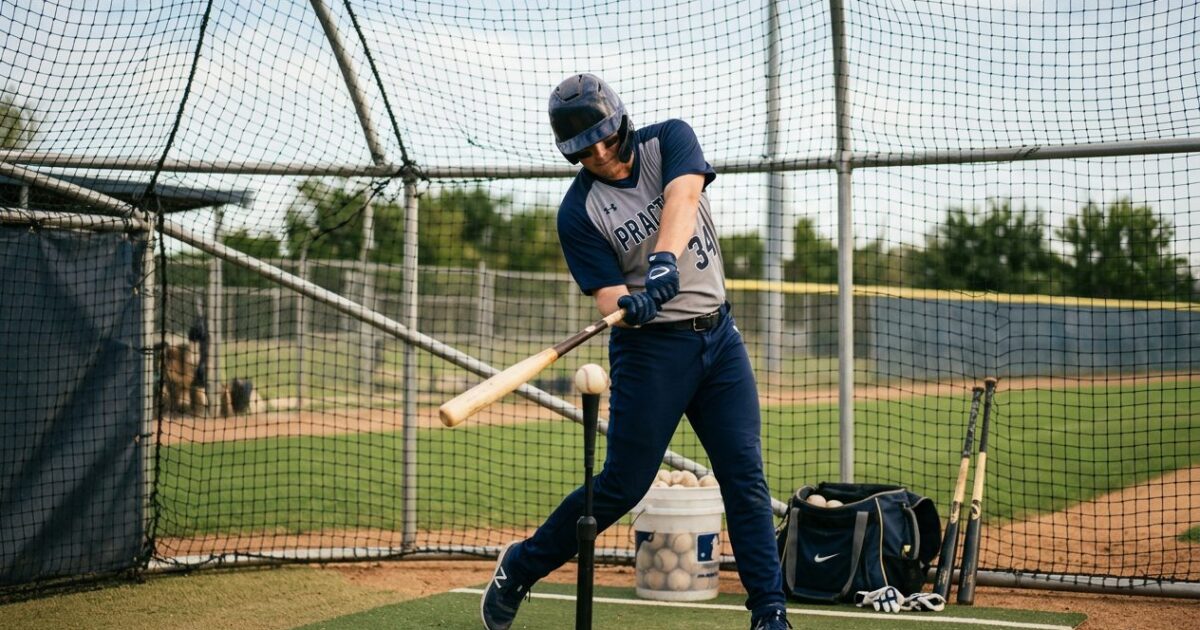
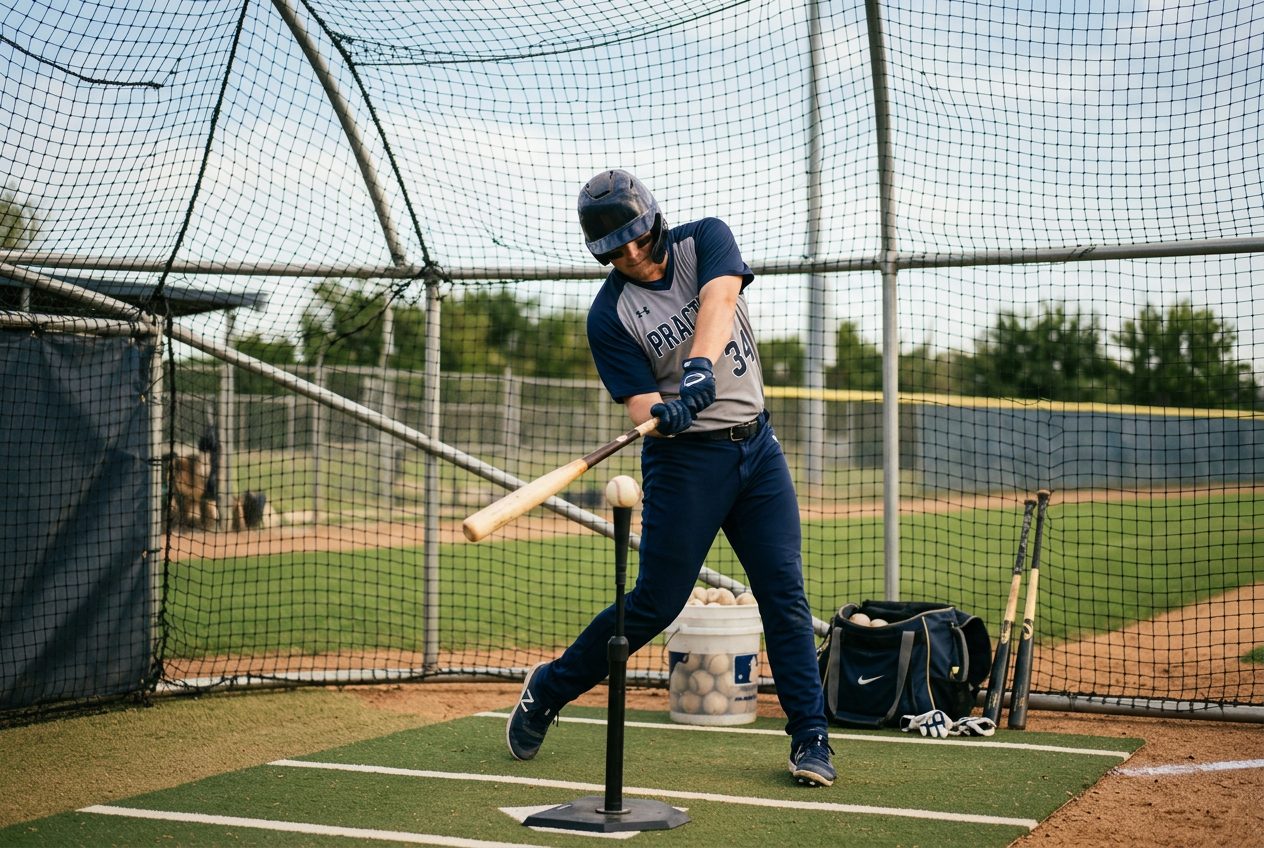
Research on skill development consistently shows that deliberate practice — practice that is focused, intentional, and includes immediate feedback — produces faster and more durable improvement than the same amount of unstructured repetition. Hitting 200 balls off a tee while your mind is on your phone is not deliberate practice. Taking 30 focused swings with a specific target (inside pitch to the opposite field, hard ground ball to the left side) and evaluating each one is.
The principles of deliberate practice applied to baseball:
- Identify specific weaknesses: Not “I need to get better” but “I struggle with off-speed pitches below the zone in right-handed pitcher counts.”
- Design practice to target that specific weakness: Create drills that replicate that scenario repeatedly.
- Get immediate feedback: Video, coaching input, tracking result patterns, or using technology like a Rapsodo or Blast Motion sensor.
- Push past comfort: The zone where you make errors at a moderate rate is the zone where learning happens fastest.
Volume Matters, But Quality Beats Volume
We have worked with players who take 500 swings a day and make minimal progress because every swing is identical (comfortable pitch, predictable location) and unchallenged. We have also worked with players who take 50–100 focused, purposeful swings and improve faster in a month than the high-volume player did all season.
The right answer for most players is moderate, high-quality volume: enough repetitions to build durable motor memory, structured specifically to address the skills that need most development.
Hitting: How to Get Measurably Better
Work Backwards from Your Weaknesses
Watch video of your last 10 at-bats. Where do the weak contacts come from? Where do you swing and miss? Which pitchers gave you the most trouble? This tells you exactly what to work on. The most common findings:
- Chasing pitches out of the zone (discipline problem, trained with deliberate pitching machine work in specific locations)
- Late on fastballs (timing problem, trained with front toss and shorter load path adjustments)
- Weak contact on off-speed pitches (recognition problem, trained with mixed pitch batting practice and off-speed-heavy sessions)
- Getting jammed on inside pitches (bat path problem, trained with inside-pitch tee work and inside-half pitching machine reps)
Our baseball hitting drills guide maps specific drill types to each weakness category with detailed instructions.
Use Video Consistently
Modern smartphones make video analysis available to every player. Film your swing from two angles (side and front) at least once a week during the season and twice a week in the off-season. Study the film with a coach or with an app like Hudl Technique or Coach’s Eye. Look for the same checkpoints every time: load timing, hip-to-shoulder separation, contact point location, and follow-through consistency.
Pitching: Developing a Complete Arsenal
Command Before Velocity
The fastest path to becoming a better pitcher is not adding velocity — it is commanding the pitches you already have to the locations you intend. A pitcher who can throw an 82 mph fastball to the low-outside corner at will is far more effective than one who throws 88 but has no idea where it is going.
Practice pitching to specific spots, not just “down in the zone.” Tape a catcher target into quadrants and aim for specific quadrants. Track your pitch location accuracy and try to improve it systematically.
Add Pitches Strategically
New pitches should be added only after the primary fastball is commanded. The typical development order for most youth and amateur pitchers: four-seam fastball → changeup → two-seam fastball or sinker → curveball or slider. Adding pitches before you command the ones you have dilutes practice time and slows development. Check our two-seam fastball guide for when and how to add movement to your fastball arsenal.
Defense: The Most Neglected Area of Development
Footwork and Positioning
Most defensive errors come from footwork, not hands. Players who get to the ball in good position — balanced, under control, in a good pre-throw stance — make far fewer errors than players with soft hands who are constantly throwing off-balance or reaching. Focus defensive practice on reading the ball early (getting your first step right), moving to optimal fielding position, and setting your feet for the throw — not just catching the ball.
Position-Specific Development
| Position | Top Development Priority | Key Drill Type |
|---|---|---|
| Infielder (SS/2B/3B) | Lateral range and footwork | Slow rollers, backhand drills, throw-on-the-run |
| Outfielder | First-step read and routes | Drop-step drills, crow hop mechanics, fly ball communication |
| Catcher | Receiving and framing | Framing mechanics, blocking drills, pop-time work |
| First Baseman | Footwork on throws, stretch technique | Short-hop drills, off-target throws in the dirt |
The Mental Game: The Biggest Separator at Every Level
Mental Visualization That Actually Works
Mental visualization is not just positive thinking. Research consistently shows that vivid, specific mental rehearsal of baseball skills activates the same neural pathways as physical practice and produces measurable performance improvements. The key is specificity and sensory richness.
Instead of vaguely imagining hitting well, visualize a specific pitch, a specific count, a specific ballpark. Feel the grip in your hands. See the pitcher’s release. Track the pitch into the contact zone. Hear the crack of the bat. Run through the full sequence in real time. Do this for 5–10 minutes before practice or games, and the neural reinforcement accumulates over the season.
Processing Failure Constructively
Baseball is a game of failure. Even the best hitters fail 65–70% of the time. How players process those failures determines how quickly they improve. We teach players to use a simple three-step routine after a bad at-bat or a defensive error:
- Step away and reset (20–30 seconds, focus on the physical feeling of relaxing).
- Extract one specific thing to do differently next time (“I was late — I’ll load earlier against this pitcher”).
- Let it go and focus on the next play.
Players who ruminate on failures carry tension into subsequent at-bats and plays. Players with a reset routine clear the slate faster.
Physical Development: What Actually Transfers
Rotational Strength and Power
Almost everything in baseball — hitting, throwing, and generating bat and arm speed — is driven by rotational power through the kinetic chain. Rotational training should be a core part of off-season and in-season maintenance programs.
Exercises with the highest transfer to baseball performance: medicine ball rotational throws, cable rotational pulls, hip hinge patterns (deadlifts, single-leg RDLs), and lateral power development (lateral bounds, broad jumps).
Flexibility and Mobility
Hip mobility, thoracic (upper back) rotation, and shoulder mobility directly limit baseball performance. A hitter who cannot fully rotate through their hips will generate less power regardless of swing technique. A pitcher who lacks thoracic mobility cannot achieve the arm height necessary for an efficient delivery. Dedicating 10–15 minutes per session to baseball-specific mobility work is not optional — it is maintenance for the exact movements the sport requires.
Sleep and Recovery
This is the most underrated performance variable in youth and amateur baseball. Physical adaptation from training — strength gains, improved coordination, motor skill consolidation — happens during sleep, not during training. Players who consistently sleep 7–9 hours improve faster from the same training volume than sleep-deprived players. Nutrition timing (protein within an hour of training) supports the same adaptation. These are not marginal gains — they are significant.
Learning from the Game: The Mental Database
Study Your Sport
The best players at every level watch baseball constantly — not passively, but analytically. Watch how pitchers set up hitters. Watch how infielders position themselves based on the count. Watch baserunning decisions. Watch outfield reads on contact. MLB’s video archive is free and publicly accessible. Watch the game the way a student studies, not just the way a fan enjoys it.
Know the Numbers Behind Your Performance
Understanding your own statistics is an underused self-coaching tool. What is your hard-hit rate? Where do your strikeouts come from — which pitch types and locations? How often do you reach base via walk versus hit? These patterns point directly at what needs work. Our guide to reading baseball statistics explains exactly how to interpret these numbers for your own development. Resources at USA Baseball also include player development pathways and coaching materials that are accessible to players at every level.
Frequently Asked Questions
What is the fastest way to become a better baseball player?
Identify your single biggest weakness through video review and honest self-assessment, then design deliberate practice specifically targeting that weakness. Improvement is fastest when you work on the skills you avoid, not the ones that already feel comfortable.
How many days a week should I practice baseball?
For year-round development, 4–5 days of focused practice per week (including a full rest day or active recovery day) is effective for most players. During the season, the goal shifts to maintaining skills and managing load — over-training during the season leads to fatigue-related decline, not improvement.
Does multi-sport participation help baseball players?
Yes. Research and the experience of elite player development programs consistently show that early multi-sport participation builds athletic foundations (coordination, agility, spatial awareness, varied movement patterns) that transfer positively to baseball. Early specialization before age 12–14 is associated with higher burnout rates and does not produce better long-term outcomes.
How do you improve baseball IQ?
Watch baseball analytically (not passively), study game film of your own performances, ask coaches to explain their tactical decisions, and read about the strategy behind pitching sequences, defensive positioning, and situational offense. Baseball IQ is built through pattern recognition — the more game situations you observe thoughtfully, the faster you build a mental database.
How important is strength training for baseball players?
Highly important, particularly rotational strength (for hitting and throwing power) and lower body power (for speed and kinetic chain generation). However, strength training should be age-appropriate. Youth players benefit more from movement skill development than from heavy resistance training. High school and older players should prioritize a structured baseball-specific strength program.
What is the most common mistake players make when trying to improve?
Working almost exclusively on strengths while avoiding weaknesses. Players naturally gravitate toward drills they are already good at because they feel productive. Sustainable improvement comes from honest identification of the skills below your level and structured practice that specifically targets them.
How do you stay motivated during a long baseball season?
Set small, specific, measurable process goals rather than outcome goals. “I will improve my walk rate by focusing on pitch recognition this week” is more controllable and more motivating than “I will hit .300 this season.” Tracking progress on process goals keeps motivation grounded in things you can control.
