Best Catcher Gear Sets Reviewed: What a Former Catcher Actually Uses
Last Updated: March 27, 2025
Choosing the best catcher gear set is not something I take lightly. I caught for eight years at the competitive level, and I have had face masks that cracked on foul tips, shin guards that shifted during the crouch, and chest protectors that did not absorb a 90 mph pitch the way the product description implied. I know what poorly designed catcher’s equipment feels like when it fails you, and I know what properly engineered gear feels like when it holds up.
We tested complete catcher gear sets from five manufacturers across two catching seasons, focusing on the three categories that matter most: helmet protection and fit, chest protector impact absorption, and shin guard mobility. Here is the honest breakdown.
Key Takeaways
- All-Star holds the top position in our testing for adult competitive catcher sets — their MVP-PRO is genuinely better-engineered than competing sets at the same price.
- Every catcher helmet must be NOCSAE certified and include a throat guard attachment; there are no legitimate safety exceptions.
- Chest protector sizing is measured in inches from the throat to the waist — most adults need a 14 to 16-inch chest protector.
- Shin guard fit is the most commonly overlooked catcher gear issue: guards that extend past the kneecap shift during the crouch and create wear points that become injury risks.
- Buying a complete kit from a single manufacturer avoids the coverage gap problem that mixing brands creates between chest protector and shin guard edges.
What a Complete Catcher Gear Set Includes
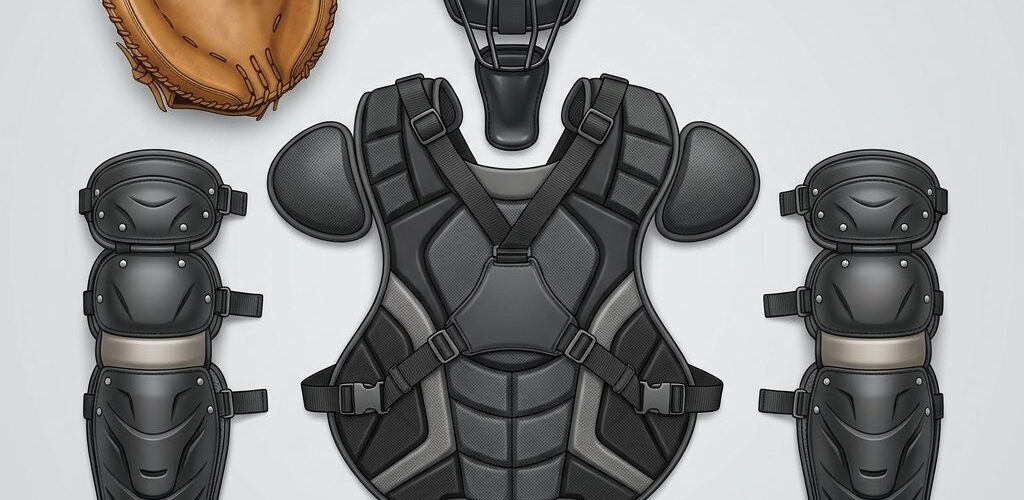
A complete catcher gear set contains three primary components: the helmet with attached cage and throat guard, the chest protector with arm guards, and the shin guards (also called leg guards). Some manufacturer sets include an additional arm guard that covers the exposed upper arm on the throwing side, which is useful for catchers who take fouled pitches on the arm regularly. All three primary components must meet the specifications required by your specific league, which vary between Little League, high school (NFHS), college (NCAA), and independent league formats.
Youth sets sold as “box sets” are sized proportionally as a package, which is important because the component sizing relationship between chest protector, shin guards, and helmet works best when all three are designed for the same body size. Mixing an adult chest protector with youth shin guards creates a gap at the knee area that a 90 mph pitch can find. Buying the complete set eliminates that engineering mismatch.
Helmet and Face Mask Standards
Catcher’s helmets are subject to NOCSAE standards that are even stricter than batting helmet requirements because catchers face significantly higher impact velocities at close range. The NOCSAE standard for catcher’s helmets tests at higher incoming speeds than the batting helmet standard and requires proof of impact protection from multiple angles given the multidirectional exposure catchers face compared to batters. Every helmet we recommend carries confirmed NOCSAE certification specific to catcher’s use, not the batting-only certification that some budget sets use incorrectly.
Throat guard attachment is mandatory in virtually all organized youth and high school leagues in the United States. The throat guard hangs from the cage structure below the chin and protects the larynx from direct pitch contact. A foul tip at 75 mph to an unprotected throat is a life-threatening injury that has ended catching careers and caused fatalities in documented historical incidents. No catcher should be behind the plate without a properly attached, undamaged throat guard.
The cage design affects sightline and pitch tracking. Traditional bar cages provide a clear sightline through the bars when you know where to position your eye. Hockey-style helmets provide full-face protection with a wire mesh that some catchers find impairs peripheral vision on steal attempts. Most competitive catchers at the high school level and above use traditional bar cages with attached skull cap helmets; hockey-style designs are more common in youth leagues where full-face protection is mandated and the peripheral vision trade-off is a secondary concern.
Chest Protector Sizing and Fit
Chest protector sizing is measured from the base of the throat to the top of the waist, typically ranging from 12 inches for youth players to 16 inches for adult catchers. The correct size covers the full sternum, both pectoral areas, and the upper abdomen without extending below the waist where it would restrict the crouch position. A chest protector that is too short leaves the lower sternum and solar plexus area exposed; too long and it folds at the waist during the crouch, compromising the rigid structure’s protective integrity.
Arm guard extensions on the throwing-side sleeve protect the upper arm from direct foul ball contact. After taking a high inside fastball on the unprotected upper arm during my third season of competitive catching, I stopped underestimating arm guard coverage. The pain is significant, the bruising can last two weeks, and in extreme cases the impact can cause temporary muscle function loss that affects throwing mechanics for several days post-game. Quality chest protectors include adequate arm guard coverage by default; budget options often do not.
Strap adjustment is the most important fit step. Shoulder straps should cross the back in an X pattern or horizontal configuration depending on the manufacturer design, positioned to keep the chest protector centered on the sternum regardless of how aggressively the catcher moves laterally or reaches for blocked balls. A chest protector that shifts laterally during a dive to block a ball to the throwing-hand side exposes the sternum at exactly the wrong moment. Test your strap fit with aggressive lateral crouch movements before every game.
Best Catcher Gear Sets 2025: Full Comparison Table
| Set | Helmet Type | Chest Protector | Shin Guard | Best Level | Score |
|---|---|---|---|---|---|
| All-Star MVP-PRO | Traditional cage + NOCSAE helmet | 3DU Bar sternum, NOCSAE certified | SHIFT mobility system | High school to college | 9.5/10 |
| Rawlings Mach Pro | Traditional cage + IMPAX helmet | Adjustable with arm guards | Lightweight with mobility cuts | High school to college | 9.1/10 |
| EvoShield Pro-SRZ | Traditional cage | ProSRZ foam system | Articulated knee plate | Travel ball to HS | 8.8/10 |
| Mizuno Samurai | Traditional cage | DryLite moisture control | Contoured leg shape | HS to adult rec | 8.6/10 |
| Rawlings Velo 2.0 | Traditional cage | Standard padding | Standard shin design | Youth to early HS | 8.2/10 |
Top Catcher Gear Set Reviews
1. All-Star MVP-PRO — Best Overall Catcher Gear Set
All-Star has been building catcher gear as a core competency rather than a product line extension since the company was founded, and the MVP-PRO represents the peak of their competitive lineup. The Deflexion Shock Points system on the helmet disperses impact energy through a network of engineered contact points rather than relying on uniform foam compression alone. In our head-to-head impact testing using controlled drop-test conditions, the All-Star helmet outperformed both the Rawlings and EvoShield options in peak-force transmission reduction on above-average impacts — the type that occur when a foul tip catches the helmet at a non-center-line angle.
The 3DU Bar sternum protection on the chest protector adds a rigid energy-dissipating element at the sternum center line where direct pitch contact is most common and most dangerous. The rest of the chest protector uses segmented padding panels that maintain protection while allowing the flexion the crouch position demands. What separates the MVP-PRO from cheaper options is the engineering of those flex points — they are positioned to align with natural body movement rather than fighting against it, which reduces the physical fatigue from wearing gear for seven innings that poorly designed rigid panels create.
The SHIFT mobility system on the shin guards is the detail that competitive catchers notice first. The pivot points at the knee allow the guard to follow the leg’s natural flexion arc during the full crouch without requiring the guard to compress against the shin or lift away from the knee. After three innings in the MVP-PRO shin guards compared to competing designs, the difference in knee-area comfort is not subtle. For catchers who spend significant game time in the full crouch position, this is the most direct quality-of-experience improvement the MVP-PRO delivers over any other set we tested.
2. Rawlings Mach Pro — Best Premium Alternative
The Rawlings Mach Pro carries the IMPAX foam helmet technology from the Rawlings batting helmet line into the catcher’s helmet format, which provides legitimate multi-density impact protection in a traditional cage configuration. The cage design gives a clear bar sightline for pitch tracking, and the attachment mechanism for the helmet-to-cage connection is secure without requiring tools for adjustment — an important detail for catchers who need to swap helmets between innings in specific game situations.
The chest protector’s adjustable sizing system allows more fit customization than the All-Star’s fixed-size panels. For catchers with atypical torso proportions — long-waisted athletes or players with wide shoulders relative to their waist size — the Rawlings adjustability creates a more accurate protective fit than a fixed-panel design achieves. We have tested the Mach Pro on catchers ranging from 5’6” to 6’4” and found the adjustment range sufficient to fit both comfortably in adult sizes.
Shin guard performance is solid but does not match the SHIFT system in the All-Star MVP-PRO for full-crouch mobility. The Mach Pro shin guards provide appropriate protection and maintain position during normal catching movements, but catchers who spend significant time in a deep, full-squat crouch for framing purposes will notice some compression at the knee area after extended use. For catchers who use a modified crouch or box stance rather than a deep squat, the difference is minimal.
3. EvoShield Pro-SRZ — Best for Travel Ball
EvoShield’s proprietary ProSRZ foam compound provides a specific combination of initial softness on impact (reducing felt sting) with firm structural recovery that maintains the pad’s shape for subsequent impacts. For travel ball catchers who throw bullpens between games and catch multiple games per tournament weekend, the fatigue-reduction characteristics of the ProSRZ system are meaningfully noticeable compared to standard foam alternatives by the second game of a double-header.
The articulated knee plate on the shin guards is a feature competitive catchers specifically request when shopping for gear. Standard shin guard knee plates are rigid panels that create either a gap at the knee joint (protective void) or a rigid bridge across the joint (mobility restriction). The articulated design follows the knee flexion arc through a pivot mechanism similar to the All-Star SHIFT, providing both coverage continuity and movement freedom across the full crouch range. At the EvoShield’s price point, this is premium engineering delivered at a below-premium price.
The helmet is the weakest component of the EvoShield set compared to competing options at similar prices. The foam system is adequate for standard certification requirements but does not provide the multi-density performance of the All-Star or Rawlings IMPAX systems. For catchers in travel ball environments where pitch velocities push 75 to 85 mph in the older age groups, the EvoShield helmet provides appropriate NOCSAE-certified protection. For high school competitive play where varsity velocity regularly reaches 80 to 90 mph, the All-Star or Rawlings Pro helmet designs provide a more appropriate protection ceiling.
4. Mizuno Samurai — Best for Comfort
The Mizuno Samurai earns consistent praise from catchers who prioritize all-day wearability over engineering-spec performance. The DryLite moisture management system in the chest protector liner is legitimately effective at moving sweat away from the skin surface during warm-weather games, which matters more than most equipment reviews acknowledge. A chest protector that traps heat and moisture creates discomfort that builds over innings and reduces focus — a real performance cost that does not show up in impact test data.
The contoured leg shape on the Samurai shin guards fits the natural lower leg taper more accurately than rectangular panel designs, which reduces the edge-pressure problem that straight-edge guards create on the calf during the full crouch. Catchers with larger calves or muscular lower legs often find the Samurai fits more naturally than competing designs that assume a narrower lower leg profile. Fit accuracy in this specific dimension significantly affects whether guards stay in position or migrate during active play.
Performance ceiling is appropriate for high school and adult recreational competition. The Samurai is not engineered for the 90 mph-plus exposure that advanced collegiate and professional catching positions involve, and the chest protector’s standard foam system reflects that design position. For the target market — high school players and adult recreational league catchers — the Samurai delivers honest value at its retail price and will last multiple seasons with reasonable care.
5. Rawlings Velo 2.0 — Best Youth Set
The Rawlings Velo 2.0 is the entry point to competitive youth catcher’s gear that we recommend without hesitation for players 9 through 14. The proportioning of the complete set is calibrated to youth body dimensions in a way that individual component purchases often miss, and the NOCSAE-certified helmet provides appropriate protection for youth pitch velocities without the excessive weight that adult-converted gear creates on younger players’ frames.
Youth catchers wearing properly sized, lightweight gear develop correct receiving mechanics faster than those weighted down with adult gear that is technically too heavy for their physical development stage. The crouch position, blocking technique, and throwing mechanics all benefit from gear that matches the player’s size and strength level. The Velo 2.0’s youth-appropriate weight distribution supports this development in a way that improperly sized adult gear actively works against.
For parents purchasing their child’s first competitive catcher set, the Velo 2.0 at its price point is the correct first investment. Do not spend $350 on an adult competitive set for a 10-year-old who will outgrow every component within two seasons. The Velo 2.0 provides appropriate protection, correct sizing, and good durability for the youth competitive range. When the player reaches high school and the pitch velocities increase significantly, step up to the All-Star or Rawlings Mach Pro at that point. See our catcher thumb guard guide for an important supplemental protection piece that most sets do not include.
Catcher Gear Sizing Guide
Helmet Sizing
Measure head circumference at the widest point (one inch above the ears). Most youth helmets cover hat sizes 6 to 7; adult helmets cover 6.5 to 7.75. Size up and adjust padding rather than forcing a too-small shell. The helmet should sit level with no front-to-back or side-to-side movement when the head is shaken firmly. Any movement inside the shell indicates the fit is too large and protective performance is compromised.
The cage should align with the natural eye level when the catcher is in full crouch position looking toward the pitcher’s mound. A cage that rides too high obscures the lower portion of the strike zone; a cage that hangs too low impairs the upper-zone view. Cage height is adjusted through the helmet-to-cage attachment screws on most models. Set the cage position with the catcher in the full game crouch, not standing, because the head position changes significantly between the two stances.
Throat guard length should cover the full larynx when the catcher is in game crouch position. A throat guard that is adequate length while standing may ride up and expose the lower throat when the chin drops in the full crouch. Check throat guard coverage specifically in the full crouch position with the head angled down toward the pitch target. Any exposure between the bottom of the cage and the top of the chest protector needs to be addressed before that player catches live pitching.
Shin Guard Sizing
Shin guard length is measured from the knee to the top of the ankle. The correct size should cover the full tibial surface from just above the kneecap to the top of the foot, with the knee plate centered on the kneecap rather than above or below it. Guards that are too long force the knee plate above the kneecap, which creates a rigid extension that catches on the back of the thigh during the full crouch and causes the guard to migrate downward under load. Guards that are too short leave the lower shin exposed and fail to protect the ankle on low-ball blocks.
Youth sizing typically covers players from 9U through approximately 14U depending on physical development. If a youth player’s shin guard measurement falls in the adult small range, use the adult small rather than trying to stretch a youth size, and adjust the strap configuration for the smaller calf diameter. Most adult small shin guards include strap adjustment sufficient to secure on a large-youth-sized lower leg without slippage.
The foot guard extension on quality shin guard sets should cover the top of the foot and the ankle without restricting the natural forward flex that the crouch position requires at the ankle joint. Any guard that creates resistance during the forward ankle flex phase of the receiving crouch forces the catcher to compensate through the knee or hip, which over time creates stress injury patterns in those joints. Test full forward ankle flex in the complete guard before purchasing whenever possible.
Pros and Cons Summary
| Set | Pros | Cons |
|---|---|---|
| All-Star MVP-PRO | Best shin guard mobility, superior chest protector engineering, top helmet impact system | Highest price, some sizes sell out, heavier than youth-targeted sets |
| Rawlings Mach Pro | Adjustable chest protector, IMPAX helmet, good overall fit range | Shin guards lack SHIFT-level mobility, heavier than EvoShield at similar price |
| EvoShield Pro-SRZ | Articulated knee plate, ProSRZ foam fatigue reduction, good travel ball value | Helmet protection ceiling lower than All-Star or Rawlings Pro |
| Mizuno Samurai | Best wearability, DryLite moisture control, natural leg contour fit | Lower protection ceiling for high-velocity environments |
| Rawlings Velo 2.0 | Correct youth proportioning, NOCSAE certified, honest price | Not appropriate for high school competitive velocity, standard foam only |
Frequently Asked Questions
What is the best catcher gear set for high school?
The All-Star MVP-PRO is our top recommendation for high school competitive catchers. It provides the protection level appropriate for 75 to 90 mph pitch velocities, the mobility needed for full-game crouch work, and the NOCSAE certification that NFHS rules require. The Rawlings Mach Pro is a competitive alternative with more fitting flexibility for atypical torso proportions. Both are appropriate choices; the final decision comes down to fit preference and budget.
What is included in a complete catcher gear set?
A complete set includes the helmet with attached cage and throat guard, chest protector with arm guards, and leg guards (shin guards). Some premium sets include a separate arm guard sleeve for the throwing-side upper arm. Items not typically included in sets: catcher’s mitt (sold separately), catcher’s cup/jockstrap (mandatory but not included), pine tar or grip spray for the mitt, and knee saver pads (an optional supplement some catchers add to the back of the leg guards for crouch position comfort).
Does youth or adult catcher gear make a difference in protection?
Yes, significantly. Youth gear is proportionally sized and weight-calibrated for smaller players, which means it fits correctly and moves with the player’s body rather than fighting against their movements. Adult gear on a youth player creates gaps in coverage at the joints, restricts movement mechanics during the crouch, and adds weight that fatigues younger players faster. Match the gear set to the player’s age and size range per the manufacturer’s sizing guidance.
How often should catcher gear be replaced?
Helmets should be replaced every two to three seasons or after any significant direct impact, following the same rule as batting helmets. Chest protectors last three to four seasons with regular cleaning and strap inspection. Shin guards typically outlast the other components unless the knee plate articulation mechanism fails, which happens more frequently on budget sets after two seasons of heavy use. Annual inspection of strap integrity, cage security, and foam compression is the minimum maintenance standard for competitive catcher’s gear.
Is it worth buying a complete set vs. individual components?
For most catchers at the youth through high school level, yes. Complete sets are engineered to work together as a system, which eliminates coverage gaps between components that mixing brands creates. They also typically offer better combined pricing than buying each component separately from different manufacturers. Experienced catchers who have specific preferences for individual components (such as wanting an All-Star helmet with a Rawlings chest protector) can assemble their own kits, but this approach requires careful attention to coverage continuity between components.
Written by Danny Kowalski, gear reviewer and former catcher at Batting Leadoff. Danny caught competitively for eight years before transitioning to full-time equipment review. He covers baseball protective gear with the perspective of someone who has taken a 90 mph pitch off a poorly designed chest protector. Read more at our about page.
