Best Wood Baseball Bats: Maple, Ash, and Birch Picks Tested
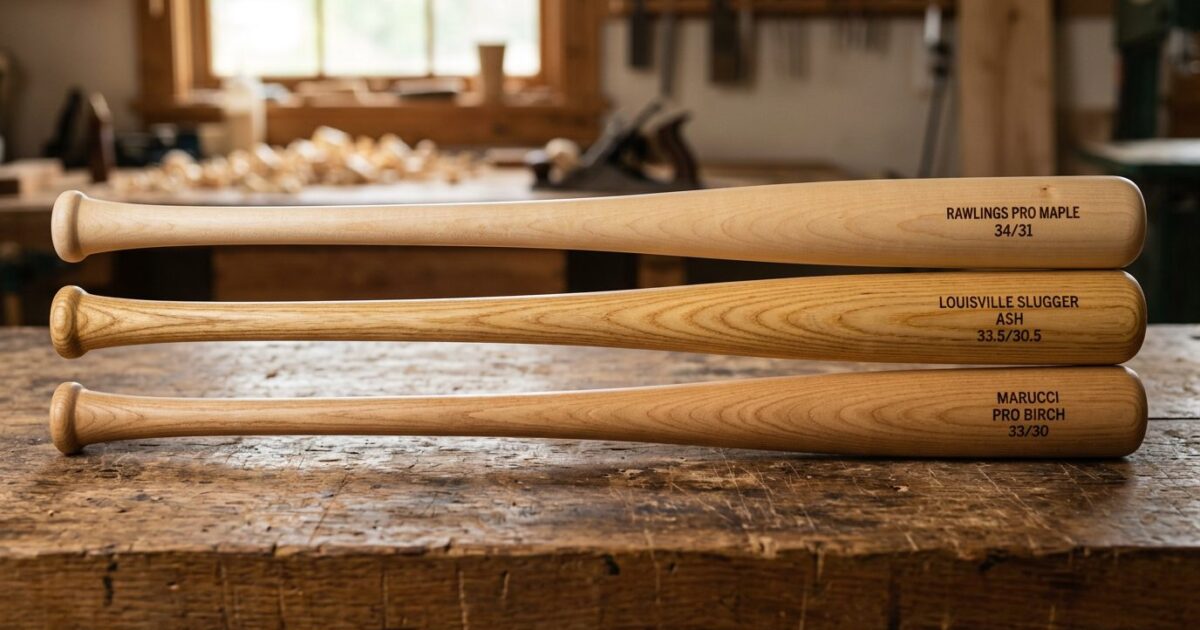
The search for the best wood baseball bats is a different conversation than the aluminum and composite bat market. Wood bats break, provide honest feedback, and require actual skill to hit with — which is exactly why every serious player should spend time swinging one. We have tested and used wood bats at every level from summer collegiate leagues to adult wood-bat tournaments, and our recommendations reflect real performance across real playing conditions.
- Maple is now the dominant wood species in MLB, overtaking ash after Barry Bonds popularized it in the early 2000s — it is harder, denser, and less likely to flake
- Ash is more flexible than maple, has a larger sweet spot feel, and is easier on your hands on mishits — but it flakes and breaks more easily
- Birch is the middle ground: flexible like ash but harder, making it a good choice for players switching from metal
- MLB regulations require wood bats to be made from one solid piece of wood, with a maximum barrel diameter of 2.61 inches
- Pro Maple (Victus, Marucci, Louisville Slugger) and Pro Ash (Old Hickory, Sam Bat) are the brands with the best wood quality at the professional and competitive level
Understanding Wood Species: Maple, Ash, and Birch
The three MLB-approved wood species are the same three that dominate the retail market: maple, ash, and birch. Understanding the differences is the single most important thing you can know before buying a wood bat, because the wood species affects everything — feel, durability, sweet spot, and how the bat handles mishits.
Maple: The Modern Professional Standard
Maple became the dominant MLB wood species in the early 2000s after high-profile players popularized it. The reason for maple’s dominance is density and hardness. Maple is denser than ash, which produces harder contact at the sweet spot and more consistent performance across the grain. Maple bats also do not flake the way ash does — ash fibers run along the grain and can flake off in strips under heavy use, while maple’s grain structure keeps it more intact. The downside of maple: it is less forgiving on mishits. Maple bats break cleanly — when they fail, they typically snap into two pieces — while ash tends to flake and splinter progressively. For MLB purposes, maple’s cleaner break pattern is actually safer.
Ash: The Classic Feel
Ash is the traditional wood bat material and carries a following among purists for good reason. It is lighter for its size than maple, produces more flex through the hitting zone, and provides a larger “sweet spot feel” because the wood’s flexibility acts as a natural spring on off-center contact. Players who come from metal bats and find maple too stiff often transition more easily through ash. The negatives: ash flakes and splinters with use, and ash bat quality has been affected by the Emerald Ash Borer (an invasive insect that has decimated ash tree populations in North America), making premium ash timber harder to source than it was 20 years ago.
Birch: The Underrated Middle Ground
Birch sits between maple and ash in both hardness and flexibility. It has more flex than maple but is harder than ash, giving it a sweet spot feel that is closer to ash without ash’s flaking tendency. Birch bats are particularly well-suited to players transitioning from metal, because the flex and forgiveness on mishits is easier to adjust to than the stiff maple feel. Birch is the least marketed of the three MLB-approved species, which keeps prices slightly lower at comparable quality tiers — a legitimate value consideration.
Top Wood Baseball Bat Reviews for 2025
Victus Pro Reserve Maple Bat Review
Victus has earned a strong reputation among serious wood bat players since entering the market. The Pro Reserve uses Victus’s proprietary Maple Wood selection process — the company sources their maple from northern regions where slower tree growth produces denser, more consistent grain. The Pro Reserve is available in standard and custom Pro Cut configurations, and Victus offers multiple handle and flare options. The surface finish is a traditional lacquer that allows the wood grain to work naturally. Price: $149-$175 for standard Pro Reserve; custom orders start at $179. Victus also offers a 6-month warranty against manufacturing defects — above-standard for wood bats.
Marucci Pro Cut Maple Wood Bat Review
The Marucci Pro Cut is arguably the most consistent production maple bat in the market for value and quality. Marucci’s manufacturing process uses rigorous slope-of-grain inspection (a measure of how straight the grain runs along the bat — straighter grain equals less likely to break), and their Pro Cut passes through multiple quality checkpoints before shipping. Available in a wide range of pro model profiles (MC271, MC340, etc.). The MC271 is our most-recommended profile for power hitters due to its end-loaded feel and large barrel. Price: $119-$149.
Louisville Slugger I13 Pro Stock Maple Review
Louisville Slugger’s Pro Stock line is the production version of their professional supply bats. The I13 model is one of the most popular pro profiles — a medium-sized barrel with a gradual taper and medium-thick handle used widely by MLB middle infielders and outfielders. Louisville Slugger uses their MLB Prime maple, sourced from the same stockpile used for professional players. The I13 Pro Stock is available in both natural and cupped end configurations. Cupped end models reduce the end cap weight, shifting the balance point slightly toward the handle for a more balanced feel. Price: $99-$129.
Old Hickory Professional Ash Bat Review
For ash lovers, Old Hickory is the brand. They supply more MLB players with ash bats than any other manufacturer, sourcing from a dwindling but carefully selected supply of white ash. An Old Hickory ash bat has a flex and feel that maple cannot replicate — the natural spring of the ash grain on contact is distinct and favored by a dedicated subset of professional hitters. Price: $129-$159 for their standard Pro Player line. Custom orders are available and are the norm for professional customers.
Sam Bat Original Maple Bat Review
Sam Bat holds a historically significant place in the wood bat market — their maple bats were the first to gain wide MLB acceptance in the early 2000s. The Original Maple uses Canadian rock maple and is available in a cupped or no-cup end. Sam Bat still produces excellent wood quality at competitive prices, though Victus and Marucci have overtaken them in market presence at the competitive amateur level. Price: $109-$149.
B45 Birch Pro Select Review
B45 specializes in yellow birch bats and has built a loyal following among players who want ash-like feel with better durability. The Pro Select is their flagship model and uses carefully graded yellow birch in multiple pro-style profiles. The flex on mishits is noticeably more forgiving than maple, making the B45 a common recommendation for metal bat players transitioning to wood. Price: $129-$159.
Wood Bat Comparison Table
| Bat | Wood Species | Feel Profile | Best For | Durability | Price |
|---|---|---|---|---|---|
| Victus Pro Reserve | Maple | Stiff, powerful | Power hitters, MLB prep | Excellent | $149-$175 |
| Marucci Pro Cut | Maple | Balanced, consistent | All-around hitters | Excellent | $119-$149 |
| Louisville Slugger I13 | MLB Prime Maple | Balanced | Middle infield, OF | Very good | $99-$129 |
| Old Hickory Pro Player | White Ash | Flexible, forgiving | Ash purists, contact | Good (flakes with use) | $129-$159 |
| Sam Bat Original | Canadian Rock Maple | Stiff, traditional | Power, tradition | Very good | $109-$149 |
| B45 Pro Select | Yellow Birch | Flexible, forgiving | Metal-to-wood transition | Good | $129-$159 |
Choosing the Right Wood Bat Profile
The bat profile — the specific combination of barrel diameter, taper, and handle thickness — matters as much as wood species when choosing a wood bat.
Reading Pro Model Designations
Most wood bat manufacturers offer their bats in named “pro model” profiles based on professional player specifications. Common profiles you will encounter: the 271 (medium barrel, medium handle — balanced, versatile), the 110 (large barrel, thin handle — power-focused), the 318 (large barrel, thicker handle — power-durability). Our breakdown of metal bat vs. wood differences explains how profile selection differs between the two categories and can help you translate your metal bat preferences to a wood profile.
Cupped vs. Non-Cupped End
A cupped end bat has a small bowl carved into the end cap of the barrel. This removes a small amount of wood weight from the end of the bat, shifting the balance point very slightly toward the handle. Cupped bats feel fractionally more balanced in the hands. Non-cupped bats have marginally more end mass. Most hitters prefer cupped end for its slightly lighter feel, while some power hitters prefer the non-cupped end for the additional barrel mass. The performance difference is minimal — it is primarily a preference choice.
Handle Thickness and Curvature
Handle thickness in wood bats ranges from very thin (the 271 profile’s thin handle is popular for its “feel” through the zone) to medium-thick (the Marucci MC340 profile). Thicker handles are more durable — they are less likely to break on check swings or jammed pitches. Thinner handles provide better feel but are more susceptible to snapping at the handle on inside pitches. For players who frequently get jammed by inside fastballs, a medium-to-thick handle profile reduces breakage significantly.
Wood Bat Maintenance and Care
Bone Rubbing for Surface Hardening
Rubbing the surface of a wood bat with a hard bone (traditionally a beef rib bone or a specialized bone rubbing tool) compresses the surface wood fibers, effectively hardening the hitting surface. This technique — common among professional players — has measurable effects on surface durability and can increase the bat’s resistance to denting on contact. Rub the bone along the barrel grain with firm pressure for 5-10 minutes before first use. Regular bone rubbing every few uses extends barrel life significantly.
Proper Storage and Conditions
Wood bats are sensitive to humidity and temperature changes. Do not leave wood bats in a car during extreme heat or cold — wood expands and contracts with temperature changes, and repeated thermal cycling can widen existing grain checks or create new ones. Store wood bats in a temperature-controlled space with moderate humidity. During the off-season, a simple rubber band around the barrel (not the handle) maintains barrel shape during extended storage.
Internal Links for More Bat Research
For more equipment context, check out our guides on metal bat vs. wood performance differences, our roundup of the best baseball bats overall for 2025, and our specific breakdown of the best baseball bats for power hitters. For external resources on wood bat regulations, MLB.com publishes the official Rules of Baseball including bat specifications, and Baseball Reference provides historical data on wood bat usage trends at the professional level. For purchasing, JustBats.com maintains one of the most complete wood bat inventories with detailed specification filters.
Frequently Asked Questions: Best Wood Baseball Bats
What wood is used in MLB baseball bats?
MLB rules approve maple, ash, and birch for professional use. Maple is now the most widely used species, having overtaken ash in popularity in the early 2000s. Maple’s density and hardness make it the performance preference of most professional hitters. Ash remains popular among a dedicated group of players who prefer its flex and traditional feel. Birch is the least used of the three but has a growing following.
Are maple bats better than ash bats?
It depends on what you value. Maple is harder, more durable, and produces harder contact at the sweet spot. Ash is more flexible, more forgiving on mishits, and has a natural spring feel that maple cannot replicate. If you are a power hitter with good contact mechanics, maple’s hardness gives you an advantage. If you are a contact hitter or transitioning from metal, ash or birch will feel more natural. Neither is objectively better for all players.
How long does a wood baseball bat last?
Wood bat lifespan depends heavily on how often you use it and where you make contact. A wood bat used for live game at-bats only might last a full season. A wood bat used for daily batting practice against machine pitching might break in 2-4 weeks. Maple bats tend to last longer than ash per average use because they do not flake progressively — they either survive or snap. Birch falls between the two in durability per use.
What size wood bat should I use?
Wood bats do not have the same drop weight variety as metal bats — most adult wood bats are approximately -3 (matching the BBCOR standard), though some companies offer slightly lighter cuts. For length, use the same length you swing in metal practice — typically 33-34 inches for adult players, 30-32 for high school players. See our bat size selection guide for a complete age-and-position sizing framework.
Can youth players use wood bats?
Yes, and we strongly recommend it for developmental training. Swinging a wood bat forces players to hit the ball on the sweet spot because mishits on wood sting and produce weak contact in a way that composite youth bats mask. Many youth travel ball programs now require players to spend a portion of practice time with wood bats for this reason. For youth wood bat practice, choose a lighter birch or ash model in a size the player can swing comfortably — typically 28-31 inches for ages 10-14.
What is the best wood bat for batting practice?
For high-volume batting practice use (machine work, tee work, soft toss), use a more affordable hardwood bat rather than your most expensive game bat. The Marucci Pro Cut ($119-$149) and Louisville Slugger I13 Pro Stock ($99-$129) are our top recommendations for batting practice use — they offer genuine MLB-grade maple construction at prices that make breaking one during a hard practice session less painful. Save your premium Victus or Old Hickory for game situations.
Wood Bat Training Programs: How to Integrate Wood Into Your Practice
Adding wood bat work to your training schedule is one of the most effective development tools available, regardless of what bat you use in games. Here is how to structure it effectively.
The 30-Percent Wood Rule for Travel Ball
A practical framework we use with players: take at least 30% of your total swing volume with a wood bat. If you take 200 swings in a week of practice, 60 of those should come on wood. This volume is enough to reap the mechanical feedback benefits of wood without fatiguing the specific contact patterns you are developing on your game bat. Many travel ball coaches who implement this rule report measurable improvement in contact quality within 3-4 weeks.
Tee Work with Wood: The Honest Feedback Loop
Tee work with a wood bat is the purest form of contact feedback training. Every swing tells you exactly where on the barrel you are making contact — a center-barrel hit on wood produces a clean, resonant crack, while a mishit on the handle or end stings immediately and sounds hollow. Use your wood bat for tee sessions before switching to your game bat for machine or live pitching work. This sequence builds contact quality first, then applies that quality against moving pitches.
Building Hand Strength Through Wood Bat Use
Sustained wood bat practice over weeks builds forearm and wrist strength in ways that metal practice does not. The feedback on mishits requires hand strength to control the bat through vibration, and the slightly heavier feel of most wood bats creates resistance training over volume. Players who commit to a full off-season of wood bat work typically return to their game bat in spring feeling notably stronger through their hands and more confident in their contact mechanics. Pair this with the glove maintenance habits in our glove oil guide and a well-structured equipment approach across all defensive positions for a complete off-season development program.
