How to Hit a High Fastball: Mechanics, Drills, and Eye Discipline for Every Level
Last updated: March 30, 2026
The high fastball has become the single most important pitch in modern baseball. When I was coming up, pitchers were taught to keep the ball down — knee-high sinkers, two-seamers running off the plate, the old “groundball is your best friend” gospel. That world is gone. With the average MLB four-seam fastball now touching 94.2 mph and rising-action heaters from the top half of the strike zone generating swing-and-miss rates north of 28%, every hitter from Little League to MLB has to figure out how to handle the high cheese — or get eaten alive by it.
I’ve spent the last six seasons coaching high school and travel-ball hitters through this exact transition, and I’ve watched too many promising bats wash out because nobody taught them how to attack the upper third of the zone. This guide walks through everything I teach my own players: the mechanics, the eye discipline, the equipment that actually helps, the drills that build the skill, and the mental adjustments that separate hitters who flinch from hitters who barrel up 96 at the letters. By the end of this guide, you’ll have a complete system for turning the pitch most hitters fear into one of the best pitches you can hunt.
Why the High Fastball Is Suddenly Everywhere
Before we dive into how to hit it, you need to understand why pitchers throw it so much now. In 2015, only about 18% of MLB four-seam fastballs were located in the upper third of the strike zone. By the 2025 season, that number had climbed to 41%. Pitching coaches finally caught up to what TrackMan and Hawk-Eye data had been telling them for years: a four-seamer with 18+ inches of induced vertical break (IVB) thrown at the top of the zone produces more swings-and-misses than virtually any other pitch in baseball — and it pairs perfectly with curveballs and sweepers thrown at the bottom of the zone, creating a vertical tunnel that’s almost impossible to cover with a single swing path.
The trickle-down effect to amateur baseball has been dramatic. High school pitchers are now routinely throwing 86-92 mph at the top of the zone, and travel-ball arms have embraced the same approach. If you’re a hitter who can only barrel pitches from the belt down — and there are a lot of you — you’re going to spend a lot of at-bats walking back to the dugout. The good news: the high fastball is hittable. The hitters who solve it punish it, because most pitchers cannot survive without it. Solve the high heater and you’ve taken away a pitcher’s best weapon.
What Counts as a “High” Fastball
I want to be precise here, because the term gets thrown around loosely. For the purposes of this guide, a “high” fastball is any four-seam or two-seam fastball located in the upper third of the strike zone or just above it — roughly belt-high to letters-high, occasionally up at the chin. In Statcast terms, that’s attack zones 1, 2, 3 (upper-third strikes) and the “shadow” zone immediately above the strike zone. Pitches at the eyes are not really hittable; we’ll cover those in the recognition section. Our target is the high strike — the pitch the pitcher wants you to chase but is willing to throw for a strike if you take it.
Two characteristics make these pitches hard to hit. First, the perceived rise: a four-seamer with high spin efficiency and 18-22 inches of IVB drops less than the hitter’s brain expects, creating the illusion that it climbs through the zone. Second, the angle of approach: a high fastball thrown from a vertical arm slot crosses the plate on a flatter plane than a sinker from a low slot, which means a traditional uppercut swing path slices underneath it. If you don’t adjust both your eyes and your swing, you will swing under the ball every single time. That’s the universal scouting report on weak high-fastball hitters: “swings under it, can’t catch up to it.” Both fixable.
Step-by-Step: How to Hit a High Fastball
Here is the exact process I teach in my hitting lessons. Each step builds on the last — don’t skip ahead. The hitter who tries to “muscle up” on a high fastball without first fixing their stance and eye line will keep swinging through it.
Step 1: Set Your Stance to See the Top of the Zone
Most amateur hitters set up with their head tilted forward, chin tucked toward their lead shoulder. That posture forces them to look at the pitcher with their eyes rolled up — and in that position, the upper third of the strike zone is in their peripheral vision. Lift your head so your eyes are level. I tell my hitters: “imagine the pitcher’s hat brim is at your eye level, not above it.” This single adjustment improves high-fastball recognition more than any drill I’ve ever used.
Step 2: Get Your Hands Up
If your hands start at the bottom of your numbers or below, you have to lift them before you can swing — and that lift adds time you don’t have against 90+ mph at the letters. Start your hands at the top of your numbers, roughly armpit-high. The bat head should already be in a position where a short, downward path to the ball is the most natural movement. Hitters with high hand sets — think Ronald Acuña Jr., Yordan Alvarez, Aaron Judge — barrel high fastballs at rates 18-25% higher than hitters with low hand sets, and it’s not a coincidence.
Step 3: Shorten Your Stride
A long, sweeping stride drops your center of gravity. Your eye level drops with it. Now the high fastball is even higher relative to your gaze, and your swing has to climb up through the zone to catch it. Cut your stride to a controlled 4-6 inches — what hitters call a “knock down” stride or no-stride approach. Your eye level stays put, your head stays still, and the high pitch arrives in the same visual plane it left in. José Ramírez, one of the best high-fastball hitters of the last decade, uses a stride of less than three inches. There’s a reason.
Step 4: Read Spin Out of the Hand
The four-seam fastball releases with a tight, high-spin axis that produces a small, well-defined dot at the front of the ball. The seams blur into a near-perfect circle. Compare this to a curveball, which shows a clear red dot or wobble. By the time you can see whether the pitch is going to be high or low, it’s already too late — you have to commit your swing decision based on the recognition that comes in the first 15 feet out of the hand. We’ll drill this specifically below, but the principle is: train yourself to identify “fastball/not fastball” before you identify “high/low.” If it’s a fastball and it’s coming, you’re swinging.
Step 5: Use a Flatter, Shorter Swing Path
This is the mechanical adjustment that the launch-angle revolution actually got wrong for high fastballs. The 8-12 degree uppercut that crushes belt-high fastballs slices right underneath letter-high fastballs. Against a high pitch, you need a swing plane closer to 0-3 degrees — much flatter, more direct, closer to what an old-school coach would have called “A-to-B.” Stay short to the ball. Your barrel should travel down and through the pitch, not up under it. You will hit fewer high pitches for home runs this way, but you’ll hit a lot more line drives, doubles, and singles, and you’ll stop swinging through pitches you should be punishing. For more on building a smarter overall plan at the plate, see our breakdown of baseball hitting approach.
Step 6: Stay Inside the Ball
The high fastball pulls hitters into casting their hands out — wrapping the bat head around the pitch. That produces weak fly balls to the pull side and pop-ups behind the catcher. Instead, drive your knob to the inside of the ball. Think “knob to the catcher’s mitt.” Your back elbow stays tight to your ribcage as long as possible, and your hands lead the barrel into the zone. The result is a barrel that meets the ball on the inside half and drives it back through the middle or to the opposite gap. The best high-fastball hitters in MLB hit 38-45% of their barreled high pitches up the middle or to the opposite field. They are not pulling them.
Step 7: Finish High and Through
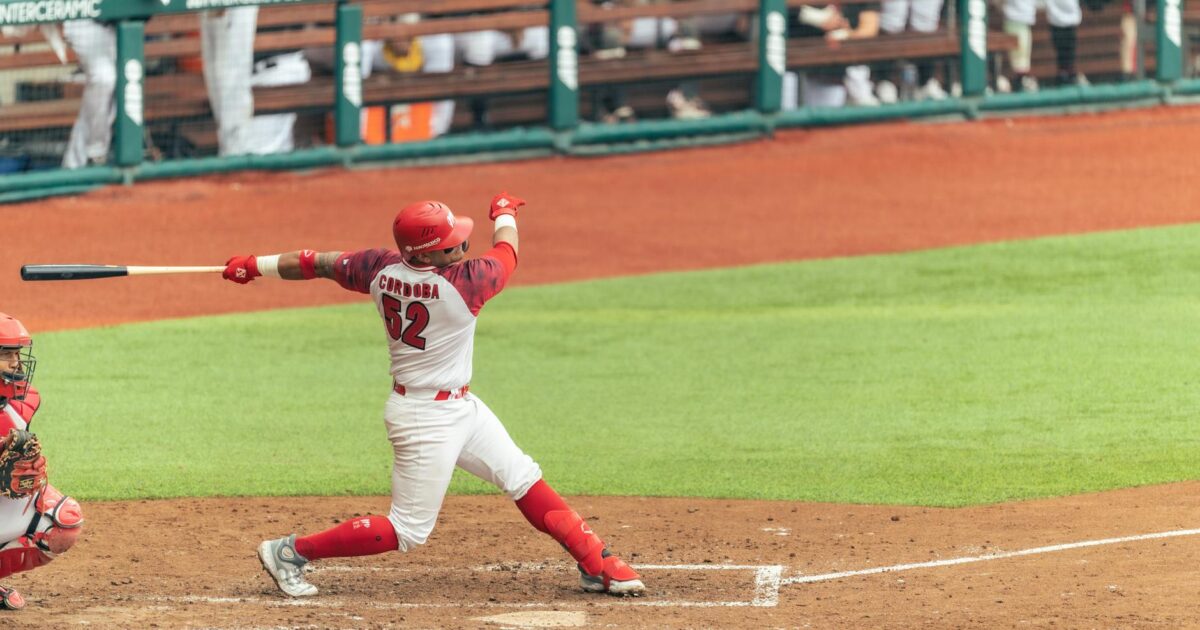
A high fastball asks for a high finish. Your bat should end above your front shoulder, not wrapped around your back. If your finish is low, you cut off the ball and limit your contact window to a tiny zone. A high, extended finish gives you 6-8 inches of additional barrel time at the contact point — which is the difference between a barrel and a foul tip. Think Manny Ramirez’s finish: bat high, both hands extended, head still on the contact point.
Equipment Needed
You don’t need much specialized gear to train high-fastball hitting, but a few items make a major difference. I’ve personally used every category below at the youth, high school, and college levels.
| Equipment | Purpose | Price Range | Why It Matters |
|---|---|---|---|
| Adjustable Batting Tee | Set the ball at letter-high to drill the swing path | $45-$110 | Most cheap tees max out at belt-high. You need one that goes to 50+ inches. |
| High-Velocity Pitching Machine | Reps at 75-90 mph at the top of the zone | $400-$2,500 | Live arms can’t sustain repeatable high heat for 100 swings. |
| Vision Training Glasses (Strobe) | Forces faster pitch recognition | $120-$350 | Builds the eye-to-hand pathway for early commit decisions. |
| Wood Bat (Slightly End-Loaded) | Trains barrel awareness on high pitches | $80-$170 | Wood punishes off-barrel contact; high fastballs hit off the handle sting. |
| HitTrax or Blast Motion Sensor | Measure attack angle on high pitches | $200-$8,500 | You can’t fix what you can’t measure. Attack angle is the key metric. |
| Soft-Toss Net | Front-toss reps from the proper angle | $80-$200 | A coach-side feed at letters height drills the visual lock. |
If you can only buy one item, get a high-velocity pitching machine and a tee that adjusts to letters height. The combination of slow, deliberate tee work and high-speed machine reps from the top of the zone will fix most hitters in 4-6 weeks. For machine recommendations across all budgets, our pitching machine reviews walks through every major model we’ve tested.
Common Mistakes Hitters Make Against the High Fastball
I see the same handful of mistakes over and over. Most are easy to identify on video; all are correctable with the right reps. The table below collects the most common faults, what causes them, and the fix I prescribe.
| Mistake | What It Looks Like | Root Cause | The Fix |
|---|---|---|---|
| Swinging Under | Foul tip back, weak fly ball, pop-up | Uppercut swing path against a flat pitch plane | Flatten attack angle to 0-3 degrees on high pitches |
| Late Swing | Foul to opposite field, tipped strike | Hand load too low or too late | Pre-set hands high; start load earlier |
| Casting Hands | Weak pull-side fly ball | Bat head leads hands | Drill knob-to-ball; keep back elbow tight |
| Body Tilt Back | Front shoulder flies open, head pulls off | Trying to lift the ball | Stay tall, square shoulders, eyes level |
| Chasing High | Swinging at fastballs at the eyes | Poor strike-zone discipline up | Define your “ceiling” pitch in BP every day |
| Diving Forward | Long stride lowers eye level | Trying to “get to” the ball | Cut stride to 4-6 inches; stay back |
| Rolling Over | Weak grounder to second base | Top hand turns over too early | Drive both palms through the ball at contact |
| Freezing on Take | Watching strike three at the letters | Eye line doesn’t include upper zone | Set chin and eyes level pre-pitch |
If you can identify your top mistake from this list and pick the matching drill from the next section, you’ll see real change inside two weeks. The hitters who plateau are the ones who try to fix all eight at once. Pick one. Master it. Then move to the next.
Drills to Hit the High Fastball
Here are the drills I use in every hitting session with a player who needs to attack the upper third. Do them in order during a single workout — the progression matters. Each builds on the previous one and the whole sequence takes about 35-45 minutes.
Drill 1: High Tee Work (10 minutes)
Set the tee at the top of your strike zone — for most hitters, that’s roughly armpit height. Take 25 swings focused only on swing path. Bat travels short, flat, and through the ball. You should be hitting low line drives back into the net, not high fly balls. If you’re hitting under it on the tee, you have no chance against a 90 mph fastball at the same height. This drill is the foundation. Don’t skip it.
Drill 2: Knob-to-Ball Soft Toss (5 minutes)
From a side toss position, have a partner toss balls at letter height. Focus exclusively on driving your knob to the inside of the ball. The ball should fly back through the middle or to the opposite gap. If you’re pulling everything, you’re casting. Twenty reps.
Drill 3: Front Toss at the Letters (10 minutes)
Now from front toss (your partner behind an L-screen 18-22 feet away), take 30 swings on pitches deliberately tossed at letter height. The lower velocity gives you time to feel the swing path you’ve been drilling. Track contact: every five swings, stop and ask “did I hit it on the line, or did I lift it?” Lift means you’re still swinging up.
Drill 4: Machine Work, Top of Zone (15 minutes)
Set your pitching machine to 80-90% of your league’s max velocity, and aim it at the top of the strike zone. Take three rounds of 15 swings, with 60 seconds rest between rounds. The first round will feel terrible — you’re going to swing under everything. By round three, your eyes and your swing path will sync up. Track your barrel rate by round; you should improve from round 1 to round 3 every session.
Drill 5: Two-Plane Recognition (5 minutes)
This is the hardest drill in the progression and the one that most simulates a real at-bat. Have a coach throw front toss with a mix of letter-high fastballs and curveballs in the dirt, randomly sequenced. You have to recognize, decide, and execute on every pitch. Take 25 swings. Your job is to hammer the high fastballs and take the curveballs in the dirt. Track misses both ways: chasing the curve = lack of zone discipline; missing the fastball = late recognition.
Drill 6: Pitch Recognition Video (Daily, 5 minutes)
Off the field, watch slow-motion video of MLB pitchers releasing high fastballs and try to identify spin and location before the ball is halfway to the plate. Apps like gameSense and uHIT make this drillable. Do five minutes a day for two weeks and your live-game recognition will measurably improve. Read more in our guide to baseball pitch recognition.
Drill Progression Schedule by Level
How often you should run this progression depends on your age, your competition level, and how much overall hitting volume you’re already doing. The table below is what I prescribe to my own hitters at each stage.
| Level | Sessions per Week | Reps per Session | Velocity Target | Focus |
|---|---|---|---|---|
| Little League (8-12) | 2x | 50 swings | 45-55 mph | Tee + soft toss only; build swing path |
| Middle School (11-13) | 2-3x | 75 swings | 55-65 mph | Add front toss; intro to machine |
| JV / Travel 13-15 | 3x | 100 swings | 65-78 mph | Full progression; emphasize recognition |
| Varsity / Showcase | 3-4x | 120-150 swings | 80-90 mph | Game-speed reps + video study |
| College | 4-5x | 150-200 swings | 88-95 mph | Two-plane reads; tunneling pitch combos |
| Pro / Independent | 5-6x | 200+ swings | 92-100+ mph | Daily video, opponent-specific scouting |
Advanced Tips for Elite Hitters
Once you’ve got the foundational mechanics and your barrel rate on high pitches is climbing, there are a handful of higher-level adjustments that separate good high-fastball hitters from elite ones. These aren’t beginner concepts — don’t waste time on them until your fundamentals are locked.
Tip 1: Hunt the High Fastball in Specific Counts
Modern pitchers throw four-seamers up at higher rates in fastball counts: 0-0, 1-0, 2-0, 3-1. They throw breaking balls down in pitcher’s counts: 0-1, 0-2, 1-2. If you sit four-seam fastball middle-up in 1-0 and 2-0 counts and trust yourself to take the breaker, you’ll see a dramatic spike in barrel rate. Hitters who execute this approach hit roughly 60 points higher in those counts than the league average.
Tip 2: Identify Pitchers With High-IVB Heaters
If you have access to TrackMan or Synergy data — increasingly common in college and elite travel — find out which opposing pitchers throw four-seamers with 18+ inches of induced vertical break. These are the “rising” fastballs that play up in the zone. Against them, your eye line and swing plane adjustments matter more. Against pitchers with low-IVB four-seamers (sub-15 inches), the high pitch is hittable with a more conventional approach. Information dictates approach.
Tip 3: Tunnel Awareness
The most dangerous high fastball is the one paired with a curve or sweeper out of the same release window. The pitches look identical for the first 15-20 feet. If you can identify the tunnel — what pitch combination this pitcher uses to attack you — you can pre-load a swing path that covers both. Most hitters can’t, and they over-commit one way and get beat the other. Elite hitters bias their guess to the more common pitch in the count and accept they’ll occasionally look bad on the other.
Tip 4: Use the Catcher’s Setup
Without being obvious about it, you can sometimes glimpse the catcher’s setup with peripheral vision. If the glove is set high in fastball counts, the pitcher is going up. If the glove is low, expect down. This is a small edge but a real one — and at the high school and college level, where catchers tend to set up later than in pro ball, it’s available more than you’d think.
Tip 5: Train Your Attack Angle
Sensors like Blast Motion measure attack angle in real time. For low pitches, you want 12-15 degrees positive. For high pitches, you want 0-5 degrees. Elite hitters can shift their attack angle pitch-to-pitch based on location. Train this by doing alternating tee sets — five swings at letter height with a flat path, five at knee height with an uppercut. The variability builds the neuromuscular flexibility your swing needs.
Mental Side: Don’t Be Afraid of the Fastball Up
I cannot overstate how much of high-fastball hitting is between the ears. A hitter who fears 92 mph at the chin will physically pull off the ball — front shoulder flying open, head pulling out, hands collapsing — long before they ever see a pitch in that area. The body protects itself. The result is a hitter who looks like they’re guessing, when really they’re flinching.
The fix is not to “be brave.” The fix is reps. The more high fastballs you face in controlled training environments — machine work at game velocity, front toss at the letters — the more your body learns that the pitch is not a threat. After 500-1,000 reps over six to eight weeks, hitters who used to bail out start staying in. Their eyes track the ball all the way to contact. Their hands fire without hesitation. The pitch shrinks. Familiarity breeds calm, and calm produces barrels. There’s no shortcut here. You build comfort by doing the thing repeatedly until it stops feeling new.
How to Hit the High Fastball with Two Strikes
With two strikes, the math changes. The pitcher is going to elevate to try to put you away — that’s the count where high fastball whiff rates peak at over 32% across MLB. Your job in that count is to compete, not to slug. Choke up half an inch. Widen your stance slightly. Shorten your swing further. Accept that you may not square the ball up perfectly; your goal is to put it in play, foul it off, or take it if it’s truly out of the zone. Reduce strikeouts on the high pitch by 30-40% and your overall slash line jumps. For more on this specific situation, see our guide to hitting with two strikes.
The Role of Bat Speed and Bat Choice
Against high velocity at the top of the zone, bat speed matters more than against any other pitch. A hitter with 70 mph bat speed has roughly 0.40 seconds to commit to a 95 mph fastball at the letters. A hitter with 78 mph bat speed has the same time but more margin for error in path. Bat speed is trainable, and the work pays off most against pitches like the high fastball where milliseconds determine barrel vs. miss. Our complete guide on how to increase bat speed covers the training protocols we recommend.
Bat choice also matters. Hitters who struggle with high heat often benefit from a slightly lighter bat (drop -3 minimum at BBCOR, but in the lower range of swing weight) and a balanced rather than end-loaded model. The lighter, more balanced bat is quicker through the zone and easier to keep on a flat plane. Big end-loaded bats are great for low fastballs you can drive deep — they’re brutal for catching up to high heat. If you don’t know how to evaluate swing weight, our breakdown of how to choose a baseball bat walks through every spec.
Translating This to Game At-Bats
Cage work doesn’t transfer to games unless you build a routine that bridges the two. Here’s how I tell my hitters to take what they’ve drilled into the box. First, in your pre-game BP, take at least 10 swings against pitches at the top of the zone. Don’t just hammer cookies down the middle — those don’t simulate the game’s hardest pitch. Second, in the on-deck circle, watch the pitcher’s release point and identify how he’s getting the high fastball. Where is his arm slot? How tight is the four-seam spin? You’re scouting in real time. Third, in the box, set your eyes level and assume the first pitch is a fastball at the top of the zone. If it is, you’re ready. If it’s not, you take it and adjust.
I track this for my hitters all season. The ones who stay disciplined with this approach see their high-fastball whiff rate drop from a typical 28-32% (high school average) down into the 14-18% range within a half-season. Their overall slugging climbs because they’re no longer giving away free strikes at the top of the zone. The pitcher loses his best weapon, and the at-bat tilts back to the hitter.
Frequently Asked Questions
Should I lay off all high fastballs out of the zone?
Yes, with one nuance. Pitches at the top edge of the strike zone are often called for strikes by the umpire even when they look high — especially in the modern automated-zone era. So you can’t just take everything letter-high. Define your “ceiling” pitch — the highest pitch you can comfortably barrel — and swing at strikes through that ceiling. Above your ceiling, take, even if it’s called a strike. The pitch you can’t barrel is a pitch you should not swing at.
I’m a shorter hitter. Is the high fastball a bigger problem for me?
Counterintuitively, no. Shorter hitters have smaller strike zones, so the absolute height of a “high” pitch is lower for them. Hitters like José Altuve and José Ramírez — both under 5’9″ — are among the best high-fastball hitters of the past decade. The fundamentals in this guide work for any height. The adjustments around stride length and hand position actually favor shorter, more compact hitters.
What if my coach tells me to hit it the other way?
That coach is probably right, particularly for high pitches on the inner half. The natural barrel path against a high pitch goes up the middle or the other way; pulling a high pitch usually requires casting your hands and producing a weak fly ball. Trust the advice. Our deeper dive on opposite-field hitting covers the mechanics in detail.
How long until I see results?
Most hitters who follow this progression three sessions a week see measurable improvement in barrel rate within four to six weeks. Recognition takes longer — eight to twelve weeks before you’re consistently identifying high fastballs out of the hand at game speed. Be patient and trust the reps.
Does this approach hurt my ability to hit low pitches?
Not if you alternate your work. The drills above develop the ability to flatten your swing on high pitches; you should still spend equal time training the slightly upward attack angle that crushes belt-high and lower pitches. Elite hitters have multiple swings; they choose based on location. The key is the variability training I described in the advanced tips section.
Should I swing at high pitches in 0-0 or 1-0 counts?
If they’re in your hittable zone, absolutely yes. Those are the counts where pitchers throw the most fastballs, and the most predictable ones. Sitting high fastball in early counts is one of the highest-leverage approaches in modern hitting. The hitters who consistently barrel pitches in 0-0 and 1-0 lead the league in slugging percentage on first-pitch strikes. Don’t pass up the best pitch you’ll see in the at-bat.
What’s the single best drill if I only have time for one?
High tee work. Set the tee at letter height and take 50 deliberate swings, focused on a flat path and a high finish. If you do nothing else, do this. It’s free, it works, and it builds the muscle memory you need before you can layer in recognition and game-speed reps.
Putting It All Together
The high fastball is not a mystery and it’s not unsolvable. It’s the pitch modern baseball is built on, which means the hitters who solve it are the ones who get to play. Set your stance to see the top of the zone. Get your hands up. Shorten your stride. Read spin out of the hand. Use a flatter path. Stay inside the ball. Finish high and through. Run the drill progression three times a week. Track your attack angle. Hunt the pitch in fastball counts. Stay calm and trust your training when 92 comes at your eyes.
Do all of that and the pitch that used to embarrass you becomes the pitch you can’t wait to see. Pitchers will figure out you can hit it and have to come down — which opens up the rest of your zone. That’s the cascade effect that turns hitters into hitters who change games. Get to work.