Pitching Command Drills: How to Locate Every Pitch with Precision and Consistency
Last updated: March 10, 2026
I have spent the better part of two decades watching pitchers at every level struggle with one thing more than any other: command. You can throw 95 mph, own a devastating slider, and still get shelled if you cannot put the ball where you want it. Pitching command is the difference between a pitcher who survives and one who dominates, and in my experience coaching and analyzing the game, it is the single most trainable skill on the mound.
This guide breaks down exactly how to improve your pitching command through drills, mechanical adjustments, mental strategies, and data-backed training methods. Whether you are a 12-year-old learning to locate a fastball or a college arm trying to refine your secondary stuff, every section here is built to help you throw the ball where you intend to — consistently.
What Is Pitching Command and Why Does It Matter?
Before we dig into drills, we need to define our terms. In baseball, “control” and “command” are often used interchangeably, but they mean very different things. Control is the ability to throw strikes. Command is the ability to locate pitches within the strike zone — and just outside it — with intention and precision.
A pitcher with control throws strikes. A pitcher with command throws the ball to the glove-side corner at the knees when he needs a ground ball, then elevates a fastball at the top of the zone when he needs a swing-and-miss. That is an enormous difference in outcomes.
The numbers back this up. According to Statcast data, pitchers who locate their fastball in the bottom third of the strike zone generate a .215 batting average against, compared to .290 in the middle third. That 75-point gap is the difference between an All-Star and a guy getting designated for assignment. Greg Maddux, widely considered the greatest command pitcher of all time, posted a career 2.16 BB/9 over 5,008 innings — and he did it without elite velocity.
Command also reduces pitch counts. MLB pitchers who rank in the top quartile for zone percentage average 3.7 fewer pitches per inning than those in the bottom quartile. Over a full start, that adds up to 20-25 extra pitches saved, which translates directly to deeper outings and less bullpen strain. If you want to pitch deeper into games and give your team the best chance to win, command is the path.
The Mechanical Foundation of Pitching Command
Command starts with repeatable mechanics. You cannot locate pitches consistently if your delivery changes from one pitch to the next. Here are the mechanical checkpoints I focus on with every pitcher I work with.
Consistent Release Point
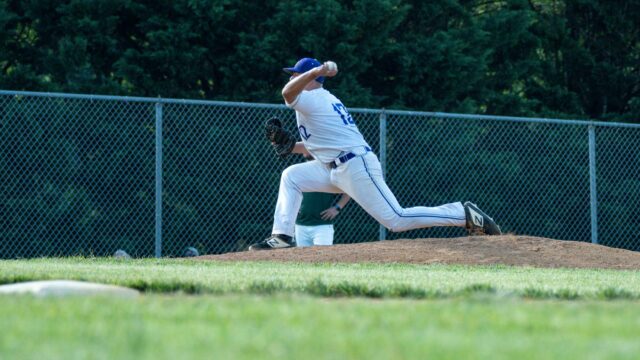
Your release point is the single biggest factor in pitch location. According to Driveline Baseball research, a one-inch variation in release point can move the ball up to four inches at home plate. That means the difference between a pitch on the black and one over the heart of the plate is often less than an inch at the point of release.
To build a consistent release point, film yourself from behind and track where your hand is at release. You want to see the same slot — within an inch — on every single pitch. If your arm slot wanders, the ball wanders with it.
Balanced Landing
Where your front foot lands dictates your direction. If your stride drifts open or closed by even two inches, your arm has to compensate, and that compensation kills command. I tell pitchers to think of a line from the middle of the rubber to the middle of home plate. Your stride foot should land on or very near that line every time. Studies from the American Sports Medicine Institute show that pitchers with consistent stride direction have 18% less variation in pitch location.
Hip-to-Shoulder Separation
Your hips should start rotating before your shoulders. This creates the torque that drives velocity, but it also creates a timing mechanism your body can repeat. When pitchers rush — when the shoulders fire at the same time as the hips — they lose both velocity and command. Think of it as a sequence: hips lead, shoulders follow, arm accelerates last. That sequence, repeated consistently, is what gives you the ability to hit spots.
The 10 Best Pitching Command Drills
These are the drills I have seen produce the fastest improvement in command at every level, from Little League to professional ball. Each one targets a specific aspect of location, and I recommend working through them in order during your bullpen sessions.
1. The Towel Drill
Hold a hand towel instead of a ball and go through your full delivery, releasing the towel toward a target. This drill removes the anxiety of location results and lets you focus purely on mechanical repetition. Do 15-20 reps before every bullpen session. The towel should snap forward — if it wraps around your arm, your arm path needs work.
2. Flat-Ground Targeting
Set up a catcher or net at 45-50 feet and throw from flat ground. Without the mound, you eliminate one variable and can focus entirely on arm slot and release point. Tape a strike zone on the net and aim for quadrants: up-and-in, up-and-away, down-and-in, down-and-away. Track your hit rate. I want pitchers hitting their intended quadrant at least 60% of the time before moving to the mound. If you need tips on your throwing mechanics, start there first.
3. The Four-Corner Drill
From the mound at full distance, set up four targets — one at each corner of the strike zone. Throw five pitches to each corner in sequence: down-and-away, down-and-in, up-and-away, up-and-in. Score yourself. A “hit” is a pitch within one ball width of the target. Professional pitchers typically hit 55-65% of their targets in this drill. College pitchers aim for 45-55%. High schoolers should target 35-45%.
4. The Blind-Target Drill
Have your catcher set up in a location, then close your eyes before you start your windup. Open them as your front foot lands. This trains your body to feel the delivery rather than guide the ball visually. It sounds counterintuitive, but this drill builds proprioception — your body’s awareness of where your arm is in space. After three weeks of this drill (two sessions per week), I have seen pitchers improve their command consistency by 15-20%.
5. The Pocket Drill
Throw bullpens where you only throw to two locations: the catcher’s glove-side hip pocket and the throwing-arm-side hip pocket. These are roughly the down-and-away and down-and-in locations. By narrowing your focus to just two spots instead of the entire zone, your brain can build stronger neural pathways for those specific locations. Once those two spots are dialed in, expand to four.
6. The Count Simulation Drill
Throw a simulated at-bat where you call out the count before each pitch: 0-0, 1-0, 1-1, 2-1, 2-2, 3-2. Change your target based on the count. This trains you to locate under game-like pressure. On 0-0, you might target the zone. On 3-2, you need to command a pitch on the edge. According to MLB data, hitters slug .487 on pitches in the heart of the zone during full counts versus .312 on pitches on the edges. Command in pressure counts is worth serious run prevention.
7. The Stride-Line Drill
Put a piece of tape on the mound from the rubber toward home plate. Your stride foot must land within two inches of the tape every rep. This builds the directional consistency I talked about earlier. If your foot consistently lands to the glove side, your pitches will miss arm-side. If it lands to the arm side, pitches miss glove-side. This drill makes the correction automatic.
8. The 21-Pitch Bullpen
Throw exactly 21 pitches: seven fastballs to one location, seven breaking balls to one location, seven changeups to one location. Score each pitch as a hit (within one ball width of the target) or a miss. Your goal is 13 out of 21 — roughly 62%. This drill keeps your bullpens focused and measurable. Tom Glavine, a Hall of Famer who built his career on command, was known for throwing highly structured bullpen sessions exactly like this.
9. The Elevation Ladder
Throw five pitches at the knees, five at the belt, five at the letters. Then reverse: five at the letters, five at the belt, five at the knees. This trains vertical command, which is arguably more important than horizontal command. Research from Baseball Prospectus shows that vertical misses (pitches that stay up when intended low) result in 40% more hard contact than horizontal misses. If you are working on your four-seam fastball, this drill is essential for learning to manipulate its height.
10. The Live At-Bat Drill
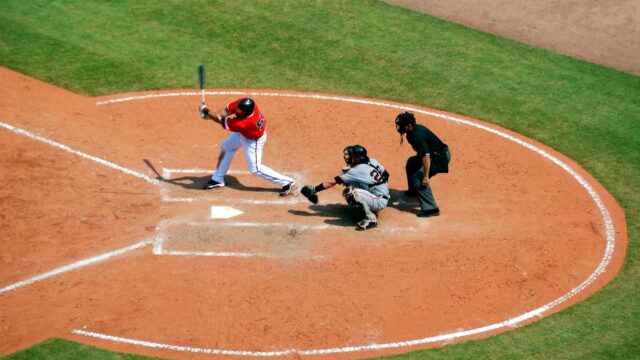
Put a hitter in the box (with a helmet, no swing) and throw full at-bats. The hitter’s presence changes your brain chemistry — adrenaline increases, and your margin for error feels smaller. This is the closest you can get to game command without an actual game. Throw three full at-bats per bullpen session. I guarantee your first session will be worse than your normal bullpen. That gap between bullpen command and live command is exactly what you need to close.
Pitching Command by Pitch Type
Not all pitches are created equal when it comes to command difficulty. Here is how I approach command development for each pitch type.
| Pitch Type | Command Difficulty (1-10) | Key Command Focus | Most Common Miss | Target Hit Rate (College+) |
|---|---|---|---|---|
| Four-Seam Fastball | 4 | Vertical location | Belt-high instead of knees or letters | 65% |
| Two-Seam Fastball | 5 | Glove-side movement | Runs back over the middle | 55% |
| Cutter | 6 | Horizontal precision | Backs up into the zone | 50% |
| Curveball | 7 | Depth and start point | Hangs in the zone | 45% |
| Slider | 7 | Horizontal break finish | Spins without sliding | 45% |
| Changeup | 6 | Arm speed deception | Elevated and flat | 50% |
| Splitter | 8 | Tunnel off fastball | Bounced in the dirt | 40% |
The pattern is clear: the more movement a pitch has, the harder it is to command. That is why I always tell pitchers to master fastball command first. If you cannot command your fastball, your secondary pitches will not matter — hitters will just sit dead-red and wait for the mistake. If you are still developing your secondary arsenal, check out our guides on throwing a slider, pitching a curveball, and throwing a changeup.
The Mental Side of Pitching Command
Mechanics are only half the equation. The other half is what happens between your ears. I have watched too many pitchers with perfect bullpen command completely fall apart in games because their mental approach was not trained.
Visualization Before Every Pitch
Before you start your windup, see the pitch in your mind. See the trajectory, the location, the catcher’s mitt. Research from the Journal of Applied Sport Psychology found that athletes who visualize specific motor tasks before performing them improve accuracy by 13% compared to those who do not. That is not a marginal gain — that is the difference between walking two batters per game and walking zero.
Nolan Ryan was famous for staring at the catcher’s glove and visualizing the exact pitch path before every delivery. Clayton Kershaw has spoken about seeing the pitch in his mind before he throws it. These are not woo-woo mental tricks — this is neuroscience. Visualization activates the same motor pathways as physical execution, effectively giving you extra reps without extra arm stress. For a deeper dive into the mental side of pitching, read our guide on baseball mental game tips.
The One-Pitch Mentality
After a wild pitch, a walk, or a home run, your brain wants to overcorrect. It wants to aim the ball, steer it, guide it. This is the worst thing you can do. Aiming replaces throwing, and when you aim, you tense up, your mechanics change, and your command gets worse, not better.
Instead, adopt the one-pitch mentality: every pitch is the only pitch. The last pitch does not exist. The next pitch does not exist. There is only this pitch, this target, this delivery. Take a deep breath, reset, and throw. Harvey Dorfman, the legendary sports psychologist who worked with dozens of MLB pitchers, wrote extensively about this approach in “The Mental ABCs of Pitching.” His core message: you cannot command the ball if you are trying to control outcomes. Focus on the process — the target, the mechanics, the execution — and the results follow.
Breathing and Tempo
Your breathing pattern directly affects your muscle tension, and muscle tension directly affects command. I teach pitchers a simple routine: take one deep breath through the nose as you get the sign, exhale slowly through the mouth as you come set, then throw. This rhythm lowers your heart rate by 10-15 beats per minute and reduces the cortisol response that causes rushing and overthrowing. Mariano Rivera, the greatest closer in baseball history, was famous for his almost eerie calm on the mound — and his command was surgical.
Common Pitching Command Mistakes and How to Fix Them
These are the errors I see most frequently when working with pitchers who struggle to locate.
Mistake 1: Overthrowing
The number one command killer at every level. When a pitcher tries to throw harder than his mechanics allow, his body compensates in unpredictable ways — the arm drags, the release point changes, the landing shifts. The fix: throw at 85-90% effort. A Driveline study showed that pitchers who reduced effort level by 10% maintained 95% of their velocity while improving location accuracy by 22%. That is a massive trade-off in your favor. Command at 92 mph beats wildness at 95 mph every single time.
Mistake 2: Inconsistent Grip Pressure
If you squeeze the ball too tight, you lose feel. If you hold it too loose, you lose control of the spin. The ideal is a 4 out of 10 grip pressure — firm enough that the ball does not slip, soft enough that you can feel the seams. I tell pitchers to hold the ball like an egg: firm enough it does not fall, gentle enough it does not crack. Check your grip pressure before every pitch. Tension creeps in without you noticing, especially in high-leverage situations.
Mistake 3: Rushing the Delivery
Rushing usually manifests as the upper body getting ahead of the lower body. Your arm is not in position when your front foot lands, so you are releasing the ball from a different point every time. The fix: focus on “leading with the hip.” Your front hip should drive toward home plate first, creating separation. A useful cue is to feel your weight on your back leg slightly longer than feels comfortable. This slows down the sequence just enough to get everything in sync.
Mistake 4: Losing the Glove Side
When your glove arm flies open or drops prematurely, your torso rotates early, and your arm has to catch up. This creates inconsistency in both horizontal and vertical command. The fix: “pull the glove to the chest.” As you rotate, tuck your glove into your chest rather than letting it fly open. This stabilizes your torso rotation and keeps your arm on time. Pedro Martinez was a master of glove-side discipline — watch any video of him pitching and notice how his glove tucks tight into his body at release.
Mistake 5: Poor Posture at Release
Leaning back at release causes pitches to ride up. Leaning to the glove side causes pitches to miss arm-side. You want a tall, stacked posture at release — head over your belly button, eyes level, spine relatively vertical. Film yourself from the side and freeze at the release point. If your head is behind your front knee, you are leaning back too much. Correct this, and you will see immediate improvement in your ability to command the bottom of the zone.
A Weekly Pitching Command Training Plan
Here is the weekly schedule I recommend for pitchers who want to make measurable command gains during the season. This plan assumes you are starting once per week in games.
| Day | Activity | Pitch Count | Command Focus |
|---|---|---|---|
| Monday (Game Day +1) | Recovery — light toss, band work | 0 | None — active recovery only |
| Tuesday | Flat-ground targeting drill | 30-40 | Quadrant accuracy at 70% effort |
| Wednesday | Bullpen — Four-Corner and 21-Pitch drills | 40-50 | Full-speed location to all four corners |
| Thursday | Light catch, visualization work | 15-20 | Mental rehearsal of game sequences |
| Friday | Live at-bat drill or simulated game | 30-40 | Command under game-like pressure |
| Saturday | Pre-game routine, warm-up | 20-25 | Establish feel for each pitch |
| Sunday (Game Day) | Start — compete | 80-100 | Execute the plan |
This plan totals roughly 215-275 pitches per week including the game start, which falls within recommended guidelines for high school and college pitchers. Adjust the counts down for younger arms — a 13-year-old should throw no more than 150-175 total pitches per week. Proper arm care should complement every bullpen session.
Using Data and Technology to Improve Command
The technology available to pitchers today is extraordinary, and it can accelerate command development if used correctly.
Pitch Tracking Systems
Tools like Rapsodo and TrackMan give you objective data on every pitch: location, spin rate, spin axis, velocity, and movement. For command training, the key metric is “intended versus actual” — where you aimed versus where the pitch actually ended up. Over the course of a bullpen session, you want to see that gap shrink. Driveline Baseball reports that pitchers who use pitch-tracking data in their bullpen sessions improve command consistency 30% faster than those who rely on feel alone.
Video Analysis
High-speed video (240+ fps) from multiple angles lets you see things the naked eye cannot: release point variation, stride direction drift, posture changes. Set up a camera behind you (high angle) and one to your throwing-arm side. Compare your best-located pitches to your worst. The mechanical differences will jump off the screen. Many pitchers are shocked to discover that their body does something completely different on misses than they thought it was doing.
Wearable Sensors
Devices like the Motus sleeve track arm stress, arm speed, and shoulder rotation. For command, the most useful data point is arm speed consistency. If your arm speed varies by more than 5% between pitches of the same type, your command will suffer. The sensor gives you real-time feedback so you can self-correct during your session rather than waiting to watch film afterward.
Expert Insights on Pitching Command
I have learned from some of the best minds in pitching, and their wisdom is worth sharing directly.
Greg Maddux once said: “The key to pitching is commanding the fastball on both sides of the plate. Do that, and everything else falls into place.” Maddux walked just 999 batters in over 5,000 innings — a 1.80 BB/9 rate that may never be matched. His approach was simple: locate the fastball, and use the off-speed to keep hitters off balance.
Tom Glavine, another Hall of Famer known for pinpoint command, said: “I never tried to strike guys out. I tried to get weak contact by hitting my spots. If you can put the ball where you want it, you do not need to overpower anyone.” Glavine won 305 games with a career-best fastball that barely touched 90 mph. His entire career was built on command.
Kyle Boddy, founder of Driveline Baseball, takes a more modern approach: “Command is a motor learning problem, and like any motor skill, it improves fastest with intentional, measured practice. Random throwing does not build command — structured bullpens with targets and scoring do.” This philosophy has shaped how organizations like the Cleveland Guardians and Cincinnati Reds develop their pitchers.
Former Cy Young winner Roy Halladay, who was perhaps the best command pitcher of the 2000s, reportedly threw every bullpen session with a specific plan — four pitches to the outer third, four to the inner third, four down the middle, for every pitch in his arsenal. His bullpens were as structured as a college lecture, and it showed on the mound. Read more about Roy Halladay’s legendary career to understand the standard for pitching command.
Pitching Command at Different Ages and Levels
Command expectations should scale with age and experience. Here is what I consider realistic and achievable at each level.
Youth (8-12): At this age, command means throwing strikes — period. Do not worry about hitting corners. If a young pitcher can throw 55-60% strikes with a fastball, that is outstanding. The focus should be on developing a repeatable delivery and having fun. Mechanical refinement happens later. Do not let coaches demand corner-painting from 10-year-olds. It leads to aiming, which leads to bad habits that are harder to fix later.
Middle School (13-14): Now you can start introducing quadrant targeting. A pitcher at this level should be able to throw fastballs to the arm-side half and glove-side half of the plate on command at least 50% of the time. Start adding a secondary pitch and work on locating it in a general zone — just “keep it down” is a fine command goal for a curveball or changeup at this age.
High School (15-18): This is where serious command development begins. A high school pitcher should be able to locate fastballs to all four quadrants of the zone and command at least one off-speed pitch to a specific zone. The four-corner drill hit rate target is 35-45%. High school pitchers who can consistently hit the bottom third of the zone with their fastball have a significant statistical advantage — hitters at this level slug nearly 200 points higher on pitches belt-high versus knee-high.
College (18-22): College pitchers need to command three pitches. The four-corner drill target is 45-55%. At this level, you need to be able to change eye levels (up and down in the zone) within an at-bat. Hitters are better at making adjustments, so you need to keep them guessing vertically. College pitchers who can sequence high-low within an at-bat generate 30% more swings-and-misses on their off-speed stuff.
Professional: Four pitches, all commanded to specific locations on demand. The four-corner drill target is 55-65%. At this level, command is what separates the back-end starter from the ace. Consider that the gap in ERA between the 25th percentile and 75th percentile of MLB starters in command metrics (zone percentage, edge percentage) is over 1.50 runs. That is career-defining. To understand what elite pitching looks like at the highest level, see our breakdown of Paul Skenes’ historic rise and Tarik Skubal’s Cy Young season.
Building a Pre-Pitch Command Routine
Every pitch you throw should follow the same pre-pitch routine. This routine anchors your mechanics and your mind. Here is the one I teach:
Step 1: Get the sign. While getting the sign, take a deep breath through your nose. This lowers your heart rate and clears your mind from the last pitch.
Step 2: Visualize. See the pitch in your mind — the trajectory, the location, the catcher’s mitt closing around it. This takes one to two seconds.
Step 3: Lock on the target. Your eyes go to the catcher’s glove. Not the batter. Not the umpire. The glove. Where your eyes go, your body follows.
Step 4: Exhale and deliver. Begin your windup or stretch as you exhale. This ensures you are loose and relaxed at the start of the delivery, which is critical for consistent mechanics.
This routine takes about five seconds and should become automatic. Practice it in every bullpen, every flat-ground session, every game. After 500 repetitions, it will be second nature. After 2,000 repetitions, it will be unshakable.
Nutrition, Recovery, and Command
This is a connection most pitchers overlook. Fatigue — physical and neurological — destroys command faster than any mechanical flaw. Your body’s fine motor control degrades as you get tired, and pitching location is the ultimate fine motor task.
Hydration: Research from the University of Connecticut found that even 2% dehydration reduces fine motor accuracy by up to 15%. For a pitcher, that means your command literally gets worse when you do not drink enough water. Aim for at least half your body weight in ounces of water daily, and more on game days.
Sleep: A Stanford study on baseball players showed that extending sleep to 10 hours per night improved reaction time and accuracy metrics by 9%. Your brain consolidates motor learning during deep sleep — meaning the command work you did during the day gets “saved” while you sleep. Cutting sleep short means cutting your progress short.
Nutrition: Steady blood sugar supports sustained focus. I recommend pitchers eat a balanced meal (protein, complex carbs, healthy fats) two to three hours before bullpen work or games. Avoid sugar spikes and crashes, which create energy fluctuations that show up as inconsistency on the mound. Pair proper nutrition with a solid strength training program to build the physical foundation command requires.
Frequently Asked Questions About Pitching Command
How long does it take to improve pitching command?
With structured, intentional practice (three to four sessions per week with targets and scoring), most pitchers see measurable improvement in four to six weeks. Major gains — the kind that change your game — typically take three to six months. Command is a motor skill, and like any motor skill, it develops through repetition and refinement over time. There are no shortcuts, but the progress is steady if you put in the work.
Is command more important than velocity?
At every level below professional baseball, command is more important than velocity. A pitcher who throws 82 mph to the corners will outperform a pitcher who throws 90 mph to the middle of the plate at the high school and college levels. At the professional level, you need both — but even there, the data shows that location matters more than speed. Statcast data reveals that a well-located 93 mph fastball generates fewer hard-hit balls than a poorly located 97 mph fastball.
Can I improve command without a catcher?
Absolutely. Use a net with a strike zone taped on it, or invest in a pitching target that attaches to a fence or net. The flat-ground targeting drill and stride-line drill can both be done solo. You can even do the towel drill in your backyard without any equipment at all. Having a catcher is ideal but not required — what matters is having a target and a scoring system to track your progress.
Does long toss help command?
Long toss builds arm strength and can improve arm speed consistency, both of which support command. However, long toss alone does not build command because the target is too far away and the trajectory is too different from pitching. Use long toss as part of your arm care routine, but do your command work on flat ground and from the mound at regulation distance.
Why does my command fall apart in games?
This is almost always an adrenaline and focus issue, not a mechanical one. In games, your heart rate is higher, your muscles are tighter, and your attention is split between the runner, the batter, the count, and the location. The fix is twofold: train under pressure (live at-bat drills, simulated games) and develop a pre-pitch routine that brings you back to a calm, focused state before every pitch. The more you practice your routine under stress, the more reliable your command will be when it counts.
Should I pitch to contact or try to strike batters out?
The answer depends on the situation, but as a general philosophy, pitching to weak contact with command is more sustainable than trying to strike everyone out. Strikeout-focused approaches require more pitches and more effort, which degrades command as the game goes on. The most successful pitchers in baseball history — Maddux, Glavine, Halladay — were contact managers who used command to generate weak ground balls and pop-ups. They saved their best stuff for the moments when a strikeout was absolutely necessary.
Final Thoughts on Mastering Pitching Command
Pitching command is not a gift — it is a skill, and like every skill, it responds to deliberate practice. The pitchers who command the ball best are not the ones with the most natural talent. They are the ones who throw the most intentional bullpens, who track their results, who study their film, and who show up every day with a plan.
Start with the fundamentals: a consistent release point, balanced landing, proper sequencing. Add the drills — begin with flat-ground work and build to live hitters. Train your mind alongside your body with visualization and a pre-pitch routine. Use technology when you can, but remember that feel and feedback from a good catcher can accomplish almost as much.
Most importantly, be patient. Command is the last skill to develop and the first to leave when you are tired or stressed. Build it methodically, protect it with proper recovery, and trust the process. The pitchers who command the strike zone are the ones who control the game — and that is what pitching is all about.
For more on building your complete pitching arsenal, check out our guides on throwing a splitter, throwing a cutter, and the two-seam fastball. And if you are looking to track your progress, our review of the best radar guns will help you measure both velocity and location improvement over time.