How to Catch a Fly Ball in Baseball: Routes, Glove Position, and Drills for Every Level
Last updated: March 04, 2026
I have been chasing fly balls for the better part of three decades, first as a kid scared of every can of corn that drifted into the gap, then as a high school center fielder, a small-college outfielder, and now as a coach who runs fly ball circuits four days a week from February through July. If there is one skill that separates the outfielders coaches trust from the ones they hide, it is the ability to read a fly ball off the bat, take a clean route, and finish the catch with rhythm. Hitting is glamorous. Catching fly balls is what keeps you on the field.
This guide covers everything I teach my players, from a six-year-old learning to track a tennis ball to varsity outfielders chasing balls hit at 105 mph exit velocity. You will get the pre-pitch setup, the read off the bat, route mechanics, glove position, communication, and the drills I run on a real practice field. I have also included an honest mistakes table, an equipment list, advanced reads for backspin and wind, and a long FAQ. By the end you will have a clear, repeatable process for converting nearly every catchable ball into an out.
Why Catching Fly Balls Is Harder Than It Looks
Most players learn the wrong lesson the first time they catch a fly ball. They put the glove up, the ball lands in it, and they think the skill is about the glove. It is not. Catching a fly ball is a tracking problem, a footwork problem, and a depth-perception problem. The glove is the last thing that happens, and if the first three steps are wrong, no glove technique can save the play.
A typical major league outfielder has between 3.5 and 5.0 seconds of hang time on a routine fly ball. That sounds like a lot until you account for a 27-foot-per-second average sprint speed, the angle of the ball, the wind, and the fact that the player has to decide drift versus all-out sprint within the first half-second. At the youth level, hang times are shorter, but eyes and brains are also less developed. The mechanics I describe below are the same at every level — only the speed changes.
Equipment You Actually Need
You can catch fly balls with almost nothing, but a few items make the learning curve much shorter. Below is the gear I keep in my outfield bucket, organized by what is essential and what makes practice better.
| Item | Why It Matters | Notes |
|---|---|---|
| Outfield glove (12.5″–13″) | Larger pocket, longer fingers, deeper web for tracking high balls | Most infield gloves are too short and shallow for the outfield |
| Sunglasses with polarized lens | Cuts glare, sharpens contrast against sky and lights | Amber or rose tints help on overcast days |
| Cleats with metal or molded spikes | Lateral grip on grass, especially during routes back | Turf shoes are fine for indoor work but slip on wet grass |
| A bucket of tennis balls | Lower-impact tracking reps, no fear factor for beginners | I keep 50 in my bag at all times |
| Fungo bat | Allows precise placement of fly balls without a pitcher | A 35″/24 oz fungo is the sweet spot for most coaches |
| Tennis racket | Generates higher, deeper fly balls than a fungo | The angle off a racket is closer to a real fly ball than a fungo |
| Cones | Marks landing zones, route checkpoints, drop steps | I use eight cones for my standard fly ball circuit |
| Pop fly machine (optional) | Repeatable hang times for solo work | Look for adjustable launch angle and feed rate |
If you only have a glove and a partner with a tennis racket, you have enough to get dramatically better. I have run entire summer outfield camps with that setup. For a deeper look at glove selection for outfielders, I keep a separate guide on the best baseball gloves for outfielders, where I cover web style and length in detail.
The Pre-Pitch Setup
Every catchable ball starts with what you do before the pitch is thrown. This is the part beginners ignore and good outfielders obsess over. Your stance, depth, and visual focus determine how fast you can react.
Stance and Weight Distribution
Stand with feet slightly wider than shoulder width, knees bent enough that you can feel your quads load. Weight should sit on the balls of your feet, never the heels. Hands rest comfortably at your thighs, glove open. The mistake I see most often is players standing tall with locked knees during the pitch — that adds about a third of a second to the first step, which translates to roughly nine feet at full sprint.
Depth and Positioning
Set your depth based on the hitter, the pitcher, the count, and the inning. A pull hitter facing a fastball pitcher should pull you toward the line. A two-strike count typically means hitters lengthen their swings, so playing a step deeper protects against gappers. Late innings with a lead, you cheat back. Tied or behind, you cheat in. I tell my outfielders to think of every pitch as having a probable landing zone, and to position themselves where they can cover the most likely zone first.
Visual Focus
Lock your eyes on the pitcher’s release point, then shift to the hitter’s hands as the ball travels. The instant the ball makes contact, your focus narrows to the ball off the bat. Many young outfielders watch the ball all the way from the pitcher’s hand and then track it through the strike zone — by the time contact happens, their eyes are already moving the wrong direction. Train yourself to break to the hitter’s hands during pitch flight. For more on developing this skill, our piece on baseball vision training drills covers the science behind eye dominance and contrast tracking.
Reading the Ball Off the Bat
The first half-second after contact is the most important moment of the play. Reading the ball off the bat means deciding three things almost simultaneously: direction, distance, and trajectory. Get any of those wrong and you are running a route that ends in a dive or a missed catch.
Direction
The ball’s flight path off the bat tells you the direction immediately, but in the first quarter-second your brain is also using the sound of contact and the bat angle. A ball that comes off with a high, sharp ping was hit with the bat angle slightly down — that ball will likely cut toward the side of the field the bat traveled. A dull thud usually means a mishit, which dies short.
Distance
Distance reads come from launch angle and exit velocity. A ball hit at 22 to 28 degrees with high exit velocity is the classic deep fly. Anything above 32 degrees is a high pop with shorter carry. Below 18 degrees you are usually looking at a line drive that will land in front of you. Coaches at the higher levels use Statcast data — average MLB exit velocity sat at 88.5 mph in 2025, with elite hitters above 95 mph — but you can train your own internal radar by watching every batting practice with the question: where does that ball land?
Trajectory
Trajectory is the curve of the ball’s path. A backspinning ball carries longer than a tumbling ball. Wind affects high balls more than line drives. The trajectory read tells you whether to drift, sprint, or play the ball off the wall. The simplest tool I teach is the “first step” rule: your first step is always back unless you are absolutely certain the ball is in front of you. Going back is harder, less natural, and can cost the most time, so we treat it as the default.
Step-by-Step: How to Catch a Routine Fly Ball
Here is the process I drill into every player I coach, broken down step by step. Practice each phase in isolation, then chain them together.
- Set your athletic stance as the pitcher delivers. Feet shoulder-width, knees bent, weight on balls of feet, glove open at thigh level.
- Track the pitch to the plate with eyes only — do not move your head. Hold your stance.
- Read contact with both eyes and ears. Listen to the bat. Watch the ball leave.
- Take a drop step with your dominant-side foot if the ball is hit deep, or a crossover step if it is to the side. The first step decides almost everything.
- Run on the balls of your feet, not flat-footed. Pump your arms — both arms — as if you have no glove on. Do not extend the glove yet.
- Pick the angle that takes you to where the ball will land, not where it currently is. Run a curved route to set up your throwing momentum if you have a runner to throw on.
- Find the ball at the apex of its flight. Once you locate the apex, you can predict the landing zone within a few feet.
- Decelerate two strides before the catch. Plant your back foot, gather, and step into the throw direction.
- Catch the ball above your head, glove fingers up, ball in front of your throwing-side eye. Use two hands when possible, especially in traffic or wind.
- Crow hop and throw immediately to the cutoff or base, even if there is no realistic play, to build the habit.
The full sequence should feel like one motion, not ten. When I coach younger players, I have them count out loud — “one, two, three, catch, throw” — to internalize rhythm. By the time they reach high school, the count disappears and the movement becomes automatic.
Glove Position and Hand Mechanics
Glove position is what beginners want to learn first and what most matters last. Done right, glove technique is invisible. Done wrong, it is the source of every dropped fly ball you remember from Little League.
The Standard Catch
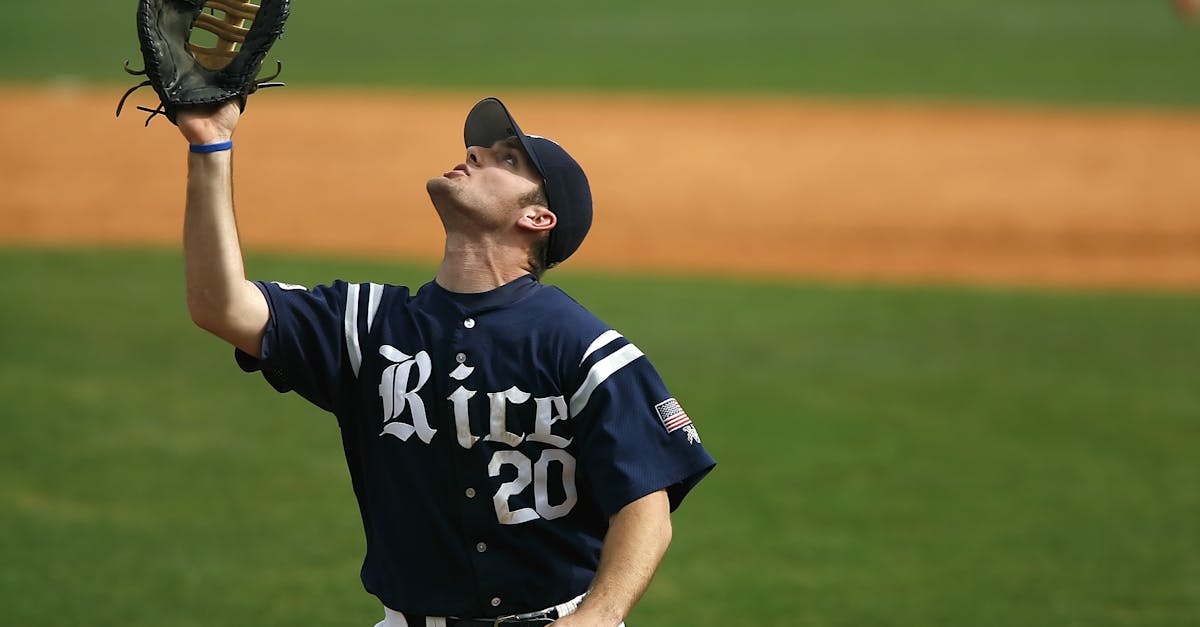
For any ball above your shoulders, the glove fingers point up. The ball should land just above and slightly to the throwing-arm side of your face, so your eye, the ball, and the glove are stacked. Your throwing hand sits next to the glove, ready to secure the ball and transfer it. This is sometimes called the “two-hand” or “alligator” catch in the outfield, even though only one hand actually catches.
The Below-Waist Catch
For a sinking liner or a ball you are charging hard, glove fingers point down. The wrist rotates, the elbow bends slightly, and the glove acts like a basket. This catch happens when you cannot get under the ball — usually a shallow line drive. Practice this one specifically; the wrist rotation feels unnatural at first.
The Over-the-Shoulder Catch
This is the catch every kid wants to make and the one that gets the most outfielders into trouble. The principle is simple: run to the spot, look back over the shoulder facing the ball, glove up and slightly across your body. The Willie Mays catch is the iconic example, but most over-the-shoulder catches are routine when the route is correct. The key is that you are turning your head, not your whole body — keep your shoulders square to the run direction so you stay fast.
The Drift Catch
For a ball that hangs above you, you “drift” by jogging under it. Drifting is fine on a calm day with a routine fly, but it is the worst catch in any kind of wind because you have no margin to adjust. I tell my outfielders to drift only when there is no wind, no traffic, and no question about where the ball will land. Otherwise, get to the spot early and wait for the ball.
Routes: Curved, Straight, and Banana
The route is the path you run from your starting position to the catch point. The best outfielders I have watched, from Pete Crow-Armstrong on the Cubs to my old college teammate who played in independent ball for nine years, all share one trait: they run smart routes. Sprint speed matters, but it cannot save a bad angle.
| Route | When to Use | Key Cue |
|---|---|---|
| Straight line | Routine ball directly toward you or directly away | Drop step, then sprint |
| Crossover | Ball hit to your side, requires lateral movement | Throwing-side foot crosses first if going to glove side, glove-side foot crosses first if going to throwing side |
| Banana (curved) | Ball with a runner on base who may tag | Curve away from the ball, then come back through the catch toward your throwing target |
| Drop and recover | Misread that takes you the wrong way | Plant, replant, sprint — never give up on the ball |
| Wall route | Deep ball headed for the warning track | Locate wall with one hand while tracking ball |
The banana route is the most underused tool at the youth and high school levels. With a runner on second and less than two outs, a routine fly to right field becomes a play at the plate. If the right fielder runs straight at the ball, all his momentum stops at the catch and he has to spin to throw. If he banana-routes — taking a slightly curved path that puts him moving toward home plate as he catches — he can crow-hop and throw with full body momentum, taking 0.4 to 0.6 seconds off the throw and adding 5 to 10 feet of accuracy.
Common Mistakes Table
Below is the list of fly ball mistakes I see across every level, the consequence of each, and how to fix it. Print this out and tape it to your dugout wall. I have used this same list for U10 to college clinics.
| Mistake | What Happens | How to Fix |
|---|---|---|
| First step in | Ball goes over your head, doubles and triples | Drill drop step until it is automatic on every read |
| Running flat-footed | Glove bounces, ball blurs, late tracking | Sprint on balls of feet, keep glove low until catch |
| Glove up too early | Blocks vision, slows running speed | Pump arms naturally, raise glove only at the last 10 feet |
| One-hand catch in traffic | Ball pops out on contact with body or other player | Two-hand any catch with a runner near or a teammate calling |
| Drifting in wind | Wind moves ball more than expected, you are out of position | Get to spot early, plant, adjust forward or back from a stop |
| Watching ball through whole flight | You stop running to track | Read off bat, sprint to spot, look up only when set |
| No call on shared ball | Collisions, dropped balls between fielders | Loud, repeated verbal call: “I’ve got it, I’ve got it, I’ve got it” |
| Not crow-hopping | Weak throws even on routine plays | Crow-hop on every fly, even with no runner |
| Sun in eyes, no shield | Lost ball, dropped routine pop | Glove up to shield, sunglasses always |
| Stationary catch | No throwing momentum, slow base advancement | Catch with momentum toward target, plant rear foot last |
Drills That Actually Work
Here are the drills I run on a real practice field. They progress from foundational to game-speed. Pick three or four per practice — never all of them — and rotate weekly so players stay sharp without burning out.
Tennis Ball Tracking
Stand 30 feet from a partner. Partner tosses tennis balls overhand at varying heights and locations — over your head, to your sides, in front. Catch barehanded. The goal is tracking, not glove work. Run this for two minutes per player, then rotate. I run this with my 8U through varsity teams; nothing else builds soft hands and depth perception faster.
Drop Step and Go
Player faces coach 20 feet away. Coach points left, right, or behind. Player executes the appropriate first step, sprints five steps, and pretends to catch a ball. Reset. Do 12 reps. This isolates the first step, which is the highest-leverage moment in fly ball defense.
Fungo Circuit
Set up six cones in the outfield grass, each 30 feet apart. A coach hits fungoes from home plate. The player catches one fly at each cone, then jogs to the next. Mix routine flies, deep flies, and shallow blooper. Twelve catches total per round. This is my standard outfield warmup four times per week. Need a quality fungo? My piece on the best fungo bats walks through what I look for.
Tennis Racket Deep Flies
A coach with a tennis racket can produce deeper, more game-realistic flies than a fungo. Stand at the warning track and have the coach hit balls 40 to 60 yards over your head. Run them down. Six reps per player. The trajectory off a racket is closer to a real swung-bat fly than anything else I have used.
Wall Drill
Player stands 20 feet from the outfield fence. Coach hits balls so the player has to locate the wall, judge the carry, and either catch or play the ball off the wall. Add a verbal call: “Wall, wall, wall” as the player approaches. This builds the habit of using the off hand to find the wall while the eyes stay on the ball.
Communication Triangle
Three outfielders in standard positions. Coach hits flies into the gaps and short outfield where two players have a play. Loudest, most committed call wins. Build the habit of calling early and repeating the call three times. The center fielder has priority on every shared ball — that rule alone prevents most collisions.
Sun Glare Drill
On a sunny day, deliberately put the player with their back to the sun, then have them turn 180 degrees, find the ball through the glare, and catch it. Glove up to shield, sunglasses on. Five reps. This drill saves at least one game per season for any team that plays day games.
Crow Hop and Throw
Catch a routine fly, crow-hop, and throw to a base or cutoff. Repeat until the catch and throw blur into one motion. Time the throw with a stopwatch. The benchmark for a college outfielder is a fly catch to throw home from medium depth in under 2.6 seconds. Track progress weekly.
Reaction Pop Up
Player faces away from coach. Coach yells “Go,” then hits a fly. Player must turn, locate, and catch. This trains the eyes to find the ball quickly and sharpens the read on partial information. Five reps per session.
Communication With Other Fielders
Half of all dropped fly balls at the youth and high school levels happen on shared balls — the ones where two fielders converge. The fix is not athleticism; it is communication. The rules I teach:
- Center fielder has priority on all balls hit between outfielders. Period. The corner outfielder yields immediately when the center fielder calls.
- Outfielders have priority on balls hit between an outfielder and an infielder. Coming forward is easier than backpedaling.
- Calls must be loud, clear, and repeated. “I’ve got it, I’ve got it, I’ve got it.” A single call is not enough — wind, crowd, and adrenaline drown it out.
- If you are yielding, also call it. “Take it, take it, take it.” Silence is not yielding; silence is confusion.
- Make your call no later than the apex of the ball. After the apex, both fielders are committed and changes are unsafe.
I have my outfielders practice calls every single day. Even on routine balls during BP, the center fielder has to call “Mine” loud enough for the corner fielders to hear. It feels excessive in February. By July, when a 15,000-fan playoff crowd is screaming, the call is automatic.
Reading Wind, Sun, and Field Conditions
The ball does not behave the same on every field. The best outfielders read conditions during warmups and adjust before the first pitch.
Wind
A wind blowing in cuts deep fly distance by 5 to 15 feet at typical speeds. A wind blowing out can add 20 feet or more, especially at high elevations or in stadiums with known wind tunnels. Crosswind moves balls laterally as much as 10 feet over a four-second hang time. Check flags, the dust on the warning track, and how the ball moves in BP. The cue I use: “Always play one step deeper into a wind blowing out, one step shallower into a wind blowing in.”
Sun
Locate the sun in the first inning. Identify your “sun zone” — the part of your defensive area where balls will be lost. Plan your alternate read for that zone: glove up to shield, drift slightly to one side to put the sun out of your line. Sunglasses are non-negotiable. I run a separate review of the best baseball sunglasses for outfielders if you want lens recommendations.
Lights
Stadium lights present a different problem from sun. Multiple light banks create multiple shadow zones. Find them during warmups. The cue: do not stare at the lights between pitches; they fatigue your eyes. Keep your eyes down or on the infield until the ball is in the air.
Wet, Dry, and Frozen Grass
Wet grass shortens your sliding distance and increases the risk of slipping on a hard cut. Dry grass holds your spikes well. Frozen ground, common in March games, makes ankle injuries more likely on a hard cut — shorten your stride and avoid sharp lateral changes. For early season play, our piece on hitting in cold weather applies the same principle to bat performance.
Position-Specific Considerations
The principles above apply to every outfielder, but the three outfield positions have distinct demands.
Center Field
You cover the most ground, you have priority on shared balls, and you usually have the strongest arm of the three. Reads here are pure. The ball comes off the bat almost straight at you most of the time, so depth perception is your edge. The fastest first step on the team plays here. For more on the position, see our how to play outfield guide.
Right Field
You see the ball off the bat from a slight angle, which actually helps reads on pulled balls from right-handed hitters. The right fielder needs the strongest arm because of the throw to third on a hit. Slice and hook on balls hit by lefties is more pronounced — the ball will tail toward the line on most pulled flies.
Left Field
Left fielders see a different angle on right-handed pull hitters. Slice tends to send those balls toward the line. The throw to third is short, but the throw to home is the longest of the three positions. Most teams hide their weakest defender in left, but at the higher levels left field demands the same skills as the other two spots.
Advanced Tips
Once you have the fundamentals, these advanced concepts separate good outfielders from great ones.
Read Backspin and Sidespin
Backspin on a fly ball generates lift, which makes the ball carry farther than its initial trajectory suggests. A 95 mph exit velocity at a 25-degree launch angle with high backspin can travel 20 feet farther than the same exit velocity with low backspin. Sidespin pushes the ball toward the foul line — left fielders see this constantly on pulled balls from righties. Train your eye to read spin in the first half-second by watching the seams in batting practice.
Catch and Throw Footwork
Your back foot at the catch should be the foot from your throwing side. From there, a crow hop becomes a single fluid motion: catch, plant throwing-side foot, gather, step with glove-side foot toward target, throw. Practice this until it is one motion. Pro outfielders complete the sequence in 1.6 to 2.0 seconds; high schoolers in 2.0 to 2.5; youth players in 2.5 to 3.5. Time yourself. Improvement is fast when you measure.
Decoy and Misdirection
On a routine fly with a runner on second who might tag, use body language to suggest the catch will be tougher than it is — slow your last few steps, drift slightly, look like you are working. The runner reads your effort and may not tag aggressively. Conversely, on a deeper ball you cannot reach, sprint hard and leave the glove down so the runner overcommits to a hold. These are nuances that take a season or two to develop.
Use the Pre-Pitch Inning Walk
Between innings, walk the warning track. Find soft spots, divots, sprinkler heads, the exact transition from grass to dirt. Look at the wall padding for thinness. Note where the bullpens are. Five minutes of walking saves a play later.
Work With Your Pitcher
Know what your pitcher is throwing and where. A high heater to a pull hitter likely produces a fly ball to your side; a sinker low and away tends to be hit on the ground or to the opposite gap. Your defensive positioning should shift slightly with each pitch. The best center fielders I have ever played behind moved a step or two between every pitch based on the call.
Mental Game and Mistakes
Outfield is a position with long stretches of nothing punctuated by single moments under high pressure. You can field 50 routine flies a season and your team’s playoff hopes ride on the 51st. The mental game matters as much as the mechanics.
The single biggest mental mistake is ball-watching after a missed catch. The ball is not done — runners are still moving. Get to the ball, hit your cutoff, end the play. Process the misplay between innings, not while runners are circling the bases. Players who own their mistakes recover faster. Players who hide miss the next ball too. For more on this side of the game, our baseball mental game tips guide goes deeper into focus and confidence work.
The second mistake is over-thinking. Once the ball is in the air, your conscious brain cannot do the math fast enough. Trust the work you have put in. The drills create the reflex. The game just lets the reflex happen.
Practice Plan: A Sample Week
Below is a sample weekly plan I use in mid-season for my high school outfielders. Adjust the volume up or down based on age and recovery.
| Day | Focus | Drills | Time |
|---|---|---|---|
| Monday | Routes and reads | Drop step, fungo circuit, banana route | 30 min |
| Tuesday | Communication | Triangle drill, shared ball BP | 20 min |
| Wednesday | Catch and throw | Crow hop, time-to-base benchmark | 25 min |
| Thursday | Conditions | Sun drill, wall drill, deep flies | 30 min |
| Friday | Game speed | Live BP from outfield positions | 30 min |
| Saturday | Game day | Pre-game warmup only | 15 min |
| Sunday | Recovery | Light tennis ball tracking, no sprinting | 10 min |
Over a 16-week high school season, that schedule produces roughly 600 fly ball reps per outfielder, plus another 200 in BP. By the playoffs, the read off the bat is automatic.
Frequently Asked Questions
How do I stop misjudging fly balls hit directly at me?
This is the hardest read in baseball. The ball has no lateral motion to anchor your depth perception. The fix is repetition and a default rule: take a drop step back on every ball that looks like it is coming at you. If the ball turns out to be in front, you can recover with a quick replant. Going back is harder than coming forward, so default back.
Should I always use two hands?
Yes when possible, no when not. Routine balls in open space — two hands. Diving, sliding, all-out sprints — one hand. The exception is in traffic with another fielder converging or near the wall, where two hands prevent the ball from popping out on contact.
What is the ideal outfield glove size?
For most outfielders, 12.5 to 12.75 inches is the sweet spot at the high school and college levels. Major leaguers often use 13 inches. Younger players should size down — 11.5 to 12.5 inches for ages 9-13. The web should be deep, and an H-web or trapeze is the standard pattern. The longer fingers and deeper pocket help on routine catches without sacrificing visibility on high balls.
How do I improve my reaction time?
The reaction is a trained reflex, not an athletic gift. Stand and watch every batting practice swing with the question: where will that ball land? Call it out before contact. Within a few weeks your eyes recognize launch angles faster, and your first step gets sharper. The reaction pop-up drill above also forces faster eye-target acquisition.
Can I practice fly balls alone?
Solo work is harder but not impossible. A pop fly machine produces consistent flies for tracking. A wall and a tennis ball lets you practice glove work and tracking by tossing high off the wall and catching the rebound. Long-toss with a partner where every throw is a high arc trains tracking too. Pure mechanical work — drop step, crossover step, crow hop — needs no equipment.
What about catching pop ups in the infield?
The mechanics are similar but the angles are tougher because the ball goes nearly straight up and then falls. Infielders should turn their back to the infield and face the outfield to catch — never try to catch with your back to the outfield, since the ball will look like it is moving away from you. Use two hands always; pop ups have heavy backspin and can knuckle.
How do I deal with a bad bounce off the wall?
Locate the wall with one hand before the ball arrives. If the ball is going to be off the wall, position yourself five to ten feet off so you can read the carom. Walls behave differently — padded outfield walls absorb energy and produce a shorter carom; concrete walls with thin padding ricochet hard. Walk the wall during warmups to know what you have.
What happens if I lose the ball in the sun?
Glove up to shield, take a half-step in or to the side to break the line of glare, and listen for your teammates’ calls. If you cannot reacquire the ball, get out of the way and let it land. A dropped ball is worse than a ball that hits grass, because a dropped ball still counts as an error and the runners advance the same.
How early should I start training kids on fly balls?
Tennis ball tracking starts at age 5 or 6. Real fly balls with a baseball, age 8 to 9. Drop step and crossover footwork can be introduced at age 9 or 10. By age 12, players should be running real routes. The earlier the tracking work begins, the better the depth perception by high school. Start with low-impact tools (tennis balls, foam balls) so fear never enters the equation.
How do I get over the fear of getting hit by a fly ball?
Fear comes from misjudging where the ball is going. Build confidence by starting with tennis balls, then soft baseballs, then game baseballs. Hundreds of low-stakes reps replace fear with prediction. If a player has been hit by a fly ball before, the recovery is repetition — work the eyes back into the read so the brain trusts the process. For overall confidence development, our mental game guide covers visualization and self-talk techniques that help.
Final Thoughts
Catching a fly ball is the cleanest skill in baseball. The play starts when the ball leaves the bat and ends when the ball is in your glove or on its way to a base. Everything in between is process. Build the process — pre-pitch stance, read off the bat, drop step, route, glove position, crow hop — and the play takes care of itself. The outfielders I have coached who got the most playing time were not the fastest or the strongest. They were the ones whose first step was always right and whose hands were always soft. Those things are 100% trainable. Spend the time, run the drills, and the catchable ball becomes an out.
If you are looking for the next layer of training, our pieces on baseball outfield drills and throwing drills are the natural follow-ups. Start with the basics, build a routine, and within a season you will notice the catches that used to scare you have become routine.