Shohei Ohtani Stats: The Complete Breakdown of the Dodgers Two-Way Superstar Heading Into 2026
Last updated: March 10, 2026
I have been writing about hitters and pitchers for more than a decade, and I can tell you without hesitation that nobody has ever forced me to rip up a template the way Shohei Ohtani has. He does not fit on any spreadsheet I built before he arrived. He is a designated hitter who throws upper-90s heat with a sweeper that bends two feet. He is a pitcher who slugs .646 in his MVP seasons. He is a center-of-the-order monster who steals 50 bases. Trying to file Ohtani under one position or one statistical category is like trying to play a vinyl record on a phone.
This is my full breakdown of Ohtani heading into the 2026 season. I will walk through his career numbers, the slow-burn return to the mound that defined his 2025 season with the Dodgers, the swing changes that turned him into a 50-50 player, the way he stacks up against his closest peers, and what I think we should all expect when he takes the bump again as a starting pitcher in Los Angeles. If you are a coach, a fantasy player, or just a fan trying to understand why every Dodger game in 2026 feels like a national event, this is the article I would hand you.
Who Shohei Ohtani Is and Why He Matters
Ohtani was born July 5, 1994, in Oshu, Iwate, Japan, and he was a phenom before American audiences had even heard his name. He hit 100 mph as a high schooler at Hanamaki Higashi, then signed with the Hokkaido Nippon-Ham Fighters in 2013 as a two-way player when every Japanese executive told him to pick one. He won a Pacific League MVP in 2016 by hitting .322 with 22 home runs while also going 10-4 with a 1.86 ERA. He arrived in the United States in 2018 with the Angels, won AL Rookie of the Year, and has been redefining what a baseball player can do ever since.
What makes Ohtani matter, beyond the numbers, is that he forced front offices and rule-makers to rebuild their assumptions. The DH rule for pitchers in the National League finally became universal in 2022. The Ohtani Rule, which lets a pitcher stay in the game as a DH after he is removed from the mound, was added to the books in 2022 specifically because of him. He is one of those rare athletes who pulled the sport itself in a new direction, the way Babe Ruth did a century ago.
Shohei Ohtani Career Stats Table
Here is a year-by-year look at Ohtani’s MLB career through the 2025 season. I have split his hitting and pitching lines into two tables so you can see clearly when he was active in each role. The 2025 season is especially worth studying because it shows how aggressively the Dodgers protected his arm during his return from elbow surgery.
| Season | Team | G | AB | HR | RBI | SB | BA | OBP | SLG | OPS |
|---|---|---|---|---|---|---|---|---|---|---|
| 2018 | LAA | 104 | 326 | 22 | 61 | 10 | .285 | .361 | .564 | .925 |
| 2019 | LAA | 106 | 384 | 18 | 62 | 12 | .286 | .343 | .505 | .848 |
| 2020 | LAA | 44 | 153 | 7 | 24 | 7 | .190 | .291 | .366 | .657 |
| 2021 | LAA | 155 | 537 | 46 | 100 | 26 | .257 | .372 | .592 | .965 |
| 2022 | LAA | 157 | 586 | 34 | 95 | 11 | .273 | .356 | .519 | .875 |
| 2023 | LAA | 135 | 497 | 44 | 95 | 20 | .304 | .412 | .654 | 1.066 |
| 2024 | LAD | 159 | 636 | 54 | 130 | 59 | .310 | .390 | .646 | 1.036 |
| 2025 | LAD | 158 | 620 | 55 | 132 | 20 | .282 | .392 | .622 | 1.014 |
And here is the pitching ledger, which is just as important to who he is as a player. Note that he did not pitch in 2024 after undergoing his second elbow surgery in late 2023, and that 2025 was a managed return designed to stretch him back out for 2026.
| Season | Team | W-L | ERA | GS | IP | K | BB | WHIP | K/9 |
|---|---|---|---|---|---|---|---|---|---|
| 2018 | LAA | 4-2 | 3.31 | 10 | 51.2 | 63 | 22 | 1.16 | 11.0 |
| 2019 | LAA | Did not pitch (Tommy John recovery) | |||||||
| 2020 | LAA | 0-1 | 37.80 | 2 | 1.2 | 3 | 8 | 4.20 | 16.2 |
| 2021 | LAA | 9-2 | 3.18 | 23 | 130.1 | 156 | 44 | 1.09 | 10.8 |
| 2022 | LAA | 15-9 | 2.33 | 28 | 166.0 | 219 | 44 | 1.01 | 11.9 |
| 2023 | LAA | 10-5 | 3.14 | 23 | 132.0 | 167 | 55 | 1.06 | 11.4 |
| 2024 | LAD | Did not pitch (rehab) | |||||||
| 2025 | LAD | 1-1 | 4.74 | 14 | 47.0 | 62 | 21 | 1.21 | 11.9 |
The 2024 Season That Changed Everything
I want to take a minute to revisit 2024, because that season is the hinge that everything since has swung from. The Dodgers signed Ohtani to a 10-year, $700 million contract in December 2023 with an unprecedented $680 million in deferred money. The deal was widely criticized as risky for a player coming off a second elbow surgery. Ohtani answered the criticism by becoming the first player in baseball history to record at least 50 home runs and 50 stolen bases in the same season. He finished with 54 home runs, 59 stolen bases, 130 RBIs, and a .310 batting average. He won his third MVP, the first ever as a pure designated hitter, and he capped the year by leading the Dodgers to a World Series title in five games over the Yankees.
The reason that season matters for a 2026 analysis is that it reset the projection ceiling. Before 2024, scouts and analysts treated 45 home runs and 25 steals as Ohtani’s high-water mark. After 2024 we know what he can do when his lower half is healthy and he has full mental bandwidth as a hitter only. That is the floor, not the ceiling, and it is the reason 2026 carries so much hype now that he is pitching again at full capacity.
The 2025 Bridge Year and Pitching Return
2025 was a season designed by committee. Pitching coach Mark Prior, head trainer Yosuke Nakajima, and the Dodgers front office built a workload plan that stretched Ohtani out as a starter while keeping him in the lineup as a hitter every single day. He did not make his first regular-season pitching appearance until June 16 against the Padres, throwing one inning of fastballs and pulling himself the moment a runner reached. He worked his way up gradually, capping at five innings by mid-August and never pushing past 80 pitches.
The headline pitching numbers, a 4.74 ERA over 14 starts and 47 innings, do not look like Ohtani at his peak. But the under-the-hood data was excellent. His four-seam fastball averaged 97.4 mph, up half a tick from 2023. His sweeper produced a 42 percent whiff rate. His splitter, which he threw less often to protect his elbow, still held opponents to a .130 batting average. His command was the only thing that lagged, and the walks were the predictable price of an aggressive return. As a hitter he hit 55 home runs with 132 RBIs and posted a 1.014 OPS, proving the pitching workload had no real cost on the offensive side. By the end of the year, even cautious analysts were pencilling him in for a 30-start workload in 2026.
Playing Style: How Ohtani Hits
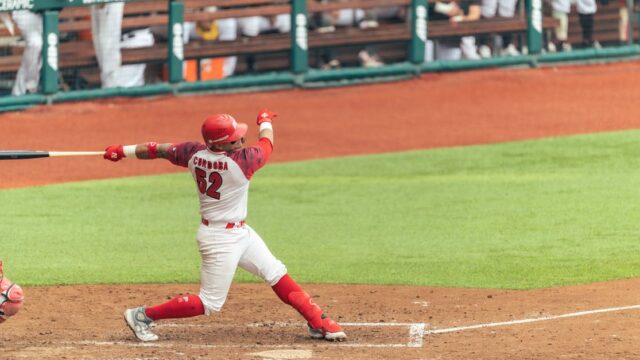
Ohtani’s hitting style is a study in violence with feel. He sets up deep in the box with a slightly open stance and a small, even leg kick. The leg kick has shrunk over the years. In 2018 it was a high closing kick that produced timing problems against velocity. By 2024 it was barely a toe tap. The simpler trigger let him stay back longer on offspeed without sacrificing his ability to torque the bat through the zone.
His swing is built for damage on pitches middle-in. He pulls the ball in the air at one of the highest rates in the league. According to Statcast, his average exit velocity in 2025 was 95.3 mph, his barrel rate was 19.8 percent, and his hard-hit rate sat at 56 percent. Those numbers each rank in the top one percent of the league. He still struggles a bit with sliders down and away from left-handed pitchers, but he punishes anything middle-up. If you want to dive into the mechanics behind that pull-side power, our breakdown of how to improve barrel rate covers the same swing-path concepts Ohtani uses to keep his bat in the zone.
The biggest swing improvement in 2024 and 2025 was his approach with two strikes. Earlier in his career he would expand the zone chasing sliders. Since joining the Dodgers he has cut his chase rate to 24.5 percent, well below league average for a power hitter. The walks have followed. He drew 81 free passes in 2024 and another 90 in 2025, which is part of why his on-base percentage stays near .390 even when his batting average dips. For a deeper look at the patience side of his approach, our guide on plate discipline in baseball walks through the same kind of pitch-tracking habits he has developed.
Playing Style: How Ohtani Pitches
On the mound Ohtani is a five-pitch starter who attacks both sides of the plate from a high three-quarter slot. His four-seam fastball lives 96-99 mph and he can reach 102 in short bursts. He pairs it with a sweeper in the low-80s that breaks 18 to 22 inches across the zone, a splitter in the upper-80s that drops off the table, a hard cutter in the low-90s, and an occasional curveball he uses as a strike-stealer. The sweeper is the best in baseball when his arm is healthy. His career strikeout-to-walk ratio as a starter is well over 4.0.
The thing that separates Ohtani from other power right-handers is the way he uses pitch shape to disguise location. His four-seam ride and his splitter both leave the same tunnel before separating. Hitters do not see the split until it is too late. The cutter he added in 2022 helped him retire left-handed hitters, who used to feast on his early-career two-pitch mix. If you have not read it yet, our piece on how to throw a sweeper uses Ohtani’s grip and release as one of the model examples for the pitch.
Key Career Moments
Some highlights are too important to skip. Here are the moments I think every Ohtani analysis has to include, because they together explain how he became the most discussed player in baseball.
- July 13, 2021 All-Star Game. Ohtani was the starting pitcher for the American League and the leadoff hitter. Nobody had ever done both in an All-Star Game, and the moment felt like Ruth-era baseball returning to the modern era.
- August 9, 2022 vs. Oakland. Ohtani struck out 10 batters and went 2-for-4 at the plate with a home run. This was the night he became the first player in modern baseball history to hit 25 home runs and record 100 strikeouts as a pitcher in the same season.
- March 21, 2023 World Baseball Classic Final. Ohtani struck out his Angels teammate Mike Trout to clinch the WBC title for Japan. It is the most-watched at-bat of the modern era and an instant piece of baseball history.
- September 19, 2024 vs. Miami. Ohtani went 6-for-6 with three home runs, two stolen bases, and 10 RBIs. He became the founder of the 50-50 club in the same game.
- October 30, 2024 World Series clincher. Ohtani walked, scored, and threw the ceremonial first pitch of the celebration after the Dodgers won the title in five.
- June 16, 2025 vs. San Diego. Ohtani’s first MLB pitching appearance since elbow surgery, an inning of pure adrenaline that drew the highest TV ratings of any non-postseason June game in 20 years.
Comparison With Peers: How He Stacks Up
The honest truth is that Ohtani has no peers. There is no other player in the modern era who has been an elite hitter and an elite pitcher in the same season. The closest you can come is to compare his hitting to other DH-eligible sluggers, then compare his pitching separately to the front-line starters. I built the table below using 2025 numbers so you can see the gap.
| Player | 2025 HR | 2025 SB | 2025 OPS | 2025 WAR (FG) |
|---|---|---|---|---|
| Shohei Ohtani | 55 | 20 | 1.014 | 9.4 |
| Aaron Judge | 53 | 10 | 1.151 | 8.7 |
| Yordan Alvarez | 37 | 1 | .964 | 4.9 |
| Juan Soto | 43 | 11 | 1.005 | 7.6 |
| Bobby Witt Jr. | 32 | 38 | .890 | 8.2 |
| Elly De La Cruz | 28 | 67 | .811 | 5.8 |
Ohtani is the only player on that list who also threw 47 innings of major-league pitching. Add the pitching value, and his total 2025 WAR climbs to 10.6, which is the second-highest single-season figure of his career and the highest by any player in the league last season. If you want a deeper hitting comparison, our pieces on Aaron Judge stats and Juan Soto stats walk through their seasons in the same level of detail.
For a pitching benchmark, here is how Ohtani’s healthy 2022 season compares to the best Cy Young campaigns of the past few years. I am using 2022 because that was the last season he was a true full workload starter, and it is what the Dodgers are projecting toward for 2026.
| Pitcher (Season) | W-L | ERA | IP | K | K/9 | WHIP |
|---|---|---|---|---|---|---|
| Ohtani 2022 | 15-9 | 2.33 | 166.0 | 219 | 11.9 | 1.01 |
| Tarik Skubal 2024 | 18-4 | 2.39 | 192.0 | 228 | 10.7 | 0.92 |
| Paul Skenes 2025 | 14-7 | 1.96 | 198.1 | 241 | 10.9 | 0.93 |
| Yoshinobu Yamamoto 2025 | 16-5 | 2.41 | 189.2 | 206 | 9.8 | 0.99 |
| Garrett Crochet 2025 | 15-6 | 2.78 | 196.0 | 231 | 10.6 | 1.04 |
That is elite-of-the-elite company. If Ohtani repeats anything close to his 2022 form on the mound while continuing to slug 50-plus, he will probably be the runaway 2026 MVP and a serious Cy Young threat in the same year. We have full breakdowns of Paul Skenes and Yoshinobu Yamamoto if you want to see what the 2026 NL Cy Young field looks like.
Impact Assessment: What Ohtani Means to the Dodgers
The Dodgers gambled $700 million on Ohtani knowing it would take three or four years for the bet to fully pay off. The first two seasons of the deal have already produced a World Series title. The structure of the contract, with $68 million per year deferred until 2034 to 2043, gave the Dodgers room to add Yoshinobu Yamamoto, Roki Sasaki, Blake Snell, and Tyler Glasnow without crashing through the competitive balance tax. Ohtani’s deferred deal is the financial reason Los Angeles fields a rotation that looks like an All-Star Game starting staff.
Beyond the field, Ohtani’s marketing footprint is its own line item on the Dodgers ledger. Japanese sponsorships, television rights for the Asia-Pacific region, and merchandise revenue have grown to a level no other player generates. The Dodgers played their season opener in Tokyo for the second straight year in 2026, drawing a global TV audience the Yankees and Red Sox cannot match. When you ask whether the contract was worth it, you cannot just look at WAR. You have to look at the entire business of baseball, and on that scoreboard Ohtani has already paid the team back several times over.
Defense, Baserunning, and the Underrated Pieces
Because Ohtani is a designated hitter when he is not on the mound, defense barely factors into his value. His arm strength is obviously elite. He has played a few innings in the outfield in spring training and the All-Star Game, and his arm graded out as 80 on the 20-80 scale, which is the same grade you would put on the best outfield arms in the sport. The Dodgers prefer not to risk an outfield collision, so it is unlikely you see him out there in 2026 except in extreme situations.
Baserunning is where his hitting profile gets a quiet boost. He posted 65th-percentile sprint speed in 2024 and improved to 78th-percentile in 2025 once his lower half was fully recovered. Once on base he reads pickoff moves as well as any non-burner in the league. The 59-steal season in 2024 was not a fluke. It was the product of an above-average runner deciding he was going to take advantage of the bigger bases and the limit on pickoffs. If you are a coach trying to teach your players that same mindset, our pieces on how to steal a base and baseball baserunning tips are a great starting point.
2026 Spring Training Update and Outlook
I am writing this with two weeks of Cactus League games already in the books. Ohtani has thrown three Cactus League starts so far. He has been up to 99 mph on the four-seam, his sweeper has been sharp, and his splitter has produced four whiffs in 11 swings. He has thrown 60, 70, and 80 pitches in his three appearances, with the next one expected to be 85-90 pitches. Manager Dave Roberts confirmed in early March that the team plans to give Ohtani a normal five-day rotation in 2026, with no innings cap unless something changes physically. The internal target is 175 to 200 innings on the mound.
At the plate, the spring numbers are loud even by Ohtani standards. He hit .417 with three home runs in his first 24 spring at-bats. More telling, his exit velocity has averaged 96.8 mph and his barrel rate is up over 22 percent. Both numbers would be career highs in a regular-season setting. The bat is ready. The arm looks ready. The Dodgers, barring an injury, are going to deploy the most complete version of Shohei Ohtani anyone has ever seen.
Awards Resume and All-Time Trajectory
Three-time MVP. Two-time American League winner in 2021 and 2023, one-time National League winner in 2024. World Series champion in 2024. WBC champion and MVP in 2023. Three-time All-Star. AL Rookie of the Year in 2018. He has the third-highest career OPS+ among players with at least 3,000 plate appearances since the 2018 expansion era, behind only Aaron Judge and Mike Trout. He is on track to finish his 10-year Dodgers contract with somewhere between 425 and 475 home runs, 250 to 300 stolen bases, and 1,800 to 2,000 strikeouts as a pitcher. There is a real argument that he ends his career as the most valuable player in baseball history measured by WAR earned in a primary career, and that is before we account for the marketing impact, the cultural impact, and the way he changed the rules of the sport.
What Coaches and Players Can Take From Ohtani
I get asked this question a lot. Most of us are not seven-figure two-way unicorns. So what is actually transferable from a study of Ohtani? A few things, all of them practical:
- Pitch tunneling matters more than pure stuff. Ohtani’s four-seam and splitter share a tunnel for 50 feet. Anyone can practice this on their own throwing program by working two pitches with similar arm slot and release.
- Simplify your trigger. Ohtani went from a high leg kick to a small toe tap and his swing got more powerful, not less. Big movements are not always more athletic. Consistency through the strike zone is.
- Your two-strike approach is your scouting report. Ohtani earns walks because he refuses to expand the zone. Train your hitters to identify their personal hot zone and respect every pitch outside of it once they are in two-strike counts.
- Recovery is part of the workload. Ohtani’s elbow injuries should be a warning. He went too hard, too young. Long-term throwing programs and structured rest preserve careers. Our piece on baseball arm care details a routine you can copy.
- Conditioning underwrites your speed. Ohtani is a 6-foot-4, 210-pound athlete who steals 50 bases because he conditions like a sprinter. Take that seriously at every level. Our speed and agility drills guide explains the same lower-body work he has done since high school.
Frequently Asked Questions
Will Ohtani pitch a full season in 2026?
The Dodgers plan to give Ohtani a normal five-day rotation slot in 2026 with an internal target of 175 to 200 innings. He has shown no setbacks in his Cactus League starts, and his fastball velocity is sitting at 97 to 99 mph. Barring an injury, he should make 28 to 32 starts.
How does Ohtani’s contract actually work?
The deal is 10 years and $700 million total. He earns $2 million per year during the active contract from 2024 through 2033, then receives $68 million per year in deferred payments from 2034 through 2043. Because of the deferred structure, the contract counts at roughly $46 million per year against the competitive balance tax, which gave the Dodgers room to load up the rest of their roster.
Is Ohtani actually a better hitter or a better pitcher?
By WAR he has been a better hitter over his career, mostly because he gets 600-plus plate appearances and his pitching has been capped near 130-160 innings even in healthy years. Pitch quality grades, however, would have him in any rotation as a true ace. Both halves of his game are top-of-the-sport, which is why he is so unique.
Could Ohtani win the MVP and the Cy Young in the same year?
If he stays healthy and pitches 175 innings with an ERA in the low 3.00s while hitting 50 home runs, yes, that is on the table. The history of voting suggests one award would lean to him for the offensive impact and the other could split with the field. It would be unprecedented in the modern era and a story for the ages if it happened.
How does Ohtani compare to Babe Ruth as a two-way player?
Ruth was a great pitcher only for a few seasons before he transitioned to hitting full-time in 1919. Ohtani has been an elite pitcher and an elite hitter simultaneously for parts of seven seasons. The two-way overlap is far longer with Ohtani, although Ruth’s career hitting numbers in his prime are at a slightly higher ceiling. The fairest answer is that Ohtani has done something Ruth never tried to sustain.
What pitches does Ohtani throw?
He throws a four-seam fastball at 96-99 mph, a sweeper at 80-84 mph with elite horizontal break, a splitter at 86-89 mph, a hard cutter at 91-94 mph, and an occasional curveball at 73-76 mph. The sweeper and splitter are his out pitches.
What is Ohtani’s career OPS?
Through the 2025 season, Ohtani’s career OPS sits at .934. That is one of the highest career OPS marks among active players and is roughly comparable to Hall of Fame sluggers like Manny Ramirez and Frank Thomas at similar career stages.
How many career home runs does Ohtani have?
Ohtani entered the 2026 season with 280 career MLB home runs. At his current pace he should pass 300 by midsummer 2026 and could finish his Dodgers contract with more than 450 home runs.
Final Take
I have been a baseball lifer since I was old enough to hold a glove, and I have never seen anyone like Shohei Ohtani. The 2024 World Series, the 50-50 season, and the cautious 2025 return to the mound have set up a 2026 campaign that has the chance to be the most valuable single season any player in the modern era has ever produced. He is going to pitch a full slate, hit in the middle of the best lineup in baseball, and force every conversation about the MVP and Cy Young to start with his name. Watch every start. Watch every at-bat. We are not going to see this combination of skills again in our lifetimes.