Baseball Baserunning Tips: How to Run the Bases Smarter at Every Level
Last updated: March 06, 2026
Baserunning is the most undercoached skill in baseball. I have watched thousands of games at every level — from 8U travel ball to the Major Leagues — and the single biggest gap between good teams and great teams almost always comes down to what happens between the bases. Players spend hours in the cage and on the mound, but very few dedicate serious practice time to running the bases with intelligence, aggression, and proper technique.
That changes today. In this guide I am going to walk you through everything you need to know about baserunning: the mechanics of running through first, how to take a proper lead, reading pitchers, rounding bases efficiently, tagging up, situational awareness, and the drills that actually translate to games. Whether you are a youth player learning the fundamentals or a high school athlete looking to earn extra bases, this article will give you a concrete system to become a smarter, faster, more dangerous baserunner.
Why Baserunning Matters More Than You Think
Let me start with the numbers, because they tell a story most coaches ignore. In the 2024 MLB season, teams collectively recorded a stolen base success rate of 80.7 percent on 4,318 attempts — a massive jump from the 68 percent success rate before the 2023 rule changes that introduced bigger bases and limited pickoff attempts. That means the game has shifted. The rules are literally rewarding aggressive baserunning, and the teams that have adapted are winning more games because of it.
FanGraphs tracks a metric called BsR (Baserunning Runs Above Average), which measures stolen base value, extra bases taken on hits, and outs avoided on the basepaths. In 2024, Bobby Witt Jr. led the American League with a +12.3 BsR, meaning his baserunning alone was worth roughly 12 extra runs compared to an average runner. That is the equivalent of adding a full win to his team just from how he ran the bases. Elly De La Cruz posted similar numbers in the National League. These are not just fast guys — they are smart runners who understand angles, timing, and leverage.
At the youth and high school level, the impact is even more dramatic. I have seen teams with below-average hitting win tournaments because they put constant pressure on defenses with aggressive, intelligent baserunning. When you force the other team to rush throws, you create errors. When you take the extra base, you turn singles into scoring opportunities. Baserunning is free offense, and it costs nothing but preparation and effort.
Running Through First Base: The Foundation
Every baserunning play starts with the sprint from home to first. This sounds basic, but I see it done wrong at every level. Here is the correct technique, step by step.
After making contact, your first step out of the box should be a crossover step with your back foot. Do not watch the ball. Your job is to run hard for three to four strides before glancing to pick up the ball. Elite MLB runners like Trea Turner and Bobby Witt Jr. average 29 feet per second in Sprint Speed (measured by Statcast from home to first), while the league average sits around 27 ft/sec. That two-foot-per-second difference translates into reaching first base approximately 0.2 seconds faster, which is the difference between safe and out on a close play.
Hit the front edge of the base when running through first. The front of the bag is a shorter distance than the middle or back, and it can save you a fraction of a step. Run through the bag — do not slow down before it. After touching first, veer slightly to the right (into foul territory) so there is no chance you can be tagged if you drift toward second.
The most common mistake I see is players slowing down in the last five to ten feet before first base. They assume they are out and coast. I tell every player I work with: run through first base like you are running to second. Every extra-base hit in your career starts with that mentality.
Taking Your Primary Lead at First Base
Once you are on first, the chess match begins. Your primary lead — the distance you take from the bag before the pitcher comes set — determines everything that follows. Too short and you cannot get a good jump on a steal or advance on a ball in the dirt. Too long and you get picked off.
The optimal primary lead at first base is 12 to 14 feet. At this distance you can dive back safely on a pickoff attempt while still being aggressive enough to steal or advance on contact. Elly De La Cruz, one of the most explosive baserunners in baseball, averages about 13.5 feet for his primary lead. That is not an accident — it is the sweet spot where the risk-reward ratio favors the runner.
Here is how to measure it quickly: take a shuffle step off the bag, then two more crossover steps. That should put you at roughly 12 to 13 feet. Your weight should be balanced, knees slightly bent, hands relaxed at your sides or in front of you. Your eyes are locked on the pitcher.
Against left-handed pitchers, you need to adjust. Take your lead slightly farther — 14 to 16 feet — because the lefty’s move home is easier to read than a righty’s. However, your first-move reaction must be quicker. Corbin Carroll stole bases at an 84 percent success rate against lefties in 2023-2024, largely because he expanded his lead and committed early to his reads.
The Secondary Lead: Where Extra Bases Are Won
The secondary lead is the most underrated baserunning technique in the game. It is the additional ground you gain after the pitcher commits to throwing home, and it is where smart baserunners separate themselves from everyone else.
As the pitcher starts their motion to the plate, take two aggressive shuffle steps toward the next base. These shuffles should cover 3 to 5 additional feet. The key is timing: you want to be moving and gaining ground as the pitch arrives, so that you are already in motion if the ball is hit, passed, or put in play. At second base, your secondary lead should be even more aggressive — 7 to 9 feet off the bag — because there is no pickoff threat once the pitch is thrown.
Ronald Acuña Jr. was one of the best secondary-lead runners in baseball before his 2024 injury, converting 41 of 46 steal attempts (89.1 percent) in his 2023 MVP season. A significant part of that efficiency came from his secondary leads, which gave him a running start on virtually every pitch.
The common error here is being flat-footed when the pitch arrives. If you are standing still at the moment of contact, you have already lost a full step. Your secondary lead should land you in an athletic position — weight slightly forward, on the balls of your feet, ready to react in any direction.
Reading Pitchers: The Key to Stealing Bases
You do not need elite speed to steal bases. What you need is elite reads. I have coached runners who ran 7.2-second 60-yard dashes steal 30 bases in a high school season because they learned to read pitchers so well that they got perfect jumps every time.
Here is what to look for when reading a right-handed pitcher from first base:
- Heel lift: Most right-handers lift their front heel slightly before going home. If the heel lifts, go.
- Shoulder turn: A subtle turn of the front shoulder toward home plate means the pitcher is committing to the delivery.
- Weight shift: Watch for the weight transferring to the back leg. Once the weight goes back, the pitcher cannot throw to first without balking.
- Delivery time: Time the pitcher’s delivery from first movement to the ball reaching the catcher’s glove. Anything over 1.3 seconds gives the runner a significant advantage. In 2024, over 70 percent of successful stolen bases came against pitchers with delivery times above 1.3 seconds.
Against left-handed pitchers, the read is different:
- Front knee direction: If the front knee moves past the back knee toward home, the lefty is going home. If it lifts straight up or drifts toward first, get back.
- Shoulder angle: A lefty opening the front shoulder usually means they are delivering the pitch.
- Head movement: Many lefties will lock their eyes on the runner before a pickoff. If the head stays focused on home, it is safe to go.
Top-10 base stealers in MLB average a reaction time of just 0.35 seconds from pitch release to their first step. Jazz Chisholm Jr. has been clocked at 0.32 seconds, which is part of why he converted 67 of 78 steal attempts (85.9 percent) from 2022 to 2024. That reaction time is trainable — and I will cover drills to improve it below.
Rounding the Bases: Angles and Efficiency
How you round a base determines whether a double stays a double or becomes a triple. The difference between a good turn and a bad turn is often 0.1 to 0.2 seconds — which, at full speed, is the margin between safe and out.
When you are running for extra bases, start your arc about 10 to 12 feet before the bag. You want to approach the base from a slight angle so that you can hit the inside corner (the corner closest to the infield) with your left foot. This creates a straight-line path to the next base and eliminates the “banana” or “bow out” pattern that costs so many runners valuable time.
Here is the full technique for rounding first on a potential double:
- Out of the box, run in a straight line for the first 60 feet.
- At roughly 10 to 12 feet from first base, start veering slightly to the right to create your arc.
- Hit the inside corner of first base with your left foot.
- Drive off the base with an aggressive push toward second.
- Lean your body toward the infield as you round — think of a sprinter leaning into a curve.
- Pick up the ball and the third base coach simultaneously to read whether to continue or hold.
Bobby Witt Jr. is a masterclass in rounding bases. His efficient angles contributed to his league-leading +4.2 BsR in 2024, turning 8 percent more singles into doubles compared to an average runner. That is pure technique — not just raw speed.
Tagging Up: How to Read Fly Balls and Advance
Tagging up is one of the highest-leverage baserunning situations in the game, yet it is practiced far less than it should be. Here is the fundamentals and the situations where tagging up can change a game.
The basic rule: on any fly ball, freeze. Do not commit to running until the ball is caught (or clearly drops). Once the outfielder catches the ball, push off the base and sprint to the next bag. At third base with fewer than two outs, you should be tagging on virtually every fly ball to the outfield, unless it is an extremely shallow pop-up.
The details that make the difference:
- Body position: Face the outfielder, not the next base. Your left foot should be on the back edge of the bag (at third base), ready to push off toward home the instant the ball hits leather.
- Read time: Top MLB runners have an average read time of 0.4 seconds from catch to first step. Poor taggers take 0.6 to 0.8 seconds, which is the difference between scoring and being out by ten feet.
- Depth of the fly ball: Elite baserunners advance on approximately 65 percent of medium-depth fly balls. The outfielder’s momentum, arm strength, and positioning should all factor into your decision.
- Two-out tagging: With two outs, you do not need to tag — run on contact. But with zero or one out, you must freeze and read the ball first.
Poor tagging costs teams an estimated 2 to 3 runs per season at the MLB level. At the youth and high school level, I have seen poor tag-up decisions cost 10 or more runs in a single season — runs that could have been scored with better preparation and instincts.
Situational Baserunning: The Decision-Making Framework
Great baserunning is not just about speed or technique — it is about knowing what to do in every situation before the pitch is thrown. Here is a framework I teach every player I work with.
| Situation | Outs | Runner Action | Priority |
|---|---|---|---|
| Runner on 1st, ball hit to right field | 0 or 1 | Read the ball off the bat — hustle to third on any single to right | Aggressive advance |
| Runner on 1st, ground ball to left side | 0 | Read the ball through the infield, avoid double play | Stay out of DP |
| Runner on 2nd, single to outfield | Any | Score unless third base coach holds — read the outfielder’s arm | Score the run |
| Runner on 3rd, fly ball to outfield | 0 or 1 | Tag and score on any ball deep enough | Tag up aggressively |
| Runner on 3rd, ground ball to infield | Less than 2 | Read the ball — go on contact only if ball is hit to right side or slow roller | Score if safe |
| Runner on 2nd, ground ball to right side | 0 or 1 | Advance to third on any ground ball hit to the right of second base | Advance one base |
| Runners on 1st and 3rd, steal attempt | Any | Runner on 1st goes — runner on 3rd reads the throw and decides | Create chaos |
Before every pitch, ask yourself three questions: How many outs are there? Where is the ball going if it is hit on the ground? Where is the ball going if it is hit in the air? If you know the answers to those three questions before the pitch, you will react faster than 90 percent of runners at any level.
Baserunning Drills That Translate to Games
Here are my favorite baserunning drills — the ones I have used with hundreds of players and that consistently produce results in game situations.
Drill 1: The Lead and React Drill
Purpose: Improve primary lead distance and first-step quickness.
Setup: Place a runner at first base. A coach stands on the mound and simulates a pitcher coming set. The runner takes their lead. On the coach’s signal (a clap for “go” or a point to first for “back”), the runner either sprints toward second or dives back to the bag.
Reps: 10 to 15 per player. Alternate between “go” and “back” signals randomly so the runner cannot anticipate. Track the runner’s lead distance — push them to hold 12 to 14 feet consistently.
Drill 2: The Rounding and Decision Drill
Purpose: Improve base-rounding angles and on-the-fly decision-making.
Setup: Runner starts at home plate. Coach hits a ball into the outfield (or rolls it). Runner runs out of the box, rounds first, and must decide — based on the ball’s location — whether to hold at first, continue to second, or go for third. A coach at third base gives a live “go” or “hold” signal.
Reps: 8 to 10 per player. Emphasize the arc and hitting the inside corner of the bag. Time the runner from home to second and push them to improve.
Drill 3: The Tag-Up Sprint
Purpose: Improve tag-up technique and reaction time at third base.
Setup: Runner on third base. Coach stands in the outfield and throws a ball high into the air. Runner must freeze, read the catch, and sprint home the instant the ball hits the coach’s glove.
Reps: 8 to 10 per player. Time the interval from catch to the runner touching home plate. A good high school runner should be under 3.5 seconds from a standing tag at third.
Drill 4: The Pitcher-Read Drill
Purpose: Develop reads on pitchers for stealing bases.
Setup: A pitcher (or coach simulating a pitcher) goes through their full windup/stretch delivery. Runners at first base watch and call out “home” or “first” based on the pitcher’s movement. No actual running — just reading and calling. After 20 reps of reads, add live steal attempts where the runner goes on their read.
Reps: 20 read-only reps, then 10 live steal attempts. Track success rate and aim for at least 80 percent correct reads before adding live running.
Drill 5: The Full-Diamond Situation Drill
Purpose: Practice situational baserunning with live reads.
Setup: Full defense on the field. Runners placed in various situations (runner on first with one out, runner on second with no outs, runners on first and third, etc.). Coach hits live ground balls and fly balls. Runners must make the correct baserunning decision in real time.
Reps: Run through 10 to 15 situations per practice. Debrief each play immediately — ask the runner what they saw and what they decided, and correct in real time.
Baserunning Metrics: Understanding the Numbers
If you want to track your baserunning improvement (or scout other players), here are the key metrics you should understand.
| Metric | What It Measures | Average (MLB) | Elite Level |
|---|---|---|---|
| Sprint Speed (ft/sec) | Top running speed from home to first | 27.0 ft/sec | 29.0+ ft/sec |
| BsR (Baserunning Runs) | Total baserunning value in runs above average | 0.0 | +8.0 or higher |
| SB Success Rate | Percentage of stolen base attempts that are successful | 80.7% | 85%+ |
| Home to 1st Time | Time from contact to touching first base (RHH) | 4.3 sec | 4.0 sec or less |
| wSB (Weighted Stolen Base) | Run value of stolen base attempts | 0.0 | +4.0 or higher |
| Extra Bases Taken % | How often a runner takes an extra base on hits | 40% | 50%+ |
At the youth and high school level, you will not have access to Statcast data, but you can still time home-to-first, 60-yard dashes, and stolen base success rates with a simple stopwatch. I recommend tracking these numbers throughout the season and setting specific improvement targets — for example, dropping your home-to-first time by 0.1 seconds over the course of a month through drills and technique work. If you want to dig deeper into how baseball statistics work, check out our guide on how to read baseball statistics.
Common Baserunning Mistakes and How to Fix Them
I have seen these mistakes hundreds of times. Here is how to identify and correct the most damaging baserunning errors.
Mistake 1: Ball-watching out of the box. Too many hitters watch their hit instead of running. The fix is simple — run hard for the first three to four strides before picking up the ball. Your teammates and coaches will tell you where the ball is. Your job is to run.
Mistake 2: Flat-footed secondary leads. If your feet are not moving when the pitch arrives at the plate, you are already behind. Practice your secondary shuffles until they become automatic on every single pitch.
Mistake 3: Wide turns around the bases. The “banana turn” — where a runner swings wide and runs in a big arc — costs 0.2 to 0.3 seconds per base. That adds up to nearly a full second over three bases. Tighten your turns by starting your arc earlier and hitting the inside corner of each bag.
Mistake 4: Not knowing the situation before the pitch. If you have to think about what to do after the ball is hit, you are already too late. Every runner should know the outs, the score, and their assignment before every pitch.
Mistake 5: Hesitating on steal attempts. Once you commit to stealing, go. Hesitation kills stolen base attempts faster than slow feet do. The 75 percent success rate threshold for positive steal value means you have room for some failed attempts — do not let the fear of being thrown out make you tentative.
Mistake 6: Ignoring the third base coach. Your coach can see things you cannot. When rounding second and heading to third, or rounding third and heading home, trust your coach’s signals. I have seen more outs at the plate from runners ignoring a stop sign than from any other baserunning error.
Expert Insights on Baserunning Development
Tony Vitello, head coach at the University of Tennessee and one of the most successful college coaches in the country, emphasizes the importance of tracking the ball: “Baserunners should follow the ball out of the hand and be able to see the angle. A lot of guys just look at the pitcher release the ball and then turn their head. The best runners keep their eyes on the ball’s trajectory and react to what they see, not what they assume.”
Tim Raines, Hall of Fame baserunner with 808 career stolen bases and an 84.7 percent success rate, once said: “Stealing bases is 90 percent reading the pitcher and 10 percent speed. If you get a good jump, speed is almost irrelevant.” Raines’ philosophy holds true today — the best modern base stealers are not always the fastest players. They are the best readers of pitchers.
Rickey Henderson, baseball’s all-time stolen base king with 1,406 career steals, built his legacy on preparation: “I studied every pitcher I faced. I knew their moves, their timing, their tendencies. By the time I got on base, I already knew when I was going to go.” Henderson’s approach is something every baserunner at every level can replicate — study pitchers during at-bats and from the dugout, not just when you are on base.
For coaches at the youth level, the ABCA (American Baseball Coaches Association) recommends dedicating at least 15 minutes of every practice to baserunning drills and situational work. “A proficient base running team establishes its presence early in the game, creating awareness, excitement, and potential stress for the opposing team,” the ABCA notes in their coaching curriculum. That 15-minute investment can change the trajectory of your entire season.
Baserunning Speed Development: Getting Faster on the Basepaths
While reading pitchers and technique are the biggest factors in effective baserunning, raw speed still matters. Here are the most effective ways to get faster for the basepaths.
Sprint mechanics: Focus on arm drive, knee lift, and staying on the balls of your feet. A proper sprint posture — slight forward lean, head still, arms driving from hip to chin — can improve your 60-yard dash time by 0.2 to 0.3 seconds without adding any actual strength or conditioning. This is one reason why working on your overall development as a baseball player pays dividends on the basepaths.
Short-burst acceleration: Baseball running is not about top-end speed — it is about how fast you get to top speed. Focus your training on 10-yard and 20-yard sprints rather than long-distance running. Three sets of six 20-yard sprints with full recovery between reps, done three times per week, will produce measurable speed improvements within four to six weeks.
Lateral agility: Baserunning involves lateral movement — shuffles, crossovers, direction changes. Incorporate lateral cone drills, side shuffles, and crossover runs into your speed work. This helps with leads, secondary leads, and reacting to batted balls.
Lower body strength: Stronger legs produce more ground force, which translates directly to speed. Squats, lunges, and single-leg exercises are the foundation. If you are a youth player, bodyweight exercises are more than enough. For high school players and older, a structured strength program focusing on posterior chain development will have the biggest impact on sprint speed. If you are looking for a complete approach to your physical preparation, our guide on baseball arm care and conditioning covers the broader physical development picture.
Sliding Technique for Baserunners
Sliding is a critical skill that goes hand-in-hand with baserunning. While we have a detailed guide on how to slide in baseball, here is a quick overview of how sliding connects to your overall baserunning strategy.
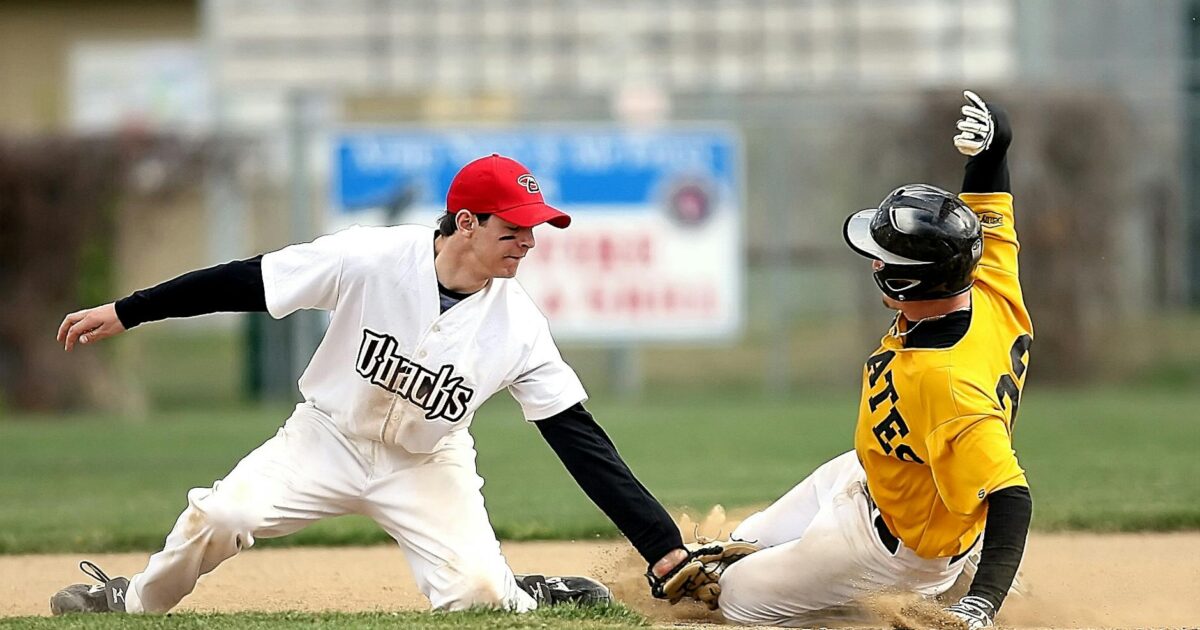
Pop-up slides are the preferred technique for most stolen base attempts and extra-base situations. A good pop-up slide allows you to hit the bag, pop to your feet, and immediately assess whether to advance further. In the MLB, players who consistently use pop-up slides take approximately 15 percent more extra bases on overthrows and relay errors compared to runners who hook-slide or go in feet-first and stay down.
The key to an effective slide is starting early enough. Begin your slide about 6 to 8 feet before the base. If you start too late, you will jam into the bag and risk injury. If you start too early, you will lose momentum and may not reach the base.
Advanced Baserunning: First-and-Third Plays and Delayed Steals
For more advanced players, here are two high-leverage baserunning plays that can create runs out of nothing.
The first-and-third play: With runners on first and third, the runner on first takes off to steal second. The runner on third reads the catcher’s throw. If the catcher throws to second, the runner on third breaks for home on the throw or on the shortstop/second baseman’s catch — depending on the pre-game plan. If the catcher fakes to second and throws to third, the runner on third stays. This play requires practice and clear communication, but when executed well, it is nearly unstoppable at the youth and high school level.
The delayed steal: Instead of going on the pitch, wait until the catcher throws the ball back to the pitcher. As the return throw is in the air, break for the next base. The delayed steal works because the defense relaxes after the pitch — the middle infielders drift back to their positions, and the pitcher is not expecting a runner to go. This play is especially effective against teams that are slow to recognize the runner going. Trea Turner used the delayed steal multiple times in his career, catching defenses completely off guard.
Both plays also work well in combination with smart base stealing fundamentals, which we cover in detail in a separate guide.
Frequently Asked Questions About Baseball Baserunning
How far should my lead be at first base?
Your primary lead at first base should be 12 to 14 feet. This gives you enough distance to steal or advance on a batted ball while still being able to dive back safely on a pickoff attempt. Against left-handed pitchers, you can extend to 14 to 16 feet because their pickoff move is easier to read. Measure your lead by taking one shuffle and two crossover steps from the bag.
What is the stolen base success rate needed to make stealing worthwhile?
The breakeven point for stolen bases is approximately 75 percent. If you are successful less than 75 percent of the time, the outs you create by being caught stealing outweigh the value of the bases you gain. In the 2024 MLB season, the league-wide success rate was 80.7 percent, which means most runners are successfully adding value with their stolen base attempts. Aim for 80 percent or better to be a net-positive base stealer.
How do I get a better jump when stealing?
A better jump comes from better reads, not faster feet. Study the pitcher’s tendencies — their heel lift, shoulder turn, and weight shift. Practice reading pitchers in the Pitcher-Read Drill described above until you can call “home” or “first” correctly 80 percent of the time. Then add live steal attempts. The best stealers in baseball react within 0.35 seconds of the pitcher’s first move — that speed comes from recognition, not reaction time.
Should I always slide into second base on a steal?
In most cases, yes. A slide keeps you low and makes you harder to tag. The pop-up slide is the best option because it gets you to the base quickly and puts you in position to advance if there is a bad throw. The only exception is if you have beaten the throw by a wide margin and the fielder is not in position to make a tag — in that case, you can stay on your feet and take your secondary lead immediately.
How do I improve my home-to-first time?
Focus on three things: your first step out of the box (crossover step with the back foot), running through the bag at full speed without slowing down, and hitting the front edge of the base. Most players can shave 0.1 to 0.2 seconds off their home-to-first time just by improving their technique out of the box, without getting any faster in a straight line. Sprint work focusing on short-burst acceleration (10-yard and 20-yard sprints) will further improve your time over four to six weeks.
When should I tag up on a fly ball?
At third base with fewer than two outs, tag up on virtually every fly ball to the outfield unless it is an extremely shallow pop-up. At second base, tag up on deep fly balls to center and right field where the outfielder’s momentum is carrying them away from third. At first base, tag up rarely — only on very deep fly balls to center or right where the outfielder has no chance to throw you out at second. Your third base coach will help with the decision, but developing your own reads makes you a more dangerous runner.
What is BsR and why does it matter?
BsR (Baserunning Runs Above Average) is a FanGraphs metric that measures the total value of a player’s baserunning in runs. It combines stolen base value (wSB), extra bases taken on hits, and outs avoided on the basepaths. A BsR of 0 is average; anything above +5 is very good, and +10 or higher is elite. Bobby Witt Jr.’s +12.3 BsR in 2024 made him one of the most valuable baserunners in baseball. Understanding BsR helps you see that baserunning value comes from much more than just stealing bases — it includes smart decisions on every batted ball.
Building a Complete Baserunning Practice Routine
Here is a sample 15-minute baserunning block that you can add to any practice. This is what I use with teams I work with, and it covers all the key skills.
- Minutes 1-3: Running through first base. Have every player take two reps running out of the box to first, emphasizing the first step and running through the bag at full speed.
- Minutes 3-6: Lead and React Drill. Players take turns at first base working on primary leads and first-step quickness.
- Minutes 6-9: Rounding and Decision Drill. Hit balls into the outfield and have runners make live decisions at first base.
- Minutes 9-12: Tag-Up Sprint. Runners at third base work on tagging and scoring on fly balls.
- Minutes 12-15: Full-Diamond Situations. Run live situational baserunning with the full defense in position.
If you are building a full baseball practice plan, this baserunning block slots in perfectly between defensive work and batting practice. Fifteen minutes is all it takes to see dramatic improvement over the course of a season.
If you are preparing for baseball tryouts, know that coaches pay close attention to baserunning. The player who runs through first at full speed, takes sharp turns, and shows game awareness on the bases will stand out — even if they are not the fastest player on the field.
Final Thoughts: The Baserunner’s Mindset
Baserunning is a skill, not a talent. You can be an elite baserunner at any speed if you commit to learning the reads, practicing the technique, and preparing for every situation before it happens. The best baserunners I have coached all share one trait: they are relentlessly prepared. They know the pitcher’s move before they get on base. They know the outfielder’s arm before a fly ball is hit. They know the score, the outs, and their assignment before every single pitch.
Start with the fundamentals — running through first, taking proper leads, and rounding bases efficiently. Then layer on the advanced reads: studying pitchers, timing deliveries, and executing delayed steals and first-and-third plays. Add the drills in this article to your practice routine and track your progress. Within a few weeks, you will see the difference — and so will the other team.
The basepaths are where games are won and lost. Make them your competitive advantage.