Pitcher Fielding Practice (PFP): Drills, Coverages, and Comebackers for Every Level
Last updated: March 26, 2026
I have been coaching pitchers for nineteen seasons across travel ball, high school, and a stint as a college assistant, and the single most neglected part of every program I have ever joined is the same thing every time: pitcher fielding practice. PFP, as everyone calls it, is the drill block that turns a pitcher from a guy who throws strikes into the tenth fielder on the diamond. And it is the work that quietly decides one-run games in April when the wind is howling, the third baseman has cold hands, and a left-handed hitter dumps a bunt down the line with a runner on first.
In this guide I am going to walk you through everything I teach my staff about PFP: why it matters, the drills I run every single week, the coverages that win pennants, the common mistakes I see at every level, and the metrics I use to track whether my pitchers are actually getting better. By the end you should be able to build a fifteen-minute PFP block that fits into any practice plan, run it without confusion, and steal a couple of outs a season that you used to give away.
What Pitcher Fielding Practice Actually Is
Pitcher fielding practice is the structured rehearsal of every defensive play a pitcher has to make after the ball leaves his hand. That includes comebackers, bunts, slow rollers, covering first base on balls hit to the right side, backing up bases, handling pop-ups in the circle, holding runners, and throwing to every base under pressure. It is not the same as fielding drills for the rest of the team. The pitcher starts every play out of balance after his delivery, and he has to recover, find the ball, find his target, and make a throw with a pitching arm that is already warm and ticking against a pitch count.
When I am explaining PFP to a parent who has never seen a real practice, I tell them this: a pitcher is involved in roughly 30 to 40 percent of defensive plays in a game once you count covering first, backing up bases, and handling balls hit back through the box. Major-league teams run PFP every day in spring training for a reason. If you skip it, you are leaving a chunk of your team’s defense unrehearsed.
Why PFP Wins You Games You Would Otherwise Lose
Let me give you the math, because the numbers are stark. In a typical nine-inning high school game, the pitcher will field somewhere between two and five balls himself, cover first base on one to three balls hit to the right side, and back up at least four bases on extra-base hits or overthrows. That is potentially a dozen plays where the pitcher is the difference between an out and a runner moving up ninety feet.
Across a thirty-game season, that is 360 plays. If your staff is even ten percent better at PFP than your opponent’s staff, you are turning 36 plays a year. That is six or seven games you flip. I have lost games on a comebacker that hit a pitcher in the chest because he never practiced the glove flip, and I have won games where a freshman covered first on a 3-1 putout because we rehearsed it for fifteen minutes the Tuesday before. The skill is small. The impact is huge.
The Foundation: Athletic Finish to Every Pitch
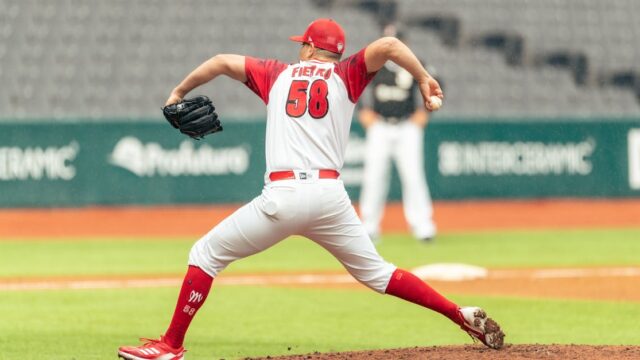
Every play in PFP starts with the same thing: a balanced, athletic landing after the pitch. If your pitcher falls off the mound to the first-base side, hops, or finishes with his glove tucked under his armpit, he is not a fielder. He is a target. I am ruthless about this. We do not field a single PFP rep until the pitcher can land in a fielding position with his glove out front, his weight centered between his feet, and his eyes up. I tell my guys: finish like you are about to catch a line drive to your face, because sometimes you are.
Greg Maddux famously said his entire career was built on landing in a position to field his position. He won 18 Gold Gloves. That is not a coincidence. If you want to learn more about the mechanics that lead to a balanced finish, our breakdown of how to pitch from the windup and how to pitch from the stretch covers the landing mechanics in detail.
Tip 1: Master the Comebacker Before Anything Else
The comebacker is the most common ball a pitcher fields, and it is also the most dangerous. A line drive struck at 95 mph from a 54-foot release point gives the pitcher about 0.40 seconds to react. That is roughly the same reaction window a major-league hitter has on a 95-mph fastball. If your glove is not already in front of you when the ball leaves the bat, you are not catching it. You are wearing it.
I teach the comebacker in three stages. First, the catch: glove out front, fingers up if it is high, fingers down if it is low, eyes following the ball into the leather. Second, the recovery: clear the ball, find your target, set your feet. Third, the throw: never rush a comebacker throw unless the runner is two steps from the bag. Most comebacker errors happen because the pitcher panics and throws before he is set.
Drill: The Trampoline Comebacker
Set a small rebounder net or pitching trampoline 40 feet in front of the pitcher. Throw a ball into the net at varying angles so it kicks back at the pitcher in unpredictable ways. He has to field it cleanly and make an accurate throw to first or second. I run this for ten minutes a week. It builds reaction time better than any other drill I have ever used because the carom is genuinely random.
Tip 2: Covering First Base Is a Footwork Drill, Not a Race
This is the single most botched play at the youth and high school level. A ball is hit to the right side, the first baseman ranges to field it, and the pitcher sprints in a straight line at the bag, gets there in a dead sprint, and either runs past it, collides with the runner, or catches the ball with his foot already off the base. I have seen this misplayed in state championship games. It is fixable in a single practice.
The correct path is a curve. The pitcher breaks toward a spot about 15 feet up the first-base line, then turns and runs parallel to the line toward the bag. This gives him a clean angle to catch the ball without crossing the runner’s path and lets him touch the inside corner of the bag with his right foot while continuing into foul territory. The mantra I use is: banana, not bullet. Run a banana-shaped route, not a bullet line.
Drill: 3-1 Cover First
Hit a fungo to the first baseman from home plate. The pitcher breaks off the mound, runs his banana route, and receives the underhand or short-toss feed at the bag. I run this in sets of ten with both right-handers and left-handers. The first baseman should aim chest-high and lead the pitcher slightly so the catch is moving toward the bag, not behind it.
Tip 3: Bunt Defense Is the Pitcher’s Game
Most bunts that succeed at any level succeed because the pitcher hesitated or threw to the wrong base. The hardest part of bunt defense is not the pickup. It is the read. Right-handed pitchers, especially, need to drill the footwork of fielding a ball down the third-base line, because their natural rotation pulls them away from the throw to first.
Here is the rule I teach: on a bunt with a runner on first, get the lead runner only if you are sure. The cost of throwing into left field at second base is two bases. The cost of a safe sacrifice bunt is one base. Always take the sure out. I drill this until my pitchers stop trying to be heroes. For a deeper look at the offensive side of this play, our guide to how to bunt in baseball is useful for understanding what the hitter is trying to do.
Drill: Bunt to All Three Bases
Have a coach bunt balls from the right side and the left side to varying parts of the infield. The pitcher has to field, plant his back foot, and throw to a designated base called out by the catcher just before the ball is bunted. This forces the pitcher to listen, decide, and execute under pressure. Run ten reps with a call to first, five with a call to second, five with a call to third.
Tip 4: Backing Up Bases Is Free Defense
Backing up bases is the easiest part of PFP to teach and the part most often skipped because it feels boring. Do not skip it. Every overthrown ball that bounces off a fence with a pitcher standing there saves at least one base. I have seen pitchers save runs by being 30 feet behind the third baseman on a relay throw from right field.
The rule is simple: if you are not involved in the play, you are backing up a base. Stand 25 to 30 feet behind the base, in foul territory, on the throwing angle. Read the throw as it comes in. Be ready to charge a ball off the fence and get it back to the infield. For more on team-wide responsibilities, our breakdown of how to back up bases in baseball covers every position.
Tip 5: Pop-Ups in the Circle Belong to the Catcher
Pop-ups around the mound and in the immediate infield are the catcher’s play 95 percent of the time. The pitcher’s job is to get out of the way and point. I cannot tell you how many times I have seen a pitcher try to make a pop-up catch and lose the ball in the sun while the catcher had a clean look the whole time. Pitchers should point at the ball, name the fielder loudly, and clear the area.
The exception is a soft floater between the mound and the foul line that nobody else can reach. In that case, the pitcher calls for it loudly and catches it with two hands. We rehearse this exact scenario every week.
Tip 6: Hold Runners with Your Eyes, Not Your Move
Holding runners is a PFP skill because it changes the geometry of every play. A pitcher who looks runners back to the bag with a slow, deliberate head turn from the stretch will see a six-tenths-of-a-second slower jump on stolen base attempts and a meaningfully shorter primary lead on every pitch. That extra time turns close plays at second into outs.
I teach a 1-2 count: one Mississippi looking at the runner, two Mississippi looking at the plate. Vary your hold times so the runner cannot time you. Mix in a slide step on every third pitch in a game-like setting. For the mechanics of the pickoff itself, see our guide to how to throw a pickoff move to first base.
Tip 7: The Glove-Side Flip on a Ball Up the Middle
One of my favorite PFP plays is the underhand glove-side flip. A ball is bunted or chopped softly to the pitcher’s glove side, and instead of pulling the ball out of the glove and throwing it conventionally, the pitcher flips it underhand directly out of the glove to the first baseman. It saves about half a second on a play where half a second is the entire margin.
The trick is committing. You either flip with full extension or you do not flip at all. A half-hearted flip ends up in the dugout. Drill this every week with soft tosses from a coach so the pitcher gets used to the feel of the ball leaving his glove.
The Weekly PFP Block I Use
Here is the fifteen-minute block I run every Tuesday and Thursday during the season. Adjust to taste, but do not skip the warm-up reps. Cold throwing arms are how shoulders get hurt.
| Time | Drill | Reps | Focus |
|---|---|---|---|
| 0-2 min | Easy comebackers, soft toss | 10 | Glove out front, athletic finish |
| 2-5 min | 3-1 cover first | 10 R / 5 L | Banana route, inside corner |
| 5-8 min | Bunts to all bases | 20 | Read, plant, accurate throw |
| 8-11 min | Trampoline comebackers | 15 | Reaction time, recovery |
| 11-13 min | Backing up bases | 10 | Positioning, angle to throw |
| 13-15 min | Hold runners + slide step | 10 | Vary hold times, pickoff look |
Common PFP Mistakes I See at Every Level
I have run PFP at every level from 10U travel ball to Division I, and the same mistakes show up no matter who is on the mound. Here are the seven I see most often.
- Standing flat-footed after the pitch. A pitcher who is not in an athletic position cannot field a comebacker. Fix the landing first.
- Sprinting straight at first base. The banana route is non-negotiable. Straight-line pitchers either miss the bag or collide with the runner.
- Pulling the ball out of the glove on every play. The glove-side flip is faster on soft choppers. Drill it.
- Throwing without setting feet. Pitchers who throw off-balance airmail the throw. Always plant the back foot unless the runner is already at the bag.
- Not communicating on pop-ups. Point, name, get out of the way. Silent pitchers cause collisions.
- Ignoring the lead runner. Looking the runner back with the eyes is half the battle. Make it a habit.
- Backing up the wrong angle. Stand on the throwing line, 25 to 30 feet deep. Standing right at the fence does nothing.
What Coaches at the Highest Levels Say
I have collected quotes on PFP from coaches I respect over the years. A few that have shaped how I teach the skill:
“The first thing I look at on a pitcher is what he does after his pitch. If he can’t field his position, he’s not going to pitch deep in games for me. He’ll get pulled in the fifth every time.”
— A longtime SEC pitching coach I worked under
“PFP is the difference between a team that wins one-run games and a team that loses them. Period.”
— Former MLB bench coach speaking at an ABCA clinic
“You can’t fake PFP. You either rehearsed the play or you didn’t. The game shows up and tells the truth.”
— Veteran high school coach I share scouting reports with
How to Measure PFP Improvement
Most coaches do not track PFP because the skill feels qualitative. It is not. Here is how I quantify it across a season so I know which guys to trust in tight spots.
| Metric | How to Measure | Good (HS) | Good (College) |
|---|---|---|---|
| Comebackers Fielded Clean | Plays cleanly fielded / total chances | 85%+ | 92%+ |
| 3-1 Cover First Success | Outs recorded / opportunities | 90%+ | 95%+ |
| Bunt Plays Lead Runner | Lead runner retired / attempts | 40%+ | 55%+ |
| Bunt Plays Any Out | Any out recorded / attempts | 85%+ | 92%+ |
| Stolen Base % Against | SB / (SB + CS), with catcher | Below 70% | Below 60% |
| Pop Time Slide Step | Release to plate, slide step | 1.3 sec | 1.2 sec |
| Backup Errors Saved | Estimated bases prevented per game | 1 / game | 1.5 / game |
I keep a simple spreadsheet for each pitcher with these numbers, updated after every game from video review. Over a thirty-game season the trends become very clear. Pitchers who are bad at PFP usually have weak comebacker numbers and weak 3-1 cover-first numbers. Both are fixable in three weeks of focused drills.
PFP by Age Group and Level
One size does not fit all. Here is how I scale PFP by age and level. The same plays show up in the game at every level, but the complexity and intensity change.
10U and 12U
At this level, focus on three things and three things only: athletic landing after the pitch, comebackers caught cleanly, and covering first base on balls hit to the right side. Do not introduce bunt defense or pickoff moves yet. They will pick up bad habits if you rush. Run a five-minute PFP block twice a week. That is all you need.
13U-14U
Add bunt defense and basic backup responsibilities. Introduce the slide step from the stretch. Continue to emphasize comebackers because the ball is coming back faster every year as hitters get stronger. Run a ten-minute PFP block twice a week.
High School
Full PFP block. Add pickoff moves, vary hold times, drill the glove-side flip, and start tracking the metrics in the table above. Run a fifteen-minute block twice a week and a thirty-minute deep dive once a week during the preseason.
College and Beyond
Daily PFP in the preseason, three times a week in season. Add video review. Track every chance from every game and grade it as A, B, or C with notes. The best programs in the country do this. The mediocre ones do not.
The PFP Mental Game
Here is something nobody talks about: PFP is largely a mental skill once the mechanics are in place. The pitcher has to know what he is going to do before the ball is hit. He has to be aware of the outs, the runners, the count, the hitter’s bunt threat, and the wind. If he is thinking about all of that after the ball is in play, he is already too late.
I teach my pitchers a pre-pitch checklist they run through between every pitch: outs, runners, what I do on a comebacker, what I do on a bunt, what I do on a ball to the right side. Five seconds, every pitch. It sounds like a lot. After two weeks it becomes automatic.
Equipment That Helps PFP Training
You do not need much to run a great PFP block, but a few pieces of equipment make the work better and safer.
- A rebounder net. For random-carom comebackers. The Rukket or SKLZ versions are both fine.
- A flat mound or portable mound. So pitchers actually land off a mound when they field. PFP off flat ground develops the wrong muscle memory.
- A protective L-screen. For comebacker drills where a coach hits live off a tee 40 feet away.
- A pitcher’s heart guard or chest protector for youth. Comebackers under 14U are no joke. Use the gear.
- A stopwatch. For measuring slide-step times and pop times.
For more on building a practice setup that supports this kind of work, our baseball practice plan walks through how to structure a full team workout that includes PFP.
Sample Game-Day PFP Warm-Up
On game day I run a six-minute PFP warm-up after the pitcher has finished his bullpen and before he heads to the dugout. It primes his hands, his feet, and his head.
- Five soft comebackers, glove out front
- Five 3-1 cover first reps with a coach hitting fungoes
- Three bunt plays with a call to a base
- Two pop-up communication drills with the catcher
- Two slide steps from the stretch with the catcher applying a tag at second
That is it. Six minutes. The pitcher walks to the dugout already in the right mindset for fielding his position, not just throwing strikes.
PFP for Left-Handed Pitchers
Left-handers have a few quirks that right-handers do not. The 3-1 cover first is slightly easier because the lefty is naturally facing first after his delivery, but the bunt down the third-base line is much harder because his momentum carries him away from the throw. Drill that play extra with lefties. I run a 5-to-2 ratio with my left-handers: five reps fielding bunts toward third for every two reps fielding bunts toward first.
The other lefty advantage is the pickoff move to first. With proper rehearsal, a lefty’s move is a weapon that ties down even the fastest runners. We cover this in detail in our pickoff move guide.
What Modern Analytics Say About PFP Value
The analytics community has caught up to what coaches have always known: pitcher defense matters. Defensive Runs Saved tracks pitcher fielding in a metric called rPM (range and positioning at the mound), and the gap between the best and worst pitcher fielders in baseball is worth roughly four to six runs per 200 innings. That is half a win on the standings page from defense alone.
At the amateur level, the gap is even bigger because the variance in skill is so much wider. A truly bad fielding pitcher in high school can cost his team eight to ten runs a season just on his own chances, before you even count the secondary effects of slow base coverage and missed backups. That is two to three wins. Nobody is talking about it because it is not flashy, but it is real.
Building PFP Into Spring Training
March is the month I run my most intense PFP work. The arms are still building up, the bullpens are short, and there is time in the practice plan that you simply do not have once games start. Here is the three-week ramp I use every preseason.
- Week 1: Daily 20-minute PFP block. Focus on fundamentals — landing, glove position, banana route to first. No live competition yet.
- Week 2: 20-minute block four days a week. Add live bunts with hitters in the box, varied counts, runners on base.
- Week 3: 15-minute block three days a week. Add scrimmage situations. Track every chance and grade it.
By Opening Day, my pitchers have logged roughly 150 PFP chances in three weeks. They are not surprised by anything in the first month of the season because they have already seen it in practice.
FAQ
How often should pitchers practice PFP?
Twice a week minimum during the season, daily during spring training. At the youth level you can get away with once a week, but the skill atrophies quickly without rehearsal. I have never seen a team that overpracticed PFP. I have seen many that underpracticed it.
Is PFP safe to run with cold arms?
No. Always warm up the arm fully before any drill that involves throwing. I make my pitchers complete a full arm care routine and at least 50 long-toss throws before they take a single PFP rep. Cold throws under stress are how shoulders and elbows get hurt.
What is the most important PFP play to drill?
The 3-1 cover first. It comes up roughly twice a game on average, it has a clear right and wrong way to execute, and the gap in success rate between teams that drill it and teams that do not is enormous. If you only have ten minutes to spend on PFP this week, spend it there.
How do I get my pitchers to take PFP seriously?
Track the metrics and post them in the dugout. Pitchers are competitive. The moment they see that their teammate has a 95% comebacker rate and theirs is 78%, they will work on it. Make it visible.
Should a pitcher field a ball if it goes between him and the second baseman?
Generally no, unless he can field it without falling toward second base. The second baseman has a better throwing angle and is moving toward first. Let the middle infielder make the play unless the ball is clearly yours.
How does PFP differ for relievers and starters?
Relievers need to be sharper because they enter cold games with runners on base, often in high-leverage moments. I make my relievers run a quick three-minute PFP refresh in the bullpen between sessions. Starters get more reps in normal practice because they have more time built in.
What about the squeeze play — what should the pitcher do?
On a suspected squeeze, throw the pitch high and tight to the batter’s hands to force a missed bunt or pop-up. If the bunt is laid down anyway, field it and throw home if you have a play, or take the sure out at first. Our squeeze play guide covers both sides of this play.
Can I run PFP without a full team?
Yes. A pitcher, a catcher, and a coach with a fungo can run an effective 15-minute PFP block. You do not need a complete defense for most drills. The trampoline comebacker drill needs just the pitcher and a coach.
Final Thoughts From the Mound
If you take one thing from this guide, take this: pitcher fielding practice is the most underpriced training in baseball. It costs you nothing in arm wear, requires almost no equipment, and pays off in wins you would not otherwise have. The teams that win one-run games in late April and May are not necessarily the teams with the best arms. They are the teams whose pitchers are also fielders.
Build a fifteen-minute PFP block into your weekly practice plan. Run it the same way every week. Track the metrics. Post them where the players can see. Three weeks in, you will have a different team. I have watched it happen at every level I have coached, and there is no reason it will not happen for you. The ball is going to come back through the box. The bunt is going to roll up the line. The runner is going to go on the 1-1 pitch. Your pitcher will know what to do because you rehearsed it. That is the whole job.