How to Frame Pitches: Catcher Framing Technique, Drills, and Tips for Every Level
Last updated: March 13, 2026
I spent twelve years behind the plate, and I can tell you this without hesitation: pitch framing is the single most valuable skill a catcher can develop. It separates roster fillers from lineup staples, travel ball backups from varsity starters, and good catchers from elite ones. Every borderline pitch you steal for your pitcher changes the at-bat, and those stolen strikes compound into wins over the course of a season.
The numbers back this up. Statcast data shows that the best pitch framers in Major League Baseball add 15 to 20 runs of value per season through framing alone. That translates to roughly two extra wins per year just from how a catcher receives the baseball. At the youth and high school level, where umpires work from behind the catcher and rely heavily on presentation, the impact is even more dramatic.
In this guide, I am going to break down everything you need to know about pitch framing: what it actually is, how the mechanics work, the equipment you need to practice, step-by-step drills you can do today, common mistakes I see at every level, and advanced tips that will take your receiving from average to outstanding. Whether you are a youth player just learning the position or a college catcher trying to refine your craft, this guide has something for you.
What Is Pitch Framing and Why Does It Matter?
Pitch framing is the art of receiving a pitch in a way that makes it appear to be in the strike zone, even if it catches the edge or lands just off the plate. It is not about yanking pitches back into the zone or making dramatic movements with your glove. Good framing is subtle. It is about quiet hands, proper positioning, and giving the umpire the best possible look at where the pitch actually landed.
Think about it from the umpire’s perspective. He is positioned directly behind you, looking over your shoulder. If you catch a borderline pitch smoothly with minimal glove movement, his brain registers that the ball was caught in a strike-zone location. If you stab at the same pitch or let your glove drift six inches after contact, his brain registers movement away from the zone, and he calls it a ball.
MLB Statcast tracks a metric called Catcher Framing Runs, which measures how many runs above or below average a catcher saves through framing. In recent seasons, the gap between the best and worst framers has been staggering. The top framers save their pitching staff 20 or more runs per season, while the worst framers cost their staff 15 or more runs. That is a 35-run swing, which equals roughly three and a half wins in the standings, just from how one player catches the baseball.
At the amateur level, framing matters even more. Professional umpires use a combination of the electronic strike zone data and their own judgment, but high school and travel ball umpires rely almost entirely on visual cues. A catcher who frames well at these levels can turn a pitcher with average command into someone who appears to paint corners all game long. I have seen catchers single-handedly change a team’s pitching staff ERA by half a run just through improved receiving.
Equipment You Need for Pitch Framing Practice
You do not need a lot of gear to work on your framing, but having the right equipment makes your practice sessions more effective and realistic. Here is what I recommend:
Catcher’s mitt: Use the same mitt you use in games. Framing is about feel, and you need to develop that feel with your game glove. A quality catcher’s mitt with a good pocket and broken-in leather will make receiving easier. Stay away from stiff, brand-new gloves for framing work because you want the ball to stick quietly in the pocket.
Full catcher’s gear: When you practice framing, wear your full catcher’s gear set including your chest protector and leg guards. You need to get comfortable framing while wearing all your equipment because it affects how you set up and move.
Baseballs: You will need a bucket of baseballs for most drills. Regulation baseballs are best for realistic practice, but tennis balls or soft training balls work for the early-stage hand drills.
Pitching partner or machine: Most framing drills require someone throwing to you or a pitching machine that can place balls on the edges of the zone. A partner is better because they can simulate different pitch types and locations.
Strike zone target or string zone: A visual strike zone reference helps you understand exactly where each pitch lands relative to the zone. You can buy a strike zone target or simply set up a string zone using PVC pipe and string.
Video camera or phone: Recording your receiving sessions is one of the best ways to improve. Set up a camera behind the pitcher so you can see your framing from the umpire’s approximate angle. A swing analyzer app or slow-motion video capability on your phone works great for this.
The Fundamentals of Catcher Framing Mechanics
Before you start doing drills, you need to understand the mechanical foundation of good framing. There are five core principles that every great framing catcher follows, and I am going to walk through each one.
1. Relaxed Setup and Stance
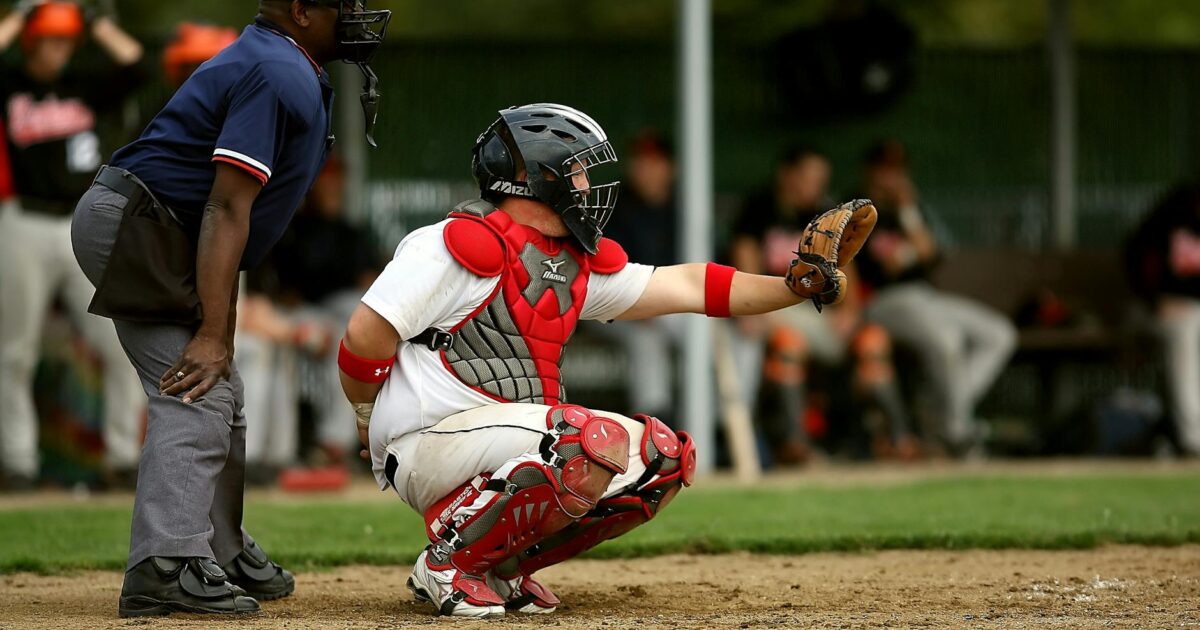
Your framing starts before the pitch is even thrown. You need to be in a receiving stance that is relaxed, balanced, and gives the umpire a clear sightline. Your feet should be slightly wider than shoulder-width, with your weight balanced on the balls of your feet. Your glove-side knee should be slightly lower than your throwing-side knee, which naturally opens your body to the pitcher and gives the umpire a better view.
The biggest key here is relaxation. If you are tense in your setup, your hands will be stiff, and stiff hands do not frame well. Think about receiving with soft hands the same way an outfielder thinks about soft hands when catching fly balls. Let the ball come to you rather than reaching out aggressively.
2. Quiet Glove Presentation
Your glove should start in a neutral position, roughly in the center of your body at the bottom of the strike zone. From this position, you make small adjustments to meet the pitch. The key word here is small. Your glove should travel the minimum distance necessary to catch the ball. Any excess movement before, during, or after the catch is wasted motion that makes the pitch look worse to the umpire.
Think of your glove as a target that absorbs the pitch rather than attacks it. You want the ball to hit the glove and stick. No bouncing, no recoiling, no dramatic snatching. Just a clean, quiet catch where the ball enters the pocket and the glove barely moves.
3. Stick the Pitch at the Catch Point
The moment of the catch is the most important fraction of a second in pitch framing. When the ball hits your glove, you need to hold it at the exact location where you caught it. This is called sticking the pitch. Do not pull it back toward you. Do not let it drift. Catch it and freeze for a beat before bringing it back.
The stick gives the umpire a clear snapshot of where the pitch was caught. If you watch elite MLB catchers like Jose Trevino, Adley Rutschman, or Cal Raleigh, you will notice they all have that brief pause after the catch where the glove is perfectly still. That pause is not accidental. It is a deliberate technique that says to the umpire: look where this pitch is, it is right here on the corner.
4. Thumb-Down Receiving on Low Pitches
Low pitches are where framing matters most because the bottom of the strike zone is the most commonly missed call location. On pitches at or below the knees, you want to rotate your glove so that your thumb is pointing down and your fingers are pointing up. This position allows you to catch the pitch and hold it at the bottom of the zone rather than letting your glove drift below the zone on the catch.
The thumb-down technique keeps the glove face visible to the umpire and prevents the wrist-dip that makes low strikes look like balls. It takes practice to get comfortable catching with a thumb-down orientation, but it is the foundation of elite low-zone framing.
5. Mirror the Pitch Back to Center
On borderline pitches to either side of the plate, the framing technique involves a subtle inward turn of the glove that mirrors the ball back toward the center of the zone. On a pitch on the outside corner, for example, you catch it and let your glove angle slightly inward, making the catch point appear closer to the center of the plate. On inside pitches, you do the reverse.
This is not about moving the glove dramatically. It is about the angle of the glove face at the moment of the catch. A slight turn of the wrist, maybe half an inch of movement, is all it takes. Anything more than that and the umpire will see you pulling the pitch, which actually works against you.
Step-by-Step Pitch Framing Drills
Now that you understand the mechanics, here are the drills I use with every catcher I work with. These progress from basic to advanced, so start at the beginning even if you are an experienced player. Building the right habits from the foundation up is what separates catchers who truly frame well from those who just think they do.
Drill 1: Wall Ball Receiving (No Partner Needed)
Time: 10 minutes
What you need: Tennis ball, wall, catcher’s mitt
Stand about six feet from a wall in your receiving stance. Toss the tennis ball against the wall at different heights and locations, then catch it with your mitt using proper framing technique. Focus on catching the ball and sticking it at the catch point for a full second before resetting.
The wall gives you unpredictable angles and speeds, which forces you to react and frame in real time. Do three sets of 20 catches, focusing on low-zone pitches in the first set, outside-corner pitches in the second, and inside-corner pitches in the third.
Drill 2: Partner Toss Framing
Time: 15 minutes
What you need: Baseballs, partner, catcher’s gear
Get in full gear and set up behind a plate or a line on the ground that represents the plate. Have your partner stand 30 feet away and toss baseballs to specific locations around the strike zone. Your partner should alternate between pitches on the corners, pitches at the knees, and pitches just off the plate.
On every pitch, focus on three things: get to the catch position with minimal glove movement, stick the catch for one second, and mirror the glove angle toward center. Have your partner call out whether each pitch looked like a strike from his angle. Do 40 to 50 pitches per session.
Drill 3: Bullpen Framing Sessions
Time: 20 minutes
What you need: Pitcher, baseballs, full catcher’s gear, plate
This is where framing practice gets real. Catch a pitcher’s full bullpen session with an emphasis on receiving rather than calling pitches. Ask the pitcher to work the edges of the zone and throw a mix of pitch types. Your job is to frame every single pitch as if an umpire is standing behind you.
Even better, have a coach or another player stand behind you and call balls and strikes. This gives you immediate feedback on whether your framing is working. If your framing is good, the person behind you should be calling more strikes than they normally would. If they are not, you have work to do on your mechanics. This drill also builds the pitcher-catcher relationship because your pitcher starts to trust that you will make their borderline pitches look good, which is crucial for playing catcher at a high level.
Drill 4: Rapid-Fire Zone Drill
Time: 10 minutes
What you need: Two partners, baseballs, catcher’s gear
This drill builds quick-twitch framing ability. Have two partners stand about 25 feet away on either side of you, each with a bucket of balls. They alternate tossing balls to you in rapid succession, one from the left and one from the right, targeting different locations each time. You have to receive and frame each pitch, reset, and immediately frame the next one.
The goal is to maintain clean framing technique even under fatigue and time pressure. Start with a pace of one pitch every three seconds and work up to one pitch every two seconds as your technique improves. Do three rounds of 30 pitches each.
Drill 5: Video Review Session
Time: 15 minutes
What you need: Phone or camera, previously recorded catching footage
Record yourself catching a bullpen or doing the partner toss drill, then review the footage in slow motion. Watch for the specific mechanical checkpoints: Is your glove starting in a neutral position? Are you keeping your glove movement minimal? Are you sticking the pitch? Is your thumb rotating down on low pitches? Is your glove angle mirroring pitches back toward center?
Compare your receiving to footage of elite MLB catchers. YouTube has endless catching highlights that show how the best framers in the world receive the ball. Watch how still their bodies are, how quiet their gloves are, and how long they hold the pitch at the catch point. Then go back and do another practice session with those images fresh in your mind.
Common Pitch Framing Mistakes
I have coached hundreds of catchers at every level from Little League to college. These are the mistakes I see most often, along with what to do instead. Recognizing these mistakes in your own catching is the first step toward eliminating them.
| Mistake | What It Looks Like | Why It Hurts You | The Fix |
|---|---|---|---|
| Stabbing at the pitch | Glove lunges forward to meet the ball | Creates movement toward the pitcher, making the pitch look farther from the zone | Let the ball travel to your glove; receive with soft, relaxed hands |
| Pulling pitches across your body | Glove drags the ball six or more inches after the catch | Umpire sees the movement and knows you are trying to steal a call | Stick the pitch at the catch point; mirror with glove angle, not glove position |
| Dropping the glove on low pitches | Glove dips below the zone after catching a knee-high pitch | Makes a strike look like it was caught below the zone | Use thumb-down technique and hold the glove at the catch point |
| Setting up too far off the plate | Body is positioned wide, forcing long reaches back toward the zone | Every pitch requires more movement to frame, and the umpire sees your body is off-center | Set up with your body centered on the plate and shift minimally for location |
| Stiff wrists and hands | Rigid glove that bounces or recoils on contact | Ball does not stick in the glove, creating a jarring visual for the umpire | Consciously relax your hand inside the glove before every pitch |
| Moving before the pitch arrives | Shifting or reaching to the pitch location early | Pre-movement signals to the umpire that the pitch is not going where expected | Stay centered and react to the pitch after it is halfway to the plate |
| Rising up on low pitches | Body pops up as the pitch arrives low in the zone | Creates upward body movement that blocks the umpire’s view | Stay low and let your glove do the work without changing your body height |
| Framing balls way off the plate | Attempting to frame pitches that are six or more inches off the zone | Umpire loses trust in your receiving because you are trying to frame everything | Only frame borderline pitches within two to three inches of the zone |
How Pitch Framing Works at Different Levels
Framing technique needs to be adapted based on the level of play. The strike zone, umpire positioning, pitch velocity, and competitive expectations all change as you move up, and your framing approach needs to evolve with them.
Youth baseball (ages 8 to 12): At this level, the focus should be on basic receiving fundamentals rather than advanced framing. Teach young catchers to catch the ball cleanly, keep their body behind the ball, and present pitches without dramatic movement. Umpires at the youth level call a slightly larger zone and are more influenced by clean catches, so simply catching the ball well is already a form of framing.
Travel ball and middle school (ages 12 to 14): This is where framing technique should start to develop more deliberately. Catchers at this age can begin learning thumb-down receiving, quiet hands, and the concept of sticking pitches. Pitch velocity is increasing, which means receiving becomes more challenging and framing becomes more impactful.
High school (ages 14 to 18): High school is where framing becomes a true competitive advantage. Umpires at this level are better trained but still rely heavily on presentation. A catcher who frames well at the high school level can steal three to five strikes per game on borderline pitches, which translates to a significant advantage for the pitching staff. College recruiters and scouts actively evaluate framing ability at this level.
College and professional: At the college and pro levels, framing is expected. Catchers who cannot frame effectively do not play. The emphasis at these levels is on framing with pitch-type awareness, meaning you adjust your receiving technique based on whether you are catching a fastball, breaking ball, or off-speed pitch. The velocity is higher, the movement is sharper, and the margin for error is smaller.
Advanced Pitch Framing Tips
Once you have the fundamentals locked in, these advanced concepts will take your framing to the next level. These are the things that separate good framers from elite ones, and they require dedicated practice to master.
Frame With Your Whole Body, Not Just Your Glove
Elite framers use subtle body positioning to sell pitches. On a pitch to the outside corner, for instance, they shift their center of gravity slightly toward the pitch so that the catch looks effortless and centered rather than like a reach. This does not mean sliding across the plate. It means a subtle lean, maybe an inch or two, that makes the catch look natural. The umpire’s eye follows the catcher’s body, so when your body says “this pitch is in the zone,” the umpire’s brain tends to agree.
Adjust Your Framing for Different Pitch Types
A fastball arrives on a relatively flat plane, which means you frame it differently than a curveball that is dropping into the zone or a slider that is sweeping across it. On breaking balls, the key is to let the ball finish its movement before making your framing presentation. Catch the pitch at the end of its break, stick it, and present from there. If you try to frame a curveball before it finishes breaking, you will end up chasing the ball and creating excess movement. Understanding how each pitch type moves will improve your receiving of every pitch your pitcher throws.
Build Trust With Your Umpire
The best framers in baseball understand that umpires are human beings with tendencies and egos. Do not try to frame every pitch, especially pitches that are clearly balls. When you try to frame a pitch that is four inches off the plate, the umpire notices, and it erodes his trust in your receiving. If he thinks you are trying to trick him on every pitch, he will become less likely to give you the close calls.
Instead, be honest with your receiving on obvious balls and save your framing effort for the pitches that are truly on the border. This builds credibility with the umpire, and when a genuine borderline pitch comes along, he is more likely to give you the call because he trusts that you are presenting it honestly.
Use Pre-Pitch Setup to Influence the Call
Where you set up your target before the pitch is thrown affects how the umpire perceives the pitch when it arrives. If you set up on the outside corner and the pitch arrives on the outside corner, the umpire sees a pitch that hit its target, which reinforces the impression that it was a strike. If you set up in the middle of the plate and the pitch ends up on the corner, the umpire sees a miss, and misses do not get called strikes as often.
Set your target close to where you actually want the pitch to go. This serves the dual purpose of giving your pitcher an accurate target and priming the umpire to expect the pitch in that location.
Pitch Framing Practice Schedule
Consistency is what builds framing skill. Here is a weekly practice schedule I recommend for catchers who are serious about improving their receiving. This schedule assumes you have access to a partner and baseballs at least three days per week.
| Day | Drill | Duration | Focus |
|---|---|---|---|
| Monday | Wall Ball Receiving | 10 minutes | Soft hands, stick the catch, glove angle |
| Tuesday | Partner Toss Framing | 15 minutes | Low-zone framing, thumb-down technique |
| Wednesday | Bullpen Framing Session | 20 minutes | Live pitching, all pitch types, umpire feedback |
| Thursday | Rapid-Fire Zone Drill | 10 minutes | Quick-twitch reactions, framing under fatigue |
| Friday | Partner Toss Framing | 15 minutes | Outside and inside corner emphasis |
| Saturday | Bullpen Framing with Video | 25 minutes | Full session with video for review |
| Sunday | Video Review and Rest | 15 minutes | Analyze Saturday footage, compare to MLB catchers |
This schedule adds up to about two hours of framing-specific work per week. That might sound like a lot, but framing is a motor skill that requires repetition to build the muscle memory needed for it to become automatic. After four to six weeks on this schedule, you will notice a significant difference in how you receive the baseball.
How to Measure Your Framing Improvement
Unlike hitting or throwing, framing is hard to measure with a simple stat at the amateur level. But there are several ways to track your progress and make sure your practice is actually translating into results.
Called strike percentage: Track the number of called strikes your pitcher gets per game and compare it over time. If your framing is improving, you should see a gradual increase in called strikes, particularly on pitches at the edges of the zone.
Video comparison: Record yourself framing early in your training and again after four weeks. Compare the two videos side by side. Look for reductions in glove movement, improved glove angle, and cleaner catches.
Umpire feedback: Some umpires will tell you when your receiving looks good. If an umpire says something like “nice catch” or “that was clean,” take note. More importantly, if your pitcher is consistently getting borderline calls, your framing is working.
Pitcher confidence: This is the intangible measure. When your pitcher starts throwing more confidently to the edges of the zone because he trusts that you will make the pitch look good, that is a direct result of your framing. A pitcher who trusts his catcher’s receiving will throw harder and with more conviction, which benefits the entire team.
The Mental Side of Pitch Framing
Framing is not purely physical. There is a significant mental component that determines whether your technique holds up under pressure. Here are the mental keys to being a great framing catcher.
Stay present on every pitch: It is easy to let your mind wander or get ahead to the next pitch. But framing requires full concentration on the moment of the catch. Develop a pre-pitch routine where you reset your focus before every single pitch. A deep breath, a glove tap, or a mental cue like “soft hands” can keep you locked in. This ties into the broader mental game skills that every catcher needs to develop.
Do not react to the umpire’s call: If an umpire calls a borderline pitch a ball, do not show frustration or look back at him. That behavior makes umpires less likely to give you the next close call. Accept the call, reset, and frame the next pitch even better. Composure is what earns you calls over the course of a game.
Trust your technique: In game situations, particularly high-pressure moments, there is a temptation to over-frame or try too hard to sell a pitch. Trust the fundamentals you have practiced. Your technique works when you let it work. Over-trying leads to pulling pitches, stabbing, and all the other mistakes that hurt your framing.
Study the umpire’s tendencies: Every umpire has a slightly different strike zone. Some are wider, some are tighter, some call the high strike, and some do not. In the first inning or two, pay attention to what the umpire is calling and adjust your framing focus accordingly. If he is not calling the low strike, focus your framing effort on the corners instead.
How the Pros Frame: Catchers to Study
Watching elite catchers frame pitches is one of the best learning tools available. Here are five MLB catchers whose framing technique I recommend studying closely.
Jose Trevino (New York Yankees): Trevino is arguably the best pure framer in baseball. His hands are impossibly quiet, and his glove barely moves on the catch. Study how he handles low pitches and how his body stays completely still while his glove does all the work.
Adley Rutschman (Baltimore Orioles): Rutschman combines elite framing with outstanding athleticism. Watch how he adjusts his body position to frame different pitch types and how smoothly he transitions from receiving to throwing. You can also see how his receiving supports his pitchers by reading about how catchers like Cal Raleigh impact pitching staffs.
Patrick Bailey (San Francisco Giants): Bailey’s thumb-down technique on low pitches is textbook. He catches pitches at the bottom of the zone and holds them there as if they are frozen in place. His receiving alone makes the Giants’ pitching staff measurably better.
Austin Wells (New York Yankees): Wells developed quickly into one of the game’s better framers. Watch his glove presentation and how he creates a clean look for the umpire on every pitch regardless of location.
William Contreras (Milwaukee Brewers): Contreras is a great example of a catcher who improved his framing significantly through dedicated practice. His early career framing numbers were below average, but he worked on his technique and became one of the better receivers in the National League.
Frequently Asked Questions About Pitch Framing
Is pitch framing the same as pitch stealing?
No, and this is an important distinction. Pitch framing is about presenting borderline pitches in the best possible light through proper receiving technique. Pitch stealing is an older term for dramatically pulling pitches back into the zone, which modern umpires can easily identify and which actually works against you. Good framing is subtle and relies on mechanics, not deception.
At what age should catchers start learning to frame?
I recommend introducing basic framing concepts around age 10 to 11, once a catcher has solid basic receiving skills. The emphasis at that age should be on soft hands and clean catches rather than advanced framing mechanics. By age 12 to 13, catchers can start working on thumb-down technique, sticking pitches, and the more nuanced aspects of framing.
Does the catcher’s mitt affect framing ability?
Absolutely. A well-broken-in catcher’s mitt with a good pocket makes framing significantly easier. Larger mitts give you more surface area to catch with but can be harder to control for precise framing. Most elite framers use a mitt with a moderate pocket depth that allows the ball to stick without bouncing. The leather quality matters too because softer leather absorbs the ball more quietly.
Can pitch framing help with the automated strike zone?
Even as baseball moves toward electronic strike zones at some levels, framing still matters. In the challenge system being tested in the minor leagues, umpires still make the initial call and catchers can influence those calls through framing. Additionally, framing discipline builds receiving skills that help you catch pitches more cleanly regardless of who or what is calling balls and strikes. The fundamentals of quiet hands, proper positioning, and clean receiving will always be valuable.
How long does it take to see improvement in framing?
With consistent practice following the schedule outlined in this guide, most catchers see noticeable improvement within three to four weeks. The initial gains come from eliminating bad habits like stabbing and pulling. Further refinement happens over months of practice, and truly elite framing takes years to develop. The key is consistent repetition and regular video review.
Should I frame pitches during warm-up and between-inning throws?
Yes. Every catch you make during a game is an opportunity to reinforce your framing technique and build trust with the umpire. Frame your pitcher’s warm-up pitches between innings just as you would during the at-bat. This keeps your hands sharp and also signals to the umpire that you are a catcher who takes receiving seriously.
What is the biggest framing mistake at the high school level?
The number one mistake I see from high school catchers is trying to frame pitches that are too far off the plate. When you attempt to frame a pitch that is four or five inches outside the zone, the umpire sees the attempt and it damages your credibility. Focus your framing effort on pitches within two to three inches of the zone’s edge. Let obvious balls be balls, and put your energy into winning the borderline calls.
Putting It All Together
Pitch framing is a skill that can transform your value as a catcher and your team’s overall performance. The technique is not complicated, but it requires dedicated practice and attention to detail. Start with the fundamentals: relaxed stance, quiet glove, stick the pitch, thumb-down on low pitches, and mirror borderline pitches back toward center. Build from there with the drills in this guide, track your progress, and study the best framers in the game.
The catchers who commit to improving their framing always see results. More called strikes for their pitchers, more trust from umpires, more confidence from the pitching staff, and more playing time. I have watched catchers go from backup to starter, from JV to varsity, and from overlooked to recruited, all because they developed elite receiving skills.
Your hands, your glove, and your focus are all you need. Start with the wall ball drill today, and commit to the weekly practice schedule. Four weeks from now, you will be framing pitches like you have been doing it your entire life, and your pitchers will thank you for every stolen strike.