How to Play Shortstop in Baseball: Positioning, Fielding, and Double Plays
Last updated: March 05, 2026
Shortstop is the most demanding defensive position on the baseball diamond. It requires elite range, a strong and accurate throwing arm, lightning-fast reflexes, and the baseball IQ to quarterback an entire infield. Over my years coaching and playing, I have seen countless talented athletes struggle at shortstop simply because they did not understand the nuances that separate a good shortstop from a great one. In this guide, I am going to break down every aspect of playing shortstop at a high level, from your pre-pitch stance to turning double plays, with real drills you can take to the field today.
Whether you are a youth player just learning the position, a high school athlete trying to earn a starting spot, or a college player looking to refine your game, this article covers the fundamentals and advanced techniques you need. I have pulled from professional coaching wisdom, Statcast data, and decades of combined experience to give you the most complete shortstop guide available.
Why Shortstop Is the Most Important Defensive Position
There is a reason shortstop has been called the “captain of the infield.” More balls are hit to the left side of the infield than any other area, and the shortstop covers more ground than any other position player. According to MLB Statcast data, shortstops field an average of 4.2 batted balls per game, more than any other infield position. They are responsible for covering second base on steal attempts from the left side, backing up throws, and serving as the relay man on outfield throws.
Hall of Fame shortstop Ozzie Smith once said, “Playing shortstop is about anticipation. You have to know what is going to happen before the ball is hit.” That mental component is what makes shortstop unique. You are not just reacting to the ball. You are reading the hitter, the pitch, the count, the game situation, and positioning yourself accordingly before every single pitch.
The modern game has only raised the bar. Today’s shortstops are expected to hit for power, run the bases aggressively, and still provide Gold Glove-caliber defense. Players like Bobby Witt Jr. and Gunnar Henderson have redefined what the position looks like, combining 30-plus home run power with plus defensive metrics. But none of that happens without mastering the defensive fundamentals first.
The Proper Shortstop Stance and Pre-Pitch Setup
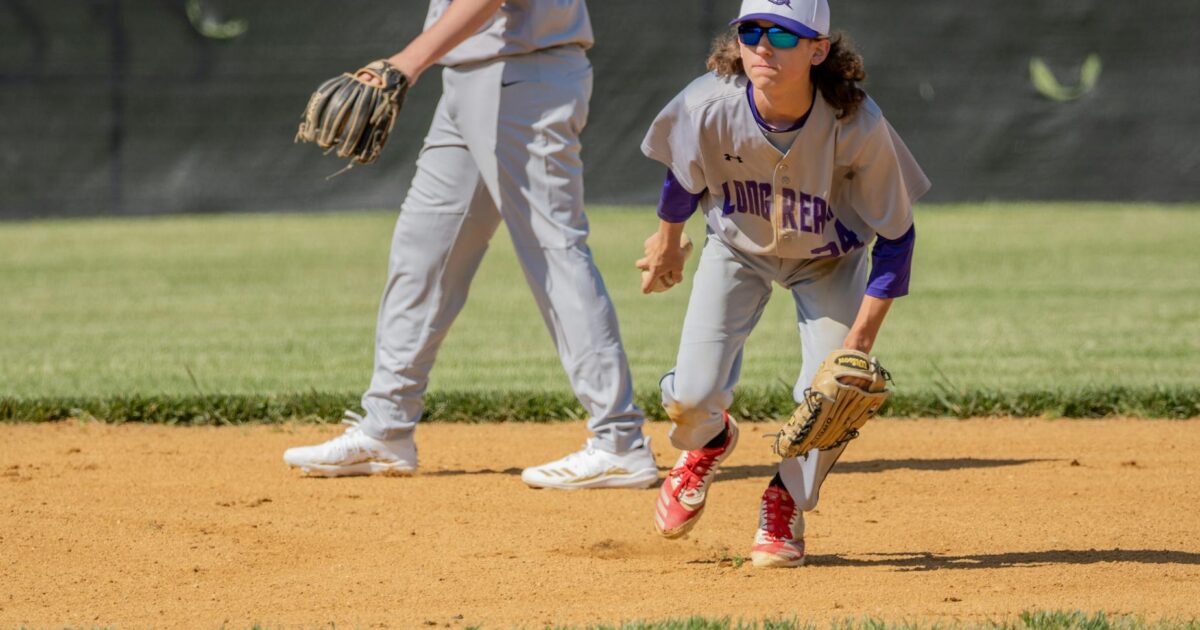
Everything at shortstop starts with your ready position. A poor setup costs you a half step on every ball, and at this position, a half step is the difference between a highlight play and a ball rolling into left field.
Feet: Shoulder-width apart or slightly wider. Your weight should be on the balls of your feet, not your heels. Some coaches teach a slight stagger with the right foot slightly back, which can help you explode toward the hole at third.
Knees: Bent and athletic. You want to be low enough that your glove can reach the ground quickly, but not so low that you cannot move laterally. Think of the position as a “loaded spring” rather than a deep squat.
Hands: Your glove should be out in front of you, fingers pointed toward the ground, at approximately knee height. Your throwing hand should be relaxed near your glove. Avoid having your hands on your knees between pitches, a common bad habit that slows your reaction time.
Eyes: Locked on the hitting zone. As the pitcher begins the delivery, take a small “creep step” or “timing hop” forward. This engages your muscles and gets your momentum moving forward so you can react in any direction. Former Gold Glove shortstop Brandon Crawford described this as “getting your feet alive before the ball is hit.”
Shortstop Positioning and Depth by Situation
One of the biggest mistakes young shortstops make is playing the same depth on every pitch. Your positioning should change based on the hitter, the count, the pitch type, and the game situation. Here is a positioning guide that covers the most common scenarios.
| Situation | Depth | Lateral Position | Key Reason |
|---|---|---|---|
| Standard (no runners) | Normal depth (even with baseline) | Midway between 2B and 3B | Maximize range both directions |
| Double play depth | 2-3 steps closer to 2B, 1 step in | Shade toward second base | Reduce feed distance to 2B |
| Pull hitter at plate | Normal to deep | Shift 2-4 steps toward 3B hole | Cover where ball is most likely hit |
| Opposite-field hitter | Normal | Shade 1-2 steps toward 2B | Protect the middle of the diamond |
| Bunt situation | 2-3 steps in from normal | Standard lateral | Cover 3B if 3B charges bunt |
| Runner on 2B, no outs | Normal to slightly in | Closer to 2B bag | Hold runner and cut off run at plate |
| Late innings, close game | Deep (2-3 steps back) | Depends on hitter tendency | Trade range for extra reaction time |
In the MLB, Statcast shift data showed that teams using optimized positioning at shortstop improved their Outs Above Average (OAA) by an average of 3 to 5 outs per season. Even at the amateur level, understanding where to stand before the pitch can turn you from a reactive fielder into a proactive one.
Fielding Ground Balls at Shortstop: Technique Breakdown
If you have read our guide on how to field ground balls, you already know the basics. But shortstop requires some position-specific adjustments because of the longer throw to first base and the wider variety of angles you will encounter.
The approach: Always try to field the ball moving toward the target. This means attacking the ball on a slight angle, coming from your right to left whenever possible. This “rounding the ball” technique puts your momentum toward first base and sets your feet for the throw. Former MLB shortstop Troy Tulowitzki was a master of this, saying, “I never wanted to field a ball flat-footed. Every ground ball is an opportunity to create momentum toward first.”
Glove position: Work from the ground up. Start your glove on the dirt and come up with the hop. A ground ball that gets under your glove is almost always an error. A short hop that hits the heel of your glove is still playable. The margin for error at shortstop is razor thin because you do not have time to recover from a bobble and still make the long throw to first.
Fielding the backhand: The backhand play in the hole between shortstop and third is one of the most spectacular plays in baseball. To execute it consistently, plant your right foot hard, reach across your body with the glove, and field the ball just inside your left foot. From there, you have three options: plant and throw, throw off your back foot, or make a jump throw. Each requires practice and depends on how deep you are and how fast the runner is.
Fielding up the middle: Balls hit to your left, toward second base, require quick lateral movement and a strong pivot. After fielding, plant your left foot, rotate your hips toward first, and fire. On balls deep in the hole toward the bag, you may need to make a sidearm or three-quarter throw to get enough on it.
Making the Throw from Shortstop: Arm Angles and Footwork
The throw from shortstop to first base is approximately 120 to 130 feet, the longest regular throw any infielder has to make. That distance demands both arm strength and efficiency. If you are looking to improve your throwing mechanics overall, check out our baseball throwing drills guide.
At shortstop, you need to be comfortable throwing from multiple arm angles. Here is when to use each one:
Over the top: Your standard throw when you have time. This gives you the most accuracy and carry on the ball. Use this on routine ground balls where you can set your feet.
Three-quarter arm slot: The most common game throw at shortstop. This angle allows you to release the ball quickly while still generating good velocity. Most professional shortstops throw three-quarter on 60 to 70 percent of their plays.
Sidearm: Reserved for double play feeds to second and plays deep in the hole where you need to get rid of the ball in a hurry. Sidearm throws sacrifice some accuracy for speed of release. Practice this angle regularly, as it will save you on bang-bang plays.
The jump throw: One of the most exciting plays in baseball. When fielding a ball deep in the hole, plant your right foot, jump and turn in the air, and release the ball at the peak of your jump. This throw requires significant arm strength and body control. Javier Báez and Francisco Lindor popularized this play at the MLB level, but it requires thousands of reps before you should attempt it in a game.
Regardless of your arm angle, the key to accurate throws from shortstop is your footwork. Your feet should always be moving toward the target. A common mistake I see is young players planting their feet and throwing with just their arm. That leads to the ball sailing or tailing away from the first baseman. Drive off your back leg and follow your throw toward first.
Turning the Double Play at Shortstop
The double play is the pitcher’s best friend, and as a shortstop, you are involved in the majority of them. There are two main scenarios: you are the fielder feeding the ball to second, or you are receiving the ball at second and turning the relay to first.
Feeding the double play (6-4-3): When you field the ball, you need to get it to the second baseman quickly with a firm, chest-high throw. Use an underhand flip if you are close to the bag (within 15 feet), a backhand flip if the ball takes you toward second, or a standard throw if you are further away. The key is making the feed easy for your partner to handle. A bad feed kills the double play faster than anything else.
Receiving and turning (6-3 or 4-6-3): When you receive the ball at second base, there are several footwork patterns you can use. The most common for shortstops is the “inside turn.” As you catch the ball, your left foot hits the bag, and you pivot to your left to throw to first. This keeps you on the infield side of the base and away from the sliding runner.
According to MLB data, the average time from ball caught at second to ball arriving at first on a double play is approximately 1.3 to 1.5 seconds. Elite middle infielders like Marcus Semien and Jeremy Peña consistently get it there in under 1.2 seconds. That quickness comes from efficient footwork, not rushing the throw.
Safety note: Always be aware of the incoming runner. Sliding runners can take out your legs if you are not careful. After releasing the throw, hop or jump to avoid contact. Major League Baseball has rules protecting the fielder on double play turns, but at the amateur level, protecting yourself is your own responsibility.
Communication and Leadership at Shortstop
Shortstop is a leadership position. You are responsible for communicating with the entire infield and the outfielders behind you. Here is what you should be calling out before and during every play:
Before the pitch: Remind your teammates of the number of outs, where the play is going on a ground ball, and who has the bag on a steal attempt. Use hand signals with the second baseman to indicate who covers second on a steal. Typically, the shortstop covers on a right-handed batter and the second baseman covers on a left-handed batter, but this varies by team and situation.
Pop flies: As a shortstop, you have priority over almost everyone on pop flies in the infield. Call the ball loudly and early. The general rule is that the shortstop takes anything they can get to, even if the third baseman or second baseman is also in the area. The only player who can call you off is the center fielder or the pitcher on a ball directly over the mound.
Relay and cutoff situations: On balls hit to the outfield with runners on base, the shortstop is typically the cutoff man on throws from left field and center field. Line yourself up between the outfielder and the target base, and listen for the catcher or third baseman to tell you where to throw. Being in the right position on relay throws can save your team a full base, which often means the difference between a run scoring and an out.
Shortstop Drills That Build Game-Ready Skills
Knowing what to do is only half the equation. You need reps to build the muscle memory. Here are the drills I recommend for shortstops at every level. You can incorporate many of these into your regular baseball practice plan.
Drill 1: Short-hop machine gun. Have a partner stand about 20 feet away and throw rapid-fire short hops, alternating slightly left, right, and directly at you. Field each one cleanly and toss it back. Do three sets of 20. This builds soft hands and quick reactions.
Drill 2: Backhand-only ground balls. Position yourself in the hole between short and third. A coach or partner hits ground balls exclusively to your backhand. Focus on getting your right foot planted, reaching across, and making a strong throw to first. Start with 10 reps at medium speed and work up to full-speed ground balls.
Drill 3: Cone range drill. Set up cones at five positions: directly at you, two steps to your left, two steps to your right, four steps to your left (the hole), and four steps to your right (up the middle). A coach calls a number and hits a ground ball to that cone. You react, field, and throw to first. This trains your first-step reaction and range in all directions.
Drill 4: Double play feeds. Work with your second baseman to practice every type of feed: underhand, backhand, standard throw, and the quick flip. Alternate who fields and who turns. Aim for 30 to 40 double play turns per practice session.
Drill 5: Bare-hand charge play. Slow rollers toward the shortstop require you to charge, field with your bare hand, and make an off-balance throw. Start with rolled balls and progress to softly hit ground balls. This drill improves your body control and arm accuracy on the run.
Drill 6: Throwing from multiple angles. Set up at normal shortstop depth and have someone hit or throw ground balls to random spots. Focus on choosing the correct arm angle for each play. Over the top when you have time, three-quarter on routine plays, sidearm on the run. Film yourself and review to check if you are using the right angle for each situation.
Shortstop Stats and Benchmarks by Level
How do you know if you are performing well at shortstop? Here are some benchmarks for fielding performance at different levels of play.
| Level | Fielding Percentage | Pop Time to 1B (routine) | Arm Velocity (mph) | 60-yard Dash |
|---|---|---|---|---|
| Youth (10-12) | .900-.930 | 4.5-5.0 sec | 55-65 mph | 8.5-9.5 sec |
| Middle School (13-14) | .920-.950 | 4.2-4.6 sec | 65-72 mph | 7.8-8.5 sec |
| High School JV | .930-.955 | 4.0-4.4 sec | 72-78 mph | 7.3-7.9 sec |
| High School Varsity | .945-.970 | 3.8-4.2 sec | 78-85 mph | 6.9-7.4 sec |
| College D1 | .960-.975 | 3.6-4.0 sec | 83-90 mph | 6.6-7.0 sec |
| MLB | .970-.985 | 3.3-3.8 sec | 85-95 mph | 6.3-6.8 sec |
These are ranges, not hard cutoffs. A shortstop with a .940 fielding percentage in high school but elite range and a plus arm may be more valuable than a player with .970 fielding percentage but limited range. As the game has evolved, scouts and coaches increasingly value range and arm strength metrics like Outs Above Average over traditional fielding percentage. If you want to read more about baseball statistics, we have a full breakdown for you.
Common Mistakes Shortstops Make and How to Fix Them
In my years of coaching, I have seen the same mistakes come up over and over again at shortstop. Here are the most common ones and the fixes for each.
Mistake 1: Playing too upright. When you stand tall in your ready position, you lose a critical fraction of a second getting down to the ball. Fix: Film yourself during practice. Your back should be at a 45-degree angle with your knees bent and your glove near the ground.
Mistake 2: Waiting for the ball instead of attacking it. Passive fielding leads to bad hops and slow plays. Fix: Think “attack” on every ground ball. Move through the ball as you field it. Your momentum should be going forward, not stopping as the ball arrives.
Mistake 3: Rushing the throw after a backhand. Young players often try to throw before they have control of the ball, resulting in wild throws. Fix: Squeeze the ball first, then set your feet (or your back foot at minimum), and throw. An extra half second to set up is better than a ball in the dugout.
Mistake 4: Not communicating. Silence on the field causes collisions, missed coverages, and confusion. Fix: Make it a habit to talk before every pitch. Call out the play, call out the number of outs, call the ball loudly. Your coaches will notice, and your teammates will trust you.
Mistake 5: One-dimensional positioning. Playing the same spot regardless of the batter or situation is a common youth baseball habit. Fix: Study hitters during the game. Watch where the ball goes on foul balls and previous at-bats. Adjust 2 to 3 steps in any direction based on what you see. Even small adjustments make a big difference over the course of a game.
Mistake 6: Poor double play feeds. Shoveling the ball too hard, too soft, or off-target to the second baseman ruins double plays. Fix: Practice your feeds daily with your double play partner. The throw should arrive at chest height, firm but catchable, and lead the fielder slightly toward first base.
Physical Training for Shortstops: What to Work On
Shortstop demands a unique blend of explosiveness, lateral agility, and arm strength. Your training should reflect those demands. Here is what to prioritize.
Lateral quickness: Ladder drills, lateral band walks, and defensive slide exercises build the side-to-side speed you need to cover ground. Research from the American Sports Medicine Institute found that elite shortstops generate 15 to 20 percent more ground reaction force laterally compared to other infielders, which translates directly to range.
Lower body explosiveness: Box jumps, split squats, and single-leg hops improve your first-step quickness. The first two steps on a ground ball are the most important. If your first step is quick and in the right direction, the rest takes care of itself.
Arm strength: Long toss programs, band work, and proper arm care routines keep your arm healthy and your throws strong. Shortstops throw more often and from more awkward positions than most other fielders, so arm maintenance is critical. A consistent long toss program, starting at 60 feet and working out to 180 to 200 feet, builds the arm strength necessary for the deep throw from the hole.
Core strength: Rotational medicine ball throws, planks, and anti-rotation exercises strengthen your core, which is where your throwing power originates. Every throw from shortstop involves a hip rotation and core transfer. A weak core means weak throws, no matter how strong your arm is.
Hand and wrist strength: Grip strengtheners, wrist curls, and rice bucket exercises improve your ability to handle tough hops and maintain control of the ball through the transfer. Soft hands are a product of both technique and physical hand strength.
Reading the Game: How Elite Shortstops Anticipate Plays
The best shortstops in baseball history were not just physical specimens. They were students of the game who could predict where the ball was going before the pitch was thrown. Here is how to develop that baseball instinct.
Study the pitcher-hitter matchup. If your pitcher is throwing a fastball inside to a right-handed hitter, the most likely result is a pull ground ball to the left side. Shade toward the hole. If the pitch is a changeup or breaking ball away, the hitter is more likely to go the other way or hit it up the middle. These tendencies are not guesses. They are based on thousands of at-bats of data.
Watch the hitter’s stance and load. An open stance usually means the hitter is looking to pull the ball. A closed stance might indicate an opposite-field approach. Watch how the hitter loads during the swing. If they are committed to pulling, the inside half of the field becomes the danger zone.
Track the count. Hitters are more aggressive on fastballs in hitter’s counts (2-0, 3-1). They are more defensive in pitcher’s counts (0-2, 1-2) and more likely to go the other way on off-speed pitches. Use the count to adjust your positioning by a step or two. This is the same skill that helps with pitch recognition from the batter’s perspective, but applied defensively.
Know the scouting report. In organized baseball, you will have access to spray charts and hitter tendencies. Study them before the game. Know which hitters pull everything, which ones use the whole field, and which ones are likely to bunt. This preparation is what separates varsity starters from JV players at the high school level.
Shortstop Equipment: What You Need
The right equipment helps you perform your best. Here is what matters most at shortstop.
Glove: Shortstops typically use an 11.25 to 11.75 inch glove with an I-web or H-web pattern. The smaller size allows for quick transfers, and the open web gives you visibility on pop flies. Look for a glove with a shallow pocket for fast exchanges. Check out our best baseball gloves guide for detailed recommendations.
Cleats: Low-cut cleats are the standard for shortstops because they allow maximum ankle mobility for lateral movements. Metal cleats provide the best traction on dirt, while molded cleats are required at many youth levels. Our best cleats for infielders breakdown covers the top options.
Protective gear: A cup is mandatory. Many shortstops also wear a batting-style protective guard on their lead shin, especially when turning double plays. The risk of getting hit by a thrown ball or a sliding runner is real, and protection lets you stay aggressive.
How to Improve as a Shortstop: A Weekly Practice Schedule
Consistent improvement requires structured practice. Here is a sample weekly schedule designed specifically for shortstops who are serious about getting better.
Monday: Ground ball work (30 minutes). Focus on routine ground balls, backhands, and slow rollers. Take 50 to 75 ground balls total. Follow with 10 minutes of double play feed practice.
Tuesday: Throwing and long toss (20 minutes). Work your long toss program from 60 feet out to your max distance. Focus on arm action and follow-through. Add 10 minutes of throwing from multiple arm angles.
Wednesday: Agility and speed work (25 minutes). Ladder drills, cone drills, and lateral shuffle exercises. Finish with five to eight full-speed sprints of 30 yards.
Thursday: Game-situation fielding (30 minutes). Have a coach call out situations (runner on first, no outs) and then hit ground balls. React to the situation, make the right play, and execute the throw. This builds your baseball IQ under pressure.
Friday: Strength training (30 to 40 minutes). Focus on lower body explosiveness, core rotation, and grip strength. Include box jumps, split squats, medicine ball throws, and band work for the arm.
Weekend: Games or scrimmages. Apply everything you have practiced during the week. After the game, make a mental note of plays you need to work on the following week.
Frequently Asked Questions About Playing Shortstop
What age should a player start learning shortstop?
Players can start learning shortstop fundamentals as young as 8 or 9 years old, but the position truly becomes specialized around age 12 to 13 when field dimensions increase to 80 or 90 foot basepaths. Before that, focus on developing general fielding skills, throwing mechanics, and athleticism. If you are preparing a young player, our baseball tryout tips article has great advice for showcasing defensive skills.
How important is arm strength for a shortstop?
Very important, but not as important as accuracy and quick release. A shortstop with an 80 mph arm who is accurate on 95 percent of throws is more valuable than a shortstop with a 90 mph arm who sails two or three throws a game. That said, you need enough arm strength to make the throw from deep in the hole, which for most high school fields is about 130 feet. Work on throwing mechanics before trying to add raw velocity.
Should shortstops use a two-handed catch?
On routine ground balls, yes. Using two hands helps secure the ball and speeds up the transfer to your throwing hand. However, on plays to your backhand, up the middle on the run, or on difficult hops, you will often field one-handed. The key is knowing when each technique is appropriate.
What is the difference between shortstop and second base defensively?
Shortstop requires a stronger arm because the throw to first is longer. Shortstops also typically have more range to their right (toward the hole) while second basemen cover more range to their left. On double plays, the footwork patterns are mirror images of each other. Both positions require excellent hands and quick feet, but shortstop generally demands more overall athleticism.
Can a catcher switch to shortstop?
It is uncommon but not impossible, especially at the youth level where the most athletic player often plays both positions. Catchers have the arm strength for shortstop, but may lack the lateral quickness and footwork. If you are making this switch, focus heavily on lateral agility drills and getting comfortable with the angles of throws from the left side of the infield.
What MLB shortstops should I study?
Watch film of Bobby Witt Jr. for explosiveness and range, Corey Seager for smooth mechanics and consistency, Francisco Lindor for double play turns and leadership, and Wander Franco for natural instincts. On the historical side, Derek Jeter’s clock management and Ozzie Smith’s acrobatics are worth studying even today. Pay attention to their pre-pitch routines, their first step on ground balls, and their throwing mechanics from various angles.
How do I deal with errors at shortstop?
Every shortstop makes errors. Even the best in the MLB commit 8 to 15 errors per season. The key is having a short memory. Flush the error, focus on the next pitch, and make the next play. If you carry an error with you, it often leads to another one. After the game, review what went wrong and work on it in practice, but during the game, move on immediately.
Final Thoughts on Mastering Shortstop
Playing shortstop at a high level is one of the most rewarding experiences in baseball. It demands everything you have, physically and mentally, on every single pitch. The best shortstops are not just talented athletes. They are tireless workers who dedicate hours to fielding practice, arm care, and studying the game.
Start with the fundamentals. Get your stance right, learn to attack ground balls, and develop consistent throwing mechanics. Then layer in the advanced skills: reading hitters, turning double plays efficiently, and mastering throws from every angle. Use the drills in this article consistently, film yourself whenever possible, and study the best in the game.
Remember, the greatest shortstops did not become elite overnight. They put in thousands of hours of deliberate practice, made thousands of errors, and kept getting better. If you have the desire and the work ethic, you can master this position. Now grab your glove and get to work.