Baseball Infield Drills: Ground Balls, Footwork, Double Plays, and Game-Speed Reps for Every Level
Last updated: March 17, 2026
I have spent more than twenty years hitting ground balls to infielders at every level from eight-year-old rec league to college showcase events. During that time I have watched thousands of players field their position, and I can tell you this with absolute confidence: the guys who stand out are not always the most athletic. They are the ones who have drilled the fundamentals so many times that every hop, every short throw, every bare-hand play looks effortless. That kind of smoothness only comes from deliberate, repetitive practice with the right baseball infield drills.
This guide gives you a complete library of infield drills organized by skill — ground balls, footwork, throws, double plays, reactions, and game-speed reads. I have included age-appropriate modifications, rep counts, coaching cues, common errors, and the data that explains why each drill matters. Bookmark this page and bring it to your next practice.
Why Dedicated Infield Drills Matter More Than Raw Talent
Major League Baseball defensive metrics tell a compelling story. According to Statcast data from the 2025 season, the top-ten infielders by Outs Above Average (OAA) converted batted balls into outs at a rate 15 percent higher than the league average. That gap has less to do with arm strength or foot speed and more to do with pre-pitch positioning, first-step quickness, and clean exchange mechanics — all of which are trainable through specific drills.
At the youth level the numbers are even more revealing. A 2024 Positive Coaching Alliance study found that teams that devoted at least 25 percent of practice time to defensive drills reduced their fielding error rate by 34 percent over a single season. Errors are the number-one run producer in youth baseball, so cutting them by a third is the equivalent of adding two or three wins to your record without changing a single thing on offense.
Whether you are a middle infielder looking to tighten your double-play feed, a third baseman trying to improve your reaction time on hard-hit balls, or a first baseman working on scoops in the dirt, the drills below will target the exact skills you need. I have personally tested every one of them with players ranging from age nine to college freshmen, and I stand behind their effectiveness.
Essential Equipment for Infield Drill Work
Before we get into the drills, let me list the gear you will want to have on hand. You do not need all of it for every session, but having these items available makes your practice time significantly more productive.
| Equipment | Purpose | Recommended For |
|---|---|---|
| Fungo bat | Hit controlled ground balls at game-like speed | Coaches, parents running drills |
| Flat-ground cones or agility dots | Mark fielding positions, footwork patterns | All ages |
| Rebounder net | Solo reaction and short-hop work | Individual training sessions |
| Bucket of practice balls (2–3 dozen) | High-rep volume without chasing | All ages |
| Infield glove (11.25–11.75 in) | Proper pocket size for quick transfers | Middle infielders, third basemen |
| First-base mitt (12–12.5 in) | Scoop and stretch drills | First basemen |
| Stopwatch or phone timer | Timed reps to build urgency | All ages 10+ |
If you need help choosing the right glove, check out our best infield baseball gloves review, where we tested models from Wilson, Rawlings, Mizuno, and 44 Pro. For fungo recommendations, our best fungo bats breakdown covers everything from traditional wood to composite options.
Ground Ball Fielding Drills
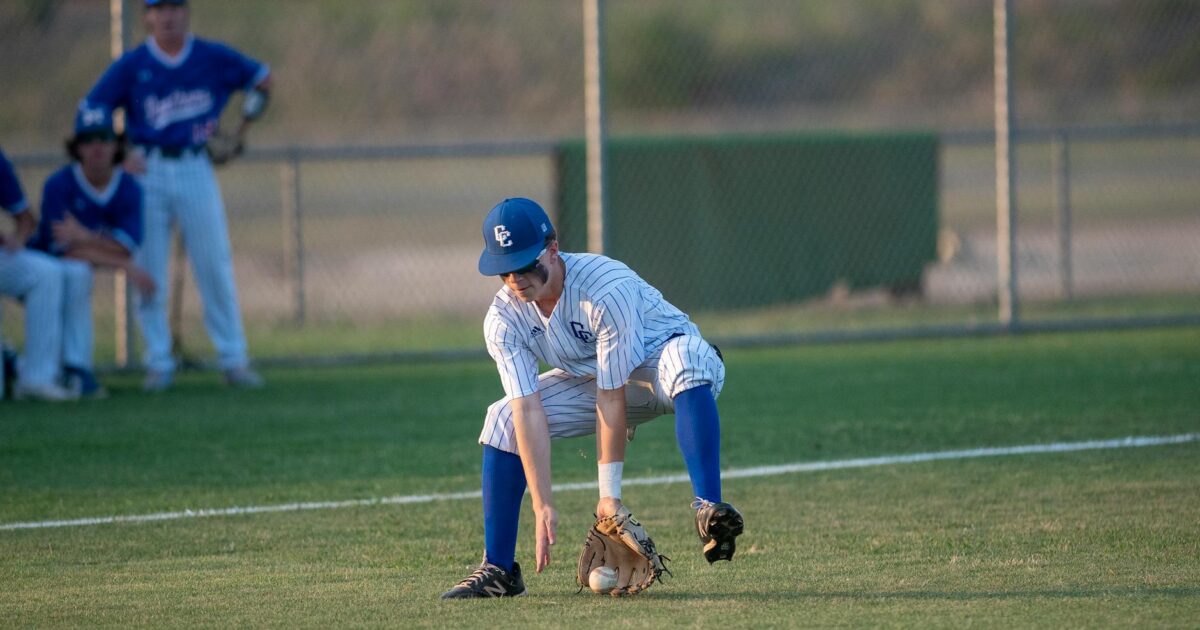
Ground balls are the bread and butter of infield defense. According to Baseball Savant, roughly 43 percent of all balls put in play during the 2025 MLB season were ground balls. At the youth level that number climbs above 55 percent because young hitters produce more top-spin and less loft. If you can field a ground ball cleanly, you can play infield.
1. The Triangle Drill
What it trains: Proper fielding posture, glove-out-front positioning, and funneling the ball to the center of the body.
Setup: Place three cones in a triangle about six feet apart. The fielder starts behind the back cone. A coach or partner rolls a ground ball to the front-center cone.
Execution: The fielder moves forward, fields the ball at the front cone with their glove out in front (the “fielding triangle” — feet wider than shoulders, glove between the knees, butt down), then shuffles to one of the side cones to simulate a throwing angle. Alternate sides every rep.
Reps: 3 sets of 10 (5 to each side). Rest 30 seconds between sets.
Age modification: For players under 10, shrink the triangle to four feet and roll the ball softer. For high school and above, increase distance to eight feet and hit fungos instead of rolling.
2. Short-Hop Gauntlet
What it trains: Reading hops, soft hands, and staying through the ball on difficult in-between bounces.
Setup: A coach stands 30 feet away with a bucket of balls. The fielder sets up in their ready position.
Execution: The coach fires one-hoppers, short-hops, and in-between hops in rapid succession. The fielder must field each ball cleanly and drop it into a bucket beside them before resetting. The key coaching cue is “let the ball travel to you” — fight the urge to stab at the ball and instead absorb it with soft hands.
Reps: 3 rounds of 15 balls. Track clean fielding percentage and try to beat your score each round.
Common error: Players often pull their glove up too early, creating a “gate” that lets the ball scoot underneath. Remind them to keep the glove on the ground and work up, never the other way around. As the old coaching saying goes, “It’s easier to come up than go down.”
For more detail on fielding mechanics, read our complete how to field ground balls guide.
3. Backhand-Only Rounds
What it trains: Backhand fielding technique, crossover step, and momentum-based throws.
Setup: The fielder positions at shortstop depth. A coach hits fungos exclusively to the backhand side (the fielder’s glove side toward the hole).
Execution: The fielder takes a crossover step, fields the ball on the backhand, plants the back foot, and throws across the diamond to first base. Focus on keeping the glove angled properly — thumb down, fingers pointed toward the ground — so the pocket stays open to the ball.
Reps: 2 sets of 8. This drill is taxing on the legs and arm, so keep volume moderate and quality high.
Footwork and Agility Drills for Infielders
Footwork separates average infielders from great ones. A study by the American Sports Medicine Institute found that elite-level infielders complete their field-to-throw transition in an average of 0.8 seconds, while amateur players average 1.3 seconds. That half-second difference is almost entirely footwork — the arm speed is comparable, but the feet create the throwing angle faster.
4. Ladder Quick-Feet to Field
What it trains: Fast-twitch foot activation before the ball is hit, simulating pre-pitch movement.
Setup: Place an agility ladder five feet behind the fielding position. Position a coach with a fungo 90 feet away.
Execution: The fielder runs through the ladder using a two-foot-in pattern, then immediately breaks into their ready stance as the coach hits a ground ball. The ladder forces quick, light feet, which translates directly to the choppy pre-pitch steps you see elite infielders use before every pitch.
Reps: 2 sets of 8. Alternate ladder patterns each set (icky shuffle, lateral in-out, single-leg hops).
5. Cone Shuffle Exchange Drill
What it trains: Lateral movement, glove-to-hand transfer, and crow-hop throwing mechanics.
Setup: Place five cones three feet apart in a line. A partner stands 60 feet away at first base.
Execution: The fielder shuffles laterally across the cones. At each cone, a coach rolls a ball. The fielder fields, makes a clean transfer, and throws to the partner. The catch is speed — the goal is to complete all five field-and-throw reps in under 12 seconds for high school players, under 15 seconds for 12U.
Reps: 3 sets of 5. Rest 45 seconds between sets. Time each set and track improvement.
6. Drop Step and Sprint
What it trains: First-step explosiveness on balls hit to the left or right, eliminating the false step many young infielders develop.
Setup: The fielder starts in their ready position. A coach stands in front holding a ball in each hand.
Execution: The coach drops one ball to the left or right. The fielder must drop-step in that direction, sprint to the ball, and field it cleanly before it stops rolling. The drop step — opening the hip and pushing off the opposite foot — eliminates the wasted motion of a false step, which Statcast data shows costs infielders an average of 0.2 seconds on their first move.
Reps: 3 sets of 6 (3 to each side). Keep rest short (20 seconds) to build conditioning alongside technique.
If you want to improve your overall speed on the diamond, our baseball speed and agility drills guide has a full program you can run alongside these infield-specific drills.
Throwing Accuracy Drills for Infielders
A clean field means nothing if the throw misses the target. MLB data from the 2025 season shows that throwing errors accounted for 38 percent of all infield errors, making them slightly more common than fielding errors. At the youth level, the split is even more dramatic — throwing errors can account for half or more of all defensive mistakes. These drills sharpen your accuracy under pressure.
7. Target Towel Throws
What it trains: Consistent release point and throw accuracy to a specific target zone.
Setup: Hang a towel or small target on a fence or net at chest height (roughly where a first baseman’s glove would be). Mark a throwing line at 90 feet (shortstop distance to first) and 60 feet (second baseman distance).
Execution: The fielder fields a ground ball, sets their feet, and throws at the towel target. Score each throw: hitting the towel is 2 points, within one arm’s length is 1 point, anything else is 0. Play to 20 points.
Reps: Play 2-3 full games. Competition drives focus, and the scoring system keeps players locked in on quality rather than just getting through reps.
8. The Four-Corner Relay
What it trains: Quick transfers, accurate throws on the move, and communication between infielders.
Setup: Four players position at each infield base (first, second, shortstop, third). Place a stopwatch visible to all players.
Execution: Starting at third base, each player catches, transfers, and throws to the next station in order (3B to SS to 2B to 1B, then back). The goal is to complete a full cycle in under 6 seconds for high school, under 8 seconds for 12U. Every dropped ball or offline throw adds 2 seconds. This drill builds the rapid-fire exchange that cutoff and relay situations demand.
Reps: 5 full cycles in each direction. Post the best time and challenge the group to beat it next practice.
For a deeper look at building arm strength alongside accuracy, check out our baseball throwing drills guide.
Double Play Drills
The double play is the pitcher’s best friend. In the 2025 MLB season, teams that ranked in the top five for double plays turned averaged 148 twin killings over 162 games, compared to 119 for bottom-five teams. That 29-double-play gap represents dozens of extra outs and hundreds of fewer baserunners over a season. The double play is a choreographed skill, and like any choreography, it must be rehearsed until it becomes automatic.
9. Feed-Only Repetitions
What it trains: The underhand feed, backhand flip, and shovel toss that middle infielders use to start double plays.
Setup: A shortstop and second baseman set up at normal depth. A coach hits or rolls ground balls alternately to each player.
Execution: The fielder receives the ball and delivers a feed to the pivot man at the bag. No throw to first — isolate the feed only. Work through three feed types: the chest-high underhand toss (for balls fielded near the bag), the backhand flip (for balls up the middle), and the firm shovel pass (for balls fielded deep in the hole). The pivot man catches each feed at the bag and simply drops the ball.
Reps: 10 feeds of each type per player. Rotate between shortstop and second base.
Common error: Rushing the feed and throwing the ball into the dirt. The feed should arrive chest-high and slightly toward the throwing-arm side of the receiver. Accuracy beats speed on the feed — the pivot man needs a clean ball to make the turn.
10. Full Turn with Runner Pressure
What it trains: Complete double-play execution under realistic game pressure with a baserunner closing in.
Setup: Full infield alignment. Place a baserunner at first who runs at three-quarter speed on contact.
Execution: The coach hits a ground ball to any infield position. The fielder starts the double play, the pivot man turns it, and the throw goes to first — all while the runner is bearing down on second base. This drill trains the pivot man to get rid of the ball quickly while maintaining accuracy, and it teaches the fielder to deliver a feed that gives the pivot man time. Refer to our dedicated how to turn a double play guide for detailed pivot mechanics at each position.
Reps: 8-10 full turns. Rest the runner every 3-4 reps. Time the play from bat contact to the ball arriving at first base — elite high school teams complete the double play in 4.0 to 4.3 seconds.
Reaction and First-Step Drills
Reaction time is the foundation of infield defense. Research published in the Journal of Strength and Conditioning found that baseball infielders who trained reaction-specific drills three times per week for eight weeks improved their lateral first-step speed by 11 percent. That improvement translates to roughly one extra foot of range on balls hit to either side — enough to turn a single into an out.
11. Tennis Ball Reaction Drill
What it trains: Hand-eye coordination, reaction speed, and soft hands on unpredictable bounces.
Setup: A coach or partner stands 20 feet away with a bucket of tennis balls. The fielder sets up without a glove.
Execution: The coach throws tennis balls at the ground in front of the fielder at varying speeds and angles. Because tennis balls bounce unpredictably compared to baseballs, the fielder must read the hop and react in real time. Bare-hand fielding forces proper hand positioning — no relying on the glove’s webbing to bail you out.
Reps: 3 sets of 20 balls. Count clean catches and aim for 80 percent or higher.
12. Rapid-Fire Paddle Drill
What it trains: Quick glove-to-hand transfer and keeping the ball in front of the body.
Setup: The fielder wears a flat training paddle (or pancake glove) instead of their regular glove. A coach is positioned 25 feet away.
Execution: The coach rolls ground balls in rapid succession — one every two to three seconds. The fielder must field each ball cleanly with the paddle and make a transfer to the throwing hand. The paddle has no pocket, so the ball will bounce out unless the fielder funnels it to the body and gets the throwing hand on top immediately. This is one of the best drills for eliminating lazy transfer habits.
Reps: 2 sets of 15. If you do not have a paddle glove, you can use a flat piece of cardboard inside the glove to simulate the flat surface.
For more on training your eyes to read the ball faster, visit our baseball vision training guide.
Position-Specific Infield Drills
While the drills above work for every infielder, each position has unique demands. Here are targeted drills for each spot on the dirt.
13. Shortstop — Slow Roller Charge and Bare-Hand
Shortstops face more slow rollers and choppers than any other infielder. The key is timing the charge so you field the ball on a clean hop while maintaining enough momentum to make the long throw to first.
Execution: The coach rolls a slow ground ball. The shortstop charges at a controlled angle, fields the ball bare-handed (or with the glove), plants the right foot, and throws across the diamond in one motion. The throw should have carry — a slight arc rather than a hard line — to give the first baseman a catchable ball. Practice both glove-side and bare-hand pickups. For shortstop-specific positioning, see our how to play shortstop guide.
Reps: 2 sets of 8.
14. Second Base — Pivot and Escape
Second basemen must master multiple pivot techniques at the bag depending on where the feed comes from and how quickly the runner is arriving. This drill isolates the three main pivots.
Execution: A coach stands at shortstop depth and delivers feeds from three angles — the standard feed from the shortstop side, the deep-hole feed from third base, and the up-the-middle feed from the pitcher or first baseman. The second baseman receives each feed at the bag, executes the appropriate pivot (inside turn, over-the-top, or rocker step), and throws to first. Work all three pivots in sequence. For more detail, see our how to play second base breakdown.
Reps: 5 feeds from each angle, 15 total per set. Run 2 sets.
15. Third Base — Hot Shot Reaction Blocks
Third basemen have the least reaction time of any infielder. An average batted ball reaches the hot corner in approximately 0.4 seconds, leaving almost no time for thought. This drill trains pure reaction.
Execution: The fielder sets up at third base depth (about 90 feet from home). A coach hits sharp ground balls from 60 feet — closer than normal — to compress reaction time even further. The fielder’s only job is to knock the ball down and keep it in front of them. Do not worry about making the throw. At third base, blocking a hard-hit ball is often more important than fielding it cleanly. For full third-base positioning strategy, see our how to play third base guide.
Reps: 3 sets of 10. Wear a cup and protective gear — these balls come fast.
16. First Base — Scoop and Stretch Series
First basemen field more throws from teammates than ground balls off the bat. Scooping low throws and stretching to shave time off close plays are the two most critical skills at the position.
Execution: A coach throws from shortstop distance, deliberately putting 50 percent of the throws in the dirt, 25 percent at chest height, and 25 percent offline (requiring a stretch to the left or right). The first baseman practices the scoop with the glove angled properly — fingers down for short hops, fingers up for chest-high balls — while keeping the back foot anchored on the bag. For comprehensive first-base technique, check out our how to play first base guide.
Reps: 3 sets of 12 throws. Mix locations randomly to keep the first baseman guessing.
Game-Speed Simulation Drills
The biggest mistake I see in youth baseball practice is drilling at half speed. Game speed is where mechanics break down, and if you only practice slowly, you will never learn to perform under pressure. These drills simulate the tempo and decision-making of a real game.
17. Situational Fungos with Runners
What it trains: Pre-pitch awareness, knowing where to throw before the ball is hit, and executing under time pressure.
Setup: Full infield with baserunners. The coach calls out the situation before every ball: “Runner on first, one out” or “Runners on first and third, nobody out.” Then the coach hits a fungo.
Execution: The fielder must read the situation, field the ball, and make the correct play — double play, throw home, tag play, or whatever the situation demands. After each play, the coach briefly confirms whether the right decision was made. This drill builds the mental database that separates instinctive infielders from players who freeze when the ball is hit to them.
Reps: 15-20 situations per session. Vary the scenarios widely.
18. Rapid-Round Infield
What it trains: Conditioning, fielding under fatigue, and maintaining mechanics when tired.
Setup: Full infield, one coach hitting fungos.
Execution: The coach hits a ground ball to each position in rapid succession — third, short, second, first — then immediately starts over. Each fielder makes the throw to first and immediately resets for the next round. Run the cycle for two minutes straight without stopping. By the end, players are breathing hard, and you get to see whose mechanics hold up under fatigue and whose fall apart. That information is gold for a coach.
Reps: 3 rounds of 2 minutes. Rest 1 minute between rounds.
Age-Appropriate Drill Programming
Not every drill belongs in every practice. Below is a recommended breakdown by age group based on developmental readiness and attention span.
| Age Group | Drill Focus | Reps per Drill | Total Infield Drill Time | Key Priority |
|---|---|---|---|---|
| 8U (Coach Pitch) | Triangle Drill, Tennis Ball Reaction | 8-10 | 10-12 minutes | Fun, basic fielding posture |
| 10U (Kid Pitch) | Add Short-Hop Gauntlet, Ladder Quick-Feet | 10-12 | 15-18 minutes | Footwork basics, fielding consistency |
| 12U (Travel Ball) | Add Feed-Only Reps, Cone Shuffle Exchange | 12-15 | 18-22 minutes | Double-play feeds, lateral range |
| 14U (Middle School) | Add Full DP Turns, Position-Specific Drills | 12-15 | 20-25 minutes | Game-speed execution, throwing accuracy |
| High School (JV/Varsity) | All drills, add Situational Fungos with Runners | 15-20 | 25-35 minutes | Situational awareness, consistency under pressure |
| College / Showcase | All drills at max intensity, timed reps | 15-20 | 30-40 minutes | Speed of play, range optimization |
For a complete practice framework that integrates these drills into a full session, take a look at our baseball practice plan guide.
Common Infield Errors and How to Fix Them
I see the same mistakes repeated at almost every level. Here are the five most common infield errors and the drills that fix each one.
1. Fielding the ball too far under the body. When players let the ball get deep, they lose sight of it and have less time to react to bad hops. The Triangle Drill (Drill 1) fixes this by forcing players to field out front.
2. Rising up before the ball is in the glove. This is the “alligator arms” problem — the head pulls up, the glove follows, and the ball rolls through. The Short-Hop Gauntlet (Drill 2) with its rapid-fire pace trains players to stay down through the ball.
3. False stepping on lateral balls. A false step is when the fielder steps toward the ball with the near foot before actually pushing off and moving laterally. The Drop Step and Sprint (Drill 6) eliminates this by training the correct push-off pattern.
4. Slow transfers. Many infield errors are not fielding errors at all — they are transfer errors. The ball is fielded cleanly but bobbled during the exchange from glove to throwing hand. The Rapid-Fire Paddle Drill (Drill 12) isolates and improves this skill faster than any other drill I have used.
5. Throwing off-balance. Players who do not set their feet before throwing often sail the ball over the first baseman’s head. The Target Towel Throws (Drill 7) forces accuracy by making players aim at a precise target every single rep.
Expert Coaching Insights on Infield Development
Hall of Fame shortstop Ozzie Smith, widely considered the greatest defensive infielder in baseball history, once said: “The plays I made look easy because I practiced them until they were easy. There is no substitute for repetition.” Smith was famous for fielding 150 ground balls before every game during his career — a volume of preparation that speaks to the value of drill work.
Former MLB infield coordinator Ron Washington, who coached Gold Glove winners at shortstop, second base, and third base during his career with the Texas Rangers and Atlanta Braves, emphasizes the importance of practicing the routine play: “I don’t care about the highlight reel. Show me you can make the routine play 100 times out of 100, and I’ll show you a guy I want on my team.” Washington’s philosophy aligns with what the data tells us — at every level from Little League to the majors, errors on routine plays cost more runs than the spectacular plays that go unmade.
Cal Ripken Jr., who played 2,632 consecutive games at shortstop and third base, built his legendary consistency through structured pre-game routines: “I took the same ground balls, in the same order, at the same speed, every single day. That routine gave me the confidence to trust my hands when the game started.” Ripken’s approach is a reminder that consistency in practice creates consistency in performance.
Building a Weekly Infield Drill Schedule
You do not need to run every drill every day. Here is a sample weekly breakdown for an in-season team that practices four days per week.
Monday — Ground Ball Focus: Triangle Drill, Short-Hop Gauntlet, Backhand-Only Rounds (25 minutes total).
Tuesday — Footwork and Transfers: Ladder Quick-Feet to Field, Cone Shuffle Exchange, Rapid-Fire Paddle Drill (20 minutes total).
Wednesday — Double Plays and Throwing: Feed-Only Reps, Full Turn with Runner Pressure, Target Towel Throws (25 minutes total).
Thursday — Game Speed: Situational Fungos with Runners, Rapid-Round Infield, Position-Specific Drills (30 minutes total).
This schedule ensures every critical skill gets attention during the week without overloading any single practice. On game days, shorten the routine to 10 minutes of light ground balls and feeds to stay sharp without fatiguing the legs or arm.
Measuring Progress: Key Metrics to Track
You cannot improve what you do not measure. Here are the metrics I recommend tracking throughout the season to gauge infield improvement.
Fielding percentage in drills: Track clean fields versus errors in each drill. A high school infielder should aim for 90 percent or better on routine ground balls in practice.
Transfer time: Use a stopwatch to measure the time from when the ball hits the glove to when it leaves the throwing hand. Elite high school middle infielders average 0.7 to 0.9 seconds. College players get below 0.7.
Throwing accuracy rate: In the Target Towel Throws drill, track the percentage of throws that hit the towel. Aim for 60 percent or higher at game distance.
Double-play completion time: From bat contact to ball arriving at first. Sub-4.5 seconds at the high school level is competitive. Sub-4.0 seconds is elite.
Game errors per week: The ultimate measure. Log errors by type (fielding, throwing, decision) after every game. You will quickly see patterns that tell you which drills to emphasize.
Frequently Asked Questions About Baseball Infield Drills
How many ground balls should an infielder take per practice?
For youth players (8U-12U), 30 to 50 ground balls per practice is a good range. For high school and above, aim for 50 to 80. Quality matters more than quantity — 40 focused reps beat 100 sloppy ones every time. If you notice mechanics breaking down due to fatigue, stop the drill and move on.
Can I do infield drills by myself?
Absolutely. A rebounder net is your best friend for solo infield work. Throw the ball at the net and field the return bounce. You can work short-hops, backhands, and transfers without a partner. Tennis ball reaction drills against a wall are another excellent solo option. The Rapid-Fire Paddle Drill can also be adapted by bouncing balls off a wall at close range.
How often should I run infield drills during the season?
During the season, four days per week of infield work is ideal for most teams. Each session should last 20 to 35 minutes. On game days, limit infield work to 10 minutes of light ground balls and feeds. During the off-season, two to three focused sessions per week will maintain and improve your skills heading into the next year.
What is the most important skill for a youth infielder to develop first?
Fielding posture. If a young player cannot get into the proper ready position — feet wider than shoulders, glove out front, butt down, eyes level — nothing else will work. Start with the Triangle Drill and master that before moving on to more advanced drills. A solid fielding base makes every other skill easier to learn.
Should infielders use a batting glove under their fielding glove?
This is personal preference. Some players like the extra padding and moisture absorption. Others feel it reduces their feel for the ball. My recommendation is to try it both ways during practice and see what feels more comfortable. At the professional level, roughly half of infielders wear a liner glove and half do not.
How do I improve my range as an infielder?
Range is a combination of three things: first-step quickness, lateral movement ability, and pre-pitch positioning. The Drop Step and Sprint drill (Drill 6) and the Ladder Quick-Feet drill (Drill 4) directly improve the first two. For positioning, study where hitters tend to hit the ball based on the count and pitch type — our pitch recognition guide covers the patterns that inform smart positioning. Improving all three together is how you add meaningful range.
What drills help with the yips (fear of throwing)?
The yips are primarily a mental challenge, but drill-based confidence building helps. Start with short-distance throws (30 feet) and gradually work back to full distance over several sessions. The Target Towel Throws drill is particularly helpful because it gives you a visual focus point, which takes your mind off the mechanics and lets muscle memory take over. Our baseball mental game tips guide goes deeper into the psychological side of the throwing yips.
Final Thoughts
Infield defense is built in practice, not in games. The drills in this guide cover every skill an infielder needs — ground balls, footwork, throwing, double plays, reactions, and game-speed decision-making. The key is consistency. Run these drills regularly, track your progress, and hold yourself to a high standard on every rep. If you put in the work on the practice field, the game will feel slow. And when the game feels slow, you are playing your best baseball.
Start with the drills that match your current level, master them, and then layer in more advanced work as your skills develop. Whether you are an eight-year-old fielding your first ground ball or a high school junior chasing a college scholarship, the path to becoming a better infielder runs through the same fundamental drills. There are no shortcuts — just reps, focus, and the willingness to get dirty.