How to Play First Base in Baseball: Footwork, Scoops, and Positioning

Last updated: March 05, 2026
First base is one of the most underrated positions on a baseball diamond. Everyone wants to talk about the flashy shortstop or the cannon-armed outfielder, but I have always believed that a great first baseman can quietly win you more games than almost any other defensive player. After spending years coaching infielders and playing the position myself at the high school and college level, I can tell you this: playing first base well is a real skill, and most players never get proper instruction on the position.
In this guide, I am going to break down everything you need to know about how to play first base in baseball. Whether you are a youth player just getting moved to the bag, a high schooler trying to lock down a starting spot, or a coach looking for a comprehensive resource, this article covers footwork, scoops, positioning, communication, and the drills that actually make a difference. I have organized it step by step so you can work through each skill in order.
Why First Base Matters More Than You Think
First base is the busiest defensive position outside of catcher and pitcher. According to MLB data, first basemen are involved in roughly 20 percent of all putouts during a typical nine-inning game. That means one out of every five outs runs through the first baseman. When you consider that an average MLB game produces around 54 total outs between both teams, the first baseman handles approximately 5 to 7 putouts per game just on routine throws alone.
But the position goes far beyond just catching throws. A first baseman fields bunts, holds runners, cuts off balls in the gap, backs up throws, and serves as a communication hub for the right side of the infield. At the MLB level, first basemen who grade out as elite defenders — guys like Freddie Freeman, Matt Olson, and Paul Goldschmidt in recent years — save their teams an estimated 10 to 15 runs per season with their glove work alone, according to advanced metrics like Defensive Runs Saved.
If you want to become a complete baseball player, understanding the first base position is essential. Let me walk you through everything you need.
Equipment You Need to Play First Base
Before we get into technique, let us talk about gear. First base has some specific equipment considerations that differ from other infield positions. Here is what you need:
First baseman’s mitt. This is the single most important piece of equipment for the position. A first baseman’s mitt is longer and wider than a standard infielder’s glove, typically measuring 12 to 13 inches. The mitt features a single closed web design and a deeper pocket specifically designed for scooping low throws and receiving balls from all angles. If you are serious about playing first base, do not use a regular fielder’s glove — the first baseman’s mitt gives you a significant advantage on every throw you receive. Check out our guide to first base gloves for specific recommendations.
Cleats with good ankle support. First basemen do a lot of stretching and lateral movement around the bag. You need cleats that allow you to stretch confidently without worrying about rolling an ankle. Metal cleats are standard at the high school level and above, while molded cleats work fine for youth leagues. Our baseball cleats guide covers the best options.
Protective gear. A batting helmet or protective cap is not required at most levels for first base, but some first basemen at the youth level wear a heart guard or cup for safety. An athletic cup is mandatory at every level. You might also want to check out elbow guards if you are playing first base and hitting in the same lineup.
Standard gear. Beyond position-specific items, you will need your regular uniform, batting gloves for practice reps, and a good pair of turf shoes for pregame work on hard surfaces.
Step 1: Learn Your Ready Position and Pre-Pitch Stance
Everything at first base starts with your ready position. Before each pitch, you need to be in an athletic stance that allows you to react quickly in any direction. Here is how I teach it:
Feet shoulder-width apart or slightly wider. Your weight should be on the balls of your feet, not your heels. Bend your knees so your thighs are roughly parallel to the ground — think of a shallow squat position. Keep your glove hand out in front of you, open and ready.
Positioning depth. When no runners are on base, you should set up about 10 to 15 feet behind the bag and 3 to 5 feet toward the second base side of the foul line. This gives you range on ground balls hit to your right while still allowing you to get back to the bag quickly on throws from other infielders. At the youth level, I usually tell kids to start a little closer — about 8 to 10 feet behind the bag — because the throws from their teammates will arrive faster relative to the runner.
Eyes on the hitter. When the pitch is delivered, take a small hop step — sometimes called a “ready hop” — to get your weight moving forward onto the balls of your feet. This ensures you are not flat-footed when contact is made. Watch the bat angle and the swing path. If you can read that the ball is going to the left side of the infield, start moving toward the bag immediately.
Step 2: Master Footwork at the Bag
Footwork is what separates a good first baseman from a great one. The way you find the bag, set your feet, and stretch toward the throw determines whether you turn a bang-bang play into an out or an error. Here is the step-by-step process:
Get to the bag early. As soon as you read that a ground ball is going to another infielder, sprint to first base and find the bag with your feet. You want to arrive at the bag before the throw, not at the same time. I tell my players: “Be there waiting, not arriving.”
Find the bag without looking down. This is one of the hardest parts to learn. You need to develop the ability to feel for the bag with your feet while keeping your eyes on the throw. Practice this by dragging your foot along the dirt until you feel the edge of the bag, then set your heel on the front inside corner.
The proper stretch. Once you have found the bag, here is the technique for a right-handed first baseman receiving a throw from an infielder:
- Place your right foot on the inside edge of the base, roughly in the middle or toward the infield side.
- As the throw comes, step toward the ball with your left foot while keeping your right foot anchored on the bag.
- Extend your glove-side arm fully toward the throw. Your body should form a long, straight line from your back foot through your glove hand.
- Keep your glove open with the fingers pointing up for chest-high throws and above, or fingers pointing down for low throws.
Left-handed first baseman advantage. If you throw left-handed, you have a natural advantage at first base because your glove hand is on the infield side. Left-handed first basemen can stretch further toward the infield on throws from shortstop and third base without crossing their body. This is one reason why about 30 percent of MLB first basemen are left-handed throwers, a significantly higher rate than any other infield position.
Switching feet based on throw location. Do not get locked into always using the same foot on the bag. If a throw takes you to the home plate side of the bag, shift so your left foot is on the base and stretch with your right. If the throw pulls you toward right field, use your right foot and stretch with your left. The key is to always step toward the ball.
Step 3: Receiving Throws — Good, Bad, and Ugly
A first baseman’s most important job is catching the ball. That sounds simple, but when you factor in offline throws, short hops, high throws, and throws in the dirt, it becomes a complex skill set. Let me break down every scenario.
Chest-high throws (the easy ones). On a good throw, stay relaxed. Catch the ball in the pocket of your mitt with soft hands, giving slightly as the ball arrives. Do not stab at it. Think of it like catching an egg — you want to absorb the energy. Keep your eyes locked on the ball all the way into the glove.
Low throws and short hops. This is where first basemen earn their money. When a throw comes in low, you need to scoop it out of the dirt. Here is the technique:
- Drop your glove hand down so the fingers point toward the ground and the palm faces the throw.
- Get your glove as close to the dirt as possible — ideally, the edge of your mitt should scrape the ground.
- Let the ball funnel into the glove by keeping your mitt moving forward and slightly up as the ball arrives, almost like you are scooping ice cream.
- Keep your bare hand close to the glove to trap the ball on the backhand scoop.
According to Statcast data, MLB first basemen who rank in the top 10 for scoops — meaning they successfully dig out low throws — save their teams an average of 8 to 12 additional outs per season compared to average defenders. That is the equivalent of saving roughly one loss over the course of a full season just from picking balls out of the dirt.
High throws. When a throw sails above your head, you have a decision to make. If you can reach it while keeping your foot on the bag, jump straight up and extend. If the throw is too high or too far off-line, come off the bag and catch the ball. An out is worthless if the ball gets past you and runners advance. Always prioritize catching the ball.
Wide throws. On throws that pull you off the bag toward home plate or toward right field, stretch as far as you can while keeping one foot on the base. If the throw is too far off-line, again, come off the bag and make the catch. At the youth level especially, keeping the ball in front of you is more important than getting the out at first.
Step 4: Fielding Ground Balls at First Base
First basemen field ground balls differently than middle infielders because of the proximity to the bag and the angles involved. You have less time to field and throw on balls hit to your right, and on balls hit to your left, you often need to field and get back to the bag yourself. If you want to work on your general ground ball fielding technique, start with our dedicated guide.
Balls hit directly at you. Field the ball using standard infield mechanics — glove out front, field out in front of your body, funnel the ball to your throwing hand. Then look for the pitcher covering first base. The throw to the pitcher should be a firm, underhand toss leading him toward the bag. Do not throw behind him.
Balls hit to your right (toward the line). Move laterally to cut off the ball. If you field it close to the bag, you can step on first base yourself for the unassisted putout. This is one of the unique plays a first baseman makes — the 3 unassisted putout. If you field it far from the bag, throw to the pitcher covering.
Balls hit to your left (toward second base). These are the toughest plays. You need to field the ball, then decide: can the second baseman cover first? If yes, toss to second or let the pitcher cover. If the second baseman fielded a ball in the hole, you may need to take it to the bag yourself. Communication is critical here.
The 3-1 putout (pitcher covering). On any ball you field away from the bag, look for your pitcher sprinting to cover first. Feed him a chest-high toss — underhanded if you are close, overhand if you are further away. Lead him so he catches the ball just before reaching the bag. This play requires practice between first basemen and pitchers, and it goes wrong far more often than it should at every level. In MLB, the 3-1 putout still accounts for roughly 3 to 5 percent of all first-base putouts, and it produces errors at a higher rate than standard groundouts.
Step 5: Holding Runners and the Pickoff Play
When a runner is on first base, your positioning and responsibilities change completely. Instead of playing behind the bag, you set up with your right foot touching the infield side of first base, your body facing the pitcher, and your glove presented as a target.
The hold position. Stand with your right foot on the edge of the bag and your left foot in fair territory, slightly open toward the pitcher. Bend your knees and get into an athletic stance. Your glove should be at about knee height, giving the pitcher a clear target. Keep your eyes on the pitcher and be ready for a pickoff throw at any moment.
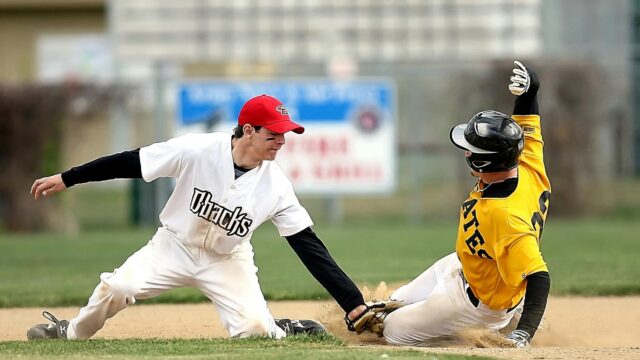
Receiving the pickoff throw. When the pitcher fires to first, catch the ball and sweep your glove down toward the runner. Make a quick tag on the runner’s hand or arm as he dives back. The sweep tag is essential — do not reach out and stab at the runner. Bring the glove to him in a smooth downward motion. According to MLB data from recent seasons, pickoff attempts at first base are successful roughly 5 to 8 percent of the time, but they serve a larger purpose by keeping runners close and disrupting their timing for stolen base attempts.
When to come off the bag. You cannot hold the runner at first base for the entire at-bat. Once the pitcher comes set and the count progresses, you need to release off the bag and get into your fielding position. The standard timing is to hold until the pitcher begins his motion to home plate, then take two or three quick shuffle steps away from the bag into your fielding position. At the youth level, I teach players to come off the bag as soon as the pitcher starts looking toward home plate.
The key decision point is the game situation. With a fast runner on first and a close game, you might hold longer to allow more pickoff attempts. With a slow runner or a big lead, get into fielding position earlier so you can handle ground balls. Great first basemen like base stealers’ opponents understand this chess match.
Step 6: Bunt Coverage and Charging
First basemen are a critical part of bunt defense. Depending on the situation, you might be the primary fielder on a bunt or you might need to cover the bag while the pitcher or third baseman fields it. Understanding your role in every bunt situation is essential.
Sacrifice bunt with runner on first. In this situation, the first baseman typically charges aggressively toward home plate as soon as the batter shows bunt. The second baseman covers first. Your job is to field any bunt that is pushed to the right side. After fielding, look for the lead runner — if you can get him at second, throw there. If not, turn and throw to the second baseman covering first for the sure out.
Sacrifice bunt with runners on first and second. This is more complex. Many teams use a “wheel play” or “rotation play” where the third baseman charges, the shortstop covers third, and the first baseman either charges or holds depending on the defensive call. Know your team’s bunt defense alignment before the play happens.
Charging technique. When you charge a bunt, sprint at an angle toward home plate on the first base side. Field the ball with two hands if possible, using a bare-hand pickup if the ball has stopped or is rolling slowly. Get your feet set before throwing. For more on bunting fundamentals, check our complete guide.
Step 7: Cutoffs, Relays, and Backing Up Throws
First basemen have specific responsibilities on balls hit to the outfield and on relay situations. These are often overlooked in youth development but they matter at every level.
Cutoff on throws to home from right field. On a base hit to right field with a runner trying to score, the first baseman is the cutoff man between the right fielder and home plate. Position yourself in a direct line between the outfielder and home plate, about 40 to 50 feet from home. Listen for the catcher’s instructions — he will tell you to “cut” (catch the ball and throw to a base) or “relay” (let it go through to the plate).
Backing up throws. When there is no play at first base and a throw is going to another infielder, the first baseman should back up the throw. For example, on a throw from the outfield to second base, position yourself behind second to catch any overthrow. This is a hustle play that prevents extra bases and shows coaches you understand the game.
Communication. On every fly ball to the right side of the field, communicate with the second baseman and right fielder. Call the ball loudly if it is yours, and call off your teammates clearly. On pop-ups near the first base dugout or the stands, be aggressive but aware of obstacles. First basemen handle more foul pop-ups than any other infielder except the catcher.
Common First Base Mistakes and How to Fix Them
I have seen hundreds of players learn the first base position, and the same mistakes come up over and over. Here is a table of the most common errors and their fixes:
| Mistake | Why It Happens | How to Fix It |
|---|---|---|
| Looking down at the bag while receiving a throw | Player is unsure where the base is and takes their eyes off the ball | Practice finding the bag with your feet by feel during warm-ups; do 50 reps per day without looking |
| Stretching before the throw is released | Trying to get maximum stretch too early | Wait until you read the throw direction, then stretch; stretching early commits you to one direction |
| Pulling the foot off the bag on close plays | Flinching or reaching too far for an offline throw | Anchor your heel on the bag corner and trust your reach; practice with intentionally offline throws |
| Using the wrong foot on the bag | Always defaulting to the same foot regardless of throw location | Practice switching feet based on throw angle; left foot for throws to the home-plate side, right foot for throws to the outfield side |
| Stabbing at short hops instead of scooping | Fear of the ball or poor glove angle | Tilt glove fingers downward, scrape the dirt, and work forward through the ball; use tennis balls for confidence |
| Not getting off the bag soon enough with runners on | Over-committing to holding the runner | Release as the pitcher starts his motion home; work on shuffle-step timing in practice |
| Throwing behind the pitcher on the 3-1 play | Not leading the pitcher or throwing too late | Aim your toss chest-high and slightly ahead of the pitcher; practice this specific play daily |
| Not communicating on pop-ups | Assuming someone else will take charge | Call every ball — loud and early; the first baseman has priority over the pitcher on pop-ups to the right side |
| Standing flat-footed before the pitch | Fatigue or lack of awareness | Use a pre-pitch hop step to get your weight on the balls of your feet every single pitch |
| Failing to back up throws | Not understanding responsibilities after the initial play | Study your cutoff and backup assignments; sprint behind the target base on every outfield throw |
First Base Drills That Actually Work
Here are the drills I use every week with my players. These are practical, game-like exercises that build the specific skills a first baseman needs.
Drill 1: Bag Work (Footwork and Stretching)
Set up at first base. Have a coach or partner stand at shortstop depth. They throw to first at various locations — left, right, high, low, in the dirt. Your job is to find the bag, set the correct foot, stretch toward the throw, and make the catch. Start with 10 good throws, then 10 intentionally offline throws, then 10 in the dirt. Do 3 sets. This drill alone will transform your first base play if you do it consistently.
Drill 2: Short Hop Scoops
Kneel about 20 feet from a partner. Have them throw short hops — one-hoppers that hit the dirt right in front of you. Focus on getting your glove to the ground with fingers pointing down, working through the ball. Start with tennis balls to build confidence if you are a younger player, then progress to baseballs. Do 3 sets of 15 scoops. This is the single best drill for improving your ability to pick balls out of the dirt, and it directly translates to better receiving on errant throws.
Drill 3: 3-1 Putout Repetitions
Set up a ground ball drill where you field a ball hit to your right, then toss to a pitcher running to cover first. The pitcher should sprint from the mound area to the first base line and receive your toss while touching the bag. Do 10 reps each, alternating between underhand and overhand tosses based on distance. This play breaks down more than almost any other in baseball, so repetitions are essential.
Drill 4: Bunt Charge and Throw
Place a ball on the ground about 20 feet from home plate on the first base side. On a coach’s signal, charge from your first base position, field the bunt with two hands, set your feet, and throw to second base (or to a coach standing at second). Do 10 reps focusing on quick feet and accurate throws. Then repeat throwing to first (the second baseman covering) for the sure out.
Drill 5: Pickoff Tag Drill
Have a runner take a lead off first base. The pitcher practices pickoff moves while you practice receiving the throw and applying a sweep tag. Focus on catching the ball cleanly and bringing the glove down to the runner in one smooth motion. Do 10 reps per pitcher. This drill improves your tag technique and helps pitchers develop their pickoff move simultaneously.
Drill 6: Reaction Ball Drill
Stand at your normal first base position. A coach hits sharp ground balls at you from 60 feet away, alternating between your left and right. React, field, and make the correct play — either step on the bag if you are close enough, or throw to the pitcher covering. This builds quick reaction time and decision-making under pressure. Do 15 reps per session.
First Base Positioning by Situation
Your positioning at first base changes based on the game situation, the batter, and the runners on base. Here is a quick reference table:
| Situation | Positioning | Key Responsibility |
|---|---|---|
| No runners on base | 10-15 feet behind the bag, 3-5 feet toward second base | Field ground balls to the right side; get to the bag on throws from other infielders |
| Runner on first base only | Right foot on the bag, holding the runner | Receive pickoff throws; release into fielding position when pitcher delivers |
| Runner on second base only | Normal depth, slightly shaded toward the line | Guard the line in late-inning situations to prevent extra-base hits; field ground balls normally |
| Runners on first and second | Holding the runner at first; release on pitch delivery | Be ready for bunt defense; know your rotation assignment |
| Runner on third, less than two outs | Normal depth, play in if needed for a drawn-in infield | Check the runner at third on every ground ball before throwing to first |
| Bases loaded | Holding runner at first; may play in for double play depth | Field ground balls and step on the bag for the force; look for the double play at home |
| Late innings, protecting a lead | Guard the line — shift closer to the foul line | Prevent doubles down the line that could score runners from first |
| Bunt situation | Creep forward from normal depth, ready to charge | Charge aggressively on bunt show; know who covers the bag behind you |
Advanced Tips for Experienced First Basemen
Once you have the fundamentals down, here are the things that will take your first base play to the next level.
Read the throw early. As the infielder releases the throw, pick up the ball out of his hand and immediately judge whether it is going to be accurate, high, low, or offline. The earlier you read the throw, the more time you have to adjust your stretch and your glove angle. Elite first basemen at the college and professional level begin their stretch before the ball is halfway to them because they have already read the trajectory.
Develop a backhand scoop. Most first basemen are comfortable scooping balls in the dirt on their glove side, but the backhand scoop — picking a ball that bounces to the throwing-hand side — is just as important. Work on turning your glove over so the fingers point toward the foul line while your thumb faces the ground, then scoop through the ball.
Work on your transfer speed. On double play situations (runner on first, ground ball to the first baseman), you may need to field, throw to second for the force, and then get back to the bag for the return throw. The speed of your field-to-throw transfer determines whether you turn two or just get one. Practice the 3-6-3 and 3-6-1 double plays regularly.
Study hitters. Know the opposing lineup. Pull hitters are more likely to hit the ball to the left side, so you can shade toward second base. Opposite-field hitters or contact hitters may hit more balls toward the first base line. At higher levels, teams use spray charts and Statcast data to position fielders, and first basemen should be involved in these discussions. Our guide on reading baseball statistics can help you understand the data behind defensive positioning.
Communication is everything. Talk constantly. Call out the number of outs before every pitch. Remind the pitcher who is covering first on a ground ball. Let the second baseman know if you are holding or playing off. Direct traffic on pop-ups. The best first basemen I have coached were also the loudest and most communicative players on the field.
Develop soft hands. “Soft hands” means you absorb the ball into your glove rather than fighting it. Think of your mitt as a cushion. When the ball arrives, give with it slightly instead of clamping down immediately. This is especially important on hard throws from the shortstop or third baseman. Players who work on their receiving and catching skills — including those who take batting practice regularly — tend to develop better overall hand-eye coordination that transfers to defensive play.
Physical Training for First Basemen
First base requires a specific set of physical attributes. While you do not need to be the fastest player on the field, you do need flexibility, core strength, and quick lateral movement. Here is what to focus on in your training:
Hip flexibility. The split-style stretch that first basemen use to receive throws demands excellent hip flexor and groin flexibility. Incorporate dynamic stretching before practice — leg swings, hip circles, and walking lunges — and static stretching after. The importance of stretching cannot be overstated for this position. First basemen who lack hip flexibility will struggle to make full stretches and will be more prone to groin injuries.
Core strength. Every scoop, stretch, and tag at first base engages your core. Planks, Russian twists, medicine ball rotations, and anti-rotation presses should be staples of your training program. A strong core helps you maintain balance while stretching and allows you to recover quickly from awkward positions.
Lateral quickness. First basemen need to move quickly to their left and right on ground balls and offline throws. Ladder drills, lateral shuffles, and cone drills build the foot speed you need. You do not need to be a burner on the base paths, but you need quick feet within a 10-foot radius of the bag.
Grip and forearm strength. Squeezing a first baseman’s mitt closed on every throw — especially on hard throws in the dirt — requires forearm endurance. Wrist curls, farmer’s carries, and grip trainers help. This is especially important during long games or doubleheaders when fatigue sets in.
First Base at Different Levels of Play
The first base position evolves as players move up through the levels. Here is what to expect and how to adjust:
Youth baseball (8U through 12U). At this level, the most important skill is simply catching the ball. Throws from teammates will be inconsistent, so focus on keeping the ball in front of you. Do not worry about full stretches or advanced footwork yet. Build confidence with the mitt, work on scoops with tennis balls, and develop the habit of finding the bag without looking down. Youth first basemen should also be working on their overall player development fundamentals.
Middle school and travel ball (13U-14U). Now you can start introducing proper stretch mechanics, foot switching, and holding runners. The game gets faster, and throws arrive harder. Players at this level should be using a first baseman’s mitt and practicing scoops with baseballs regularly. Introduce bunt defense assignments and cutoff responsibilities.
High school (15U-18U). High school first basemen need to be complete defenders. You should be able to scoop any short hop, stretch to both sides, turn the 3-1 play cleanly, and manage bunt defense. Footwork should be automatic. Start studying hitters and adjusting your positioning. Many high school coaches expect their first baseman to be a vocal leader on the field.
College and beyond. At this level, the margin for error shrinks dramatically. Throw velocity from infielders is higher, runners are faster, and games are closer. College first basemen need elite scooping ability, flawless footwork, and the baseball IQ to manage complex defensive situations. Physical tools like flexibility and lateral quickness become even more important as the game speeds up.
Frequently Asked Questions About Playing First Base
Do you have to be left-handed to play first base?
No. While left-handed throwers have a natural advantage at first base because their glove is on the infield side, plenty of elite first basemen throw right-handed. Players like Albert Pujols, Paul Goldschmidt, and Pete Alonso are all right-handed throwers who excelled at the position. The key is developing good footwork and stretch mechanics regardless of which hand you throw with.
What size glove should a first baseman use?
First baseman mitts typically range from 12 to 13 inches for adults and 11.5 to 12.5 inches for youth players. The larger mitt gives you a bigger target and a deeper pocket for scooping throws. I recommend going with the largest mitt you can comfortably close and control. Check our glove sizing guide for detailed measurements.
Can a first baseman use a regular infielder’s glove?
Technically yes, the rules allow it at most levels. But I strongly recommend against it. A first baseman’s mitt is specifically designed for the position — it is wider, longer, and has a deeper pocket that makes catching throws and scooping short hops significantly easier. Using a regular glove at first base is like using a butter knife when you have a steak knife available.
How do I practice first base by myself?
You can work on footwork at the bag without a partner — practice finding the bag with your feet, switching feet, and stretching in every direction. Use a rebounder net to throw balls against the net and practice scooping the returns. You can also throw a ball against a wall and practice catching it on the short hop. For conditioning, work on hip flexibility and lateral movement drills on your own.
Should a first baseman stretch on every throw?
Yes, on any throw from another infielder where you are receiving at the bag, you should stretch toward the ball. This shortens the distance the throw has to travel and gives your teammate the biggest target possible. The only exception is when a throw is so far offline that stretching would pull you off the bag or put you in a bad position — in those cases, come off the bag and just catch the ball.
What makes a great first baseman at the MLB level?
At the MLB level, the best first basemen combine elite scooping ability with excellent footwork, strong communication skills, and baseball IQ. Freddie Freeman, for example, consistently ranks among the top defensive first basemen because of his ability to save infielders on errant throws. Statcast data shows that the gap between the best and worst defensive first basemen can be worth 15 to 20 runs over a full season — a significant difference in a game where margins are razor-thin.
Is first base a good position for bigger players?
First base is often associated with bigger, less mobile players, but that is a misconception. While it is true that first basemen tend to be among the tallest players on the field — the average MLB first baseman stands about 6 feet 2 inches and weighs around 220 pounds — size alone does not make you a good first baseman. Agility, flexibility, and soft hands matter more than raw size. That said, being taller does give you an advantage on high throws and allows you to stretch further on offline throws.
How important is the first baseman’s arm?
The first baseman does not need a cannon arm, but you do need to make accurate throws. The most common throws a first baseman makes are short tosses to the pitcher covering, throws to second base on double play attempts, and throws to home plate on cutoff plays. Accuracy and quick release matter more than raw arm strength at this position. If you are looking to improve your overall throwing, check out our throwing mechanics guide.
Putting It All Together
Playing first base well is about mastering a collection of specific skills and having the baseball intelligence to know which skill to apply in each situation. Start with the fundamentals — finding the bag, stretching toward throws, and scooping short hops. Then build outward to holding runners, managing bunt defense, handling cutoffs, and communicating with your teammates.
The best first basemen I have coached and played with were not always the most talented athletes on the field. They were the most prepared, the most vocal, and the most willing to put in the repetitions. If you commit to the drills in this guide and focus on one skill at a time, you will see dramatic improvement at the position in a matter of weeks, not months.
Remember: a great first baseman makes everyone around him better. When your shortstop knows you can dig any throw out of the dirt, he plays more aggressively. When your pitcher knows you will handle the 3-1 play, he fields his position with confidence. When your catcher knows you are holding the runner tight, he calls more breaking balls in the dirt. First base is the position that ties the entire infield together, and doing it well is one of the most valuable things you can contribute to your team.