How to Steal a Base in Baseball: Leads, Jumps, Slides, and Drills for Every Level
Last updated: March 17, 2026
I have spent more than two decades around the game — first as a leadoff hitter who lived and died by the 90-foot grind, and now as a coach who teaches baserunning to high school and travel ball kids who want to play at the next level. In all those years, no single skill has separated good players from great ones quite like the ability to steal a base. Stealing is one of the few moments in baseball where a single player can completely flip the game on his own. No pitcher, no hitter, no umpire — just you, a lead, a pitcher’s first move, and a 90-foot dash that either ends in a cloud of dust and a safe sign or a long walk back to the dugout.
The funny thing is, most players I have coached think stealing is about raw speed. It isn’t. I have seen 6.9 sixty-yard kids get thrown out every single time they tried to go, and I have seen 7.5 catchers’ sons swipe 30 bags a year because they read pitchers like a book. Stealing bases is a skill — a real, learnable, repeatable skill — and that is what this guide is going to teach you. By the end, you will know how to take a proper lead, read a pitcher’s tells, get the jump that turns a 4.3-second pop time into a tie at second, and slide in a way that does not get you tagged or hurt.
Why Stealing Bases Still Matters in 2026 Baseball
If you have watched MLB over the last few seasons, you already know the running game is back in a big way. Since the bigger bases, the pitch clock, and the disengagement limit hit the majors in 2023, steal attempts have exploded. MLB averaged roughly 0.7 stolen bases per game in 2024 — the highest rate since the 1980s — and the league-wide success rate climbed past 79 percent. Translation: when smart runners get green lights, they win more than four out of five attempts. That kind of return on investment did not exist when I was playing.
Down at the amateur level, the gap is even bigger. High school catchers throwing 2.1 to 2.3 pop times cannot keep up with a runner who gets a quality jump, and most travel ball pitchers have not been coached on holding runners at all. If you can steal at the youth, high school, or college level, you will score runs your team would have stranded — and you will get noticed. Coaches at every level are hunting for runners who can change a game without swinging the bat.
Equipment You Need to Steal Bases Effectively
You do not need much to steal bases, but the gear you wear matters more than people think. I learned this the hard way after pulling a hamstring sliding head-first into second on a hot July afternoon — I was wearing the wrong cleats and the wrong sliding shorts, and that combination cost me three weeks of my senior season. Here is what I recommend.
| Equipment | Why It Matters | What to Look For |
|---|---|---|
| Metal or molded cleats | Traction on the first crossover step | Low-cut models for ankle mobility, broken in at least 2 weeks |
| Sliding shorts | Protect your hips, thighs, and tailbone | Compression fit with foam padding on the hips |
| Sliding mitt | Protects the lead hand on headfirst slides | Padded glove that fits snugly with a finger loop |
| Wristbands or batting gloves | Grip the bag, avoid scrapes | Light and breathable, not bulky |
| Stopwatch (training) | Measure home-to-first and first-to-second times | Any digital watch that reads to hundredths |
| Radar gun (training) | Track catcher pop times and pitcher delivery | Pocket Radar is plenty for high school and below |
If you take baserunning seriously, the sliding mitt is the upgrade I would buy first. I resisted them for years because I thought they looked silly, but after watching too many of my players jam fingers and break bones on headfirst slides, I changed my mind. Pair that with a quality set of sliding shorts and you will feel safer taking aggressive leads — which means you will get better jumps.
Step 1: Get a Quality Primary Lead
Every successful steal starts before the pitcher even comes set. Your primary lead — the distance you stand off first base before the pitch is thrown — is the foundation of the whole operation. Too short, and you are conceding a step you will never get back. Too long, and you are getting picked off before you ever get a chance to run.
For most high school and college runners, a primary lead of three to three-and-a-half body lengths off the bag is the sweet spot. That works out to roughly 11 to 13 feet — far enough to matter, close enough to get back. I teach my players to step off the bag with their right foot first, then shuffle (never cross over) to their lead spot. Crossing over is how you get picked off — your hips are turned, your weight is committed, and you cannot get back in time.
Once you reach your lead, settle into an athletic stance. Feet slightly wider than shoulder width, knees bent, weight on the balls of your feet, hands relaxed in front of your body. Your eyes are locked on the pitcher — never the bag, never the catcher, never the third base coach until you have registered the pitcher’s first move. The whole point of the primary lead is to put your body in a position where you can either dive back to first or explode to second the instant you read the pitcher.
Step 2: Read the Pitcher’s Move (This Is Where Steals Are Won)
If there is one thing I wish I could tattoo on every young baserunner’s arm, it is this: stealing a base is a recognition skill, not a speed skill. The fastest kid in the world will get thrown out if he leaves on the wrong move, and a 7.0 sixty will steal 40 bases a year if he reads pitchers correctly. The good news is, every pitcher in the world telegraphs his intent. Your job is to find the tell.
The single most reliable tell is the front shoulder. When a right-handed pitcher commits to home plate, his front shoulder dips and his front foot lifts simultaneously. When he is coming to first, his shoulders stay level and his front foot pushes off rather than lifts. Watch a few innings of any pitcher and you will see the pattern emerge.
For left-handed pitchers, life gets harder. The lefty’s front foot points right at first base, which means he can pick you off without breaking the plane. I teach my players the “knee tell” against lefties — if his front knee crosses back over the rubber, he is going home. If it lifts and stays on the first-base side, he is coming over. Some lefties are masters at hiding this; against those guys, you take a shorter lead and steal on first movement only when the count and situation are right. For a deeper look at this skill, my full breakdown of how to read a pitcher’s pickoff move covers every common variation.
Step 3: The Secondary Lead and the Walking Lead
Even when you are not stealing, your secondary lead can turn a single into a double on a hit. As the pitcher commits to home plate, you take two or three shuffle steps toward second base, gaining four to six additional feet without ever leaving your feet. By the time the ball crosses the plate, you have effectively cut the steal distance from 90 feet down to about 75. That is a massive head start.
If you are an advanced runner with a green light, the walking lead is your highest-percentage move. Instead of stopping at your primary lead, you keep gaining ground in a controlled rhythm so that you are already moving toward second the instant the pitcher commits. Done right, your first step is essentially free. Done wrong, you get hung up between bases and tagged out by 20 feet. The walking lead requires both excellent recognition skills and total confidence in your read — it is not a beginner technique.
Step 4: The Crossover Step and the First Three Steps
Once you have decided to go, the next 1.5 seconds determine whether you are safe or out. Most runners lose the steal in their first three steps, not in the last 30 feet. The crossover step is the technique you must master.
Here is the sequence I teach: pivot your right foot 90 degrees toward second base, then drive your left knee across your body in a crossover motion. Your hips and shoulders should rotate together — never lead with the upper body or you will lose balance. As your left foot plants, your right arm drives forward hard, and you accelerate in a straight line toward the bag.
The most common mistake I see at every level is the “false step” — that little hop or rocker step back toward first before going forward. It feels natural because your weight has to transfer, but it adds two-tenths of a second to your steal time and that is the difference between safe and out at every level above Little League. Drill the crossover step until it feels automatic.
Step 5: Sprint Mechanics — Stay Low, Stay Long
From the crossover through about 45 feet, your body should be in a forward lean of roughly 45 degrees, with your eyes focused down the basepath, not at the bag. Long, powerful strides — not choppy quick steps. Your arms drive in a sprinter’s rhythm, hand to chin, hand to hip. Do not grab at your helmet, do not look back at the catcher, do not look up to find the bag too early.
Around 50 feet, start to rise into a more upright running posture so you can see the bag and prepare your slide. The runners who get thrown out late usually slow down to find the bag — the runners who get in safe run hard through second base and let muscle memory tell them when to drop.
Step 6: The Slide — Feet First or Headfirst?
This debate has been going on since the early 1900s and it will go on long after I am gone. The truth is, both slides have a time and place, and a complete base stealer knows how to do both.
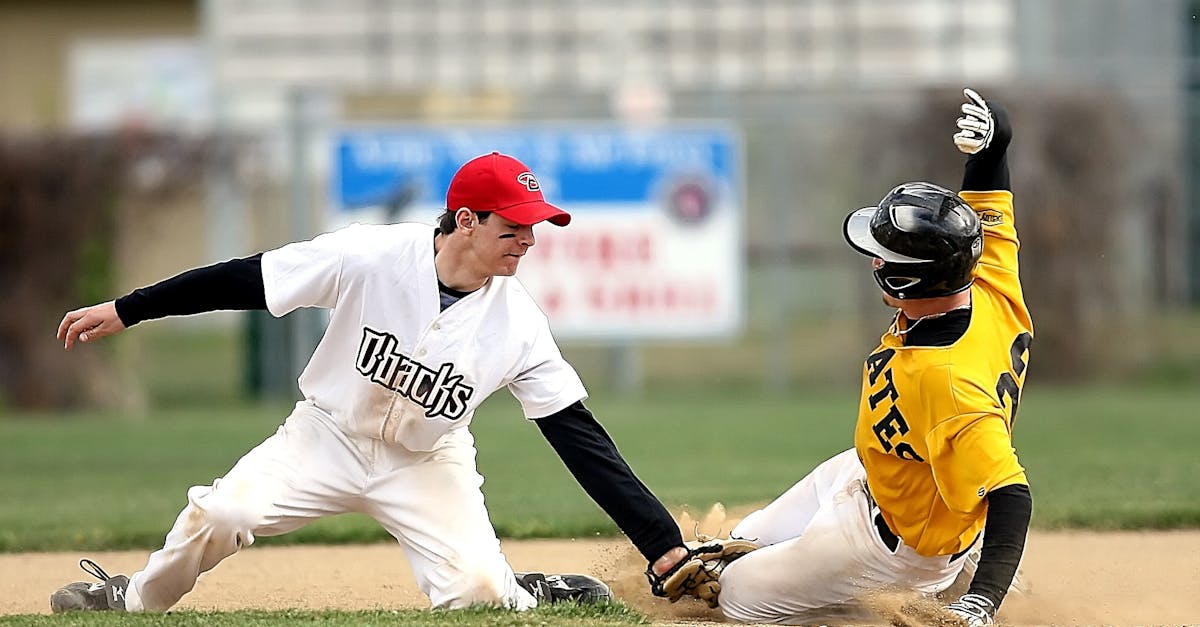
The feet-first or “pop-up” slide is safer for your hands, wrists, and shoulders, and it lets you bounce up and advance on an overthrow without losing momentum. I teach all my younger players to start with the feet-first slide until they have the mechanics down cold. Land on your back pocket, lead leg bent and out toward the bag, trail leg tucked underneath. Hands up in the air — never down on the dirt where they can get spiked or jammed.
The headfirst slide is faster — research has shown it saves about 0.05 to 0.1 seconds on average because your center of mass does not have to rotate as far. But it is also where most injuries happen. If you headfirst slide, you must wear a sliding mitt and you must lead with the hand, not the head or shoulder. Aim for the corner of the bag closest to you, not the middle, and grab the bag with your fingertips as you go through. For a deep dive into protective gear, check the best baseball sliding mitts review I put together after testing dozens of pairs.
Common Mistakes That Get Runners Thrown Out
After years of coaching, I have kept a mental list of the recurring mistakes that turn would-be steals into outs. Almost every caught-stealing I have ever seen falls into one of these buckets.
| Mistake | What Happens | The Fix |
|---|---|---|
| False step backward | Adds 0.15-0.20 sec to time, runner is out by a step | Drill crossover step against a wall daily |
| Too small a primary lead | Even great speed cannot overcome the deficit | Push your lead until you have been picked off once that week |
| Looking at the catcher mid-run | Slows you down and gives away the slide direction | Eyes on the basepath, trust your route |
| Running through the bag too far | Catcher pegs you for a tag-out moving past second | Drill the pop-up slide so you stop on the bag |
| Sliding too early | Body decelerates 3-5 feet short of the base | Practice from a chalk mark to find your launch spot |
| Sliding too late | Slamming the bag with full velocity equals injury | Eyes up to spot the bag at about 10 feet out |
| Stealing on the wrong count | Pitchers pitch out or hold the ball | Steal on 2-0, 2-1, 3-1 unless given a sign |
| Telegraphing the steal | Body tension or leaning gives it away | Stay relaxed in your stance every single pitch |
| Stealing against a slide step | Pitcher gets to the plate in 1.1 sec instead of 1.5 | Watch pitcher’s first hold — adjust or stay put |
| Crossing over with shoulders behind hips | Loses momentum on the first three steps | Drill simultaneous shoulder and hip rotation |
Drills to Train Every Phase of the Steal
Stealing bases gets better with repetition the same way hitting does — through specific, deliberate drills that isolate one skill at a time. Here are the drills I run with my players every week in practice. If you do these consistently, you will get faster, smoother, and more confident on the bases.
Drill 1: The Wall Crossover Drill
Stand in your primary-lead stance with your right shoulder six inches from a wall. On a coach’s command, pivot and crossover. The wall forces you to rotate cleanly — if you false-step, your hips will smack the wall. Three sets of five reps daily. This single drill eliminates the false step faster than anything else I have found.
Drill 2: The Three-Step Burst
Mark a starting line and a finish line 10 feet apart. From your primary-lead stance, explode through the finish line and decelerate. Time yourself. The goal at the high school level is under 1.2 seconds; college and pro runners are under 1.1. This drill develops the explosive first-three-steps that decide nearly every steal attempt.
Drill 3: The Read-and-React Drill
Have a coach or teammate stand on a portable mound and randomly mix in pickoff moves with deliveries home. Your job is to react correctly every time — go on home, dive back on the pickoff. Start at 50 percent speed and build to game tempo. This is the drill that teaches you to trust your eyes and your read.
Drill 4: Live Pitcher Timing
Stand at the first-base bag during your team’s bullpen sessions with a stopwatch. Time the pitcher from first move to ball-in-mitt. If he is at 1.5 seconds or higher, that is a steal opportunity in a real game. Under 1.3, you had better be on green light and ready to fly. Doing this drill once a week against your own pitchers trains your brain to recognize “stealable” deliveries instantly.
Drill 5: The Tarp Slide
Lay a wet tarp on the outfield grass with a base anchored on the far end. Sprint in from 30 feet and practice both feet-first and headfirst slides. The slick surface lets you get hundreds of reps without tearing up your hips. I credit this drill with cutting our team’s sliding injuries by more than half.
Drill 6: Resistance Band Starts
Loop a resistance band around your waist with a partner anchoring it. From your primary-lead stance, fire out into your crossover and accelerate against the resistance for 10 yards. Three sets of five. This builds the explosive hip and glute strength that powers the first-step quickness. Pair it with the broader work in our baseball speed and agility drills program for compound gains.
Steal Signs, Green Lights, and Game Situation
Not every base is a base you should steal. The best runners in the game pick spots — they know which pitchers they can run on, which counts favor a steal, and which scoreboard situations make an attempt smart or reckless. A baseline rule I use: never make the first or third out of an inning at second or third base. That single principle would have saved every team I have ever played for at least five runs a season.
Most teams use a sign system from the third base coach that includes a “go” sign (you are stealing this pitch), a “green light” (you can steal whenever you want for the rest of the at-bat), and a “no-go” (you are holding regardless). If your coach gives you a green light, you have earned trust — use it wisely. Learn the rest of your team’s sign system inside out by reading our deep dive on baseball signs and signals.
Favorable counts are 2-0, 2-1, and 3-1 — pitchers in those counts will throw a fastball at home plate the majority of the time, which is your easiest pitch to steal on. Unfavorable counts are 0-2 and 1-2, when a catcher might call for a pitchout or a high fastball designed to be easy to throw on. With two strikes on a contact hitter, holding back makes more sense than risking the out.
Advanced Tips: How to Steal Like Chandler Simpson
The elite base stealers in baseball today share a few skills that go far beyond raw speed. If you want to take your game to the highest level, these are the techniques to start studying. For a real-world case study of speed at the highest level, my breakdown of Chandler Simpson’s stats shows exactly how a modern speed merchant builds a year.
Tip 1: Steal third more often. Most amateur runners are obsessed with stealing second but ignore third. Yet third base is statistically easier to steal — pitchers hold the ball less from the stretch with a runner on second, and catchers have a much longer throw with less reaction time. If you have already gotten to second and there are zero or one outs, stealing third should be on the table.
Tip 2: Use the delayed steal. This is one of my favorite plays at the youth and high school level. As the pitch crosses the plate, instead of going on the pitcher’s first move, you break the moment the ball hits the catcher’s mitt. If the catcher is lazy with his footwork or the middle infielders are not covering, you have got a free base. The delayed steal is especially effective against young or unfocused defenses.
Tip 3: Steal home. The rarest steal in baseball requires a left-handed pitcher with a slow delivery and a hitter you trust to take the pitch. Take a big lead off third on the pitcher’s right side (away from the line) and time your break to coincide with his leg lift. It is risky, it is breathtaking, and when it works it is the single most exciting play in baseball.
Tip 4: Mind the catcher’s pop time. Pop time is the seconds from the ball hitting the catcher’s mitt to the moment it hits the second baseman’s glove. Major league catchers average around 1.95 to 2.05 seconds. Anything 2.0 and below is plus; 2.1 to 2.2 is average; 2.3 and up is below average and very stealable. If you can find out a catcher’s pop time during your scouting work, you will know exactly what jump you need. Our guide on catcher pop time explains exactly how this measurement breaks down.
Tip 5: Practice the “stutter step” return. If you read fastball and break, but the pitcher steps off the rubber, you need to be able to stop and dive back without panicking. Most pickoffs happen because the runner commits with no plan B. Stuttering, dropping your weight, and exploding back to first should be a drilled reflex.
Stealing Bases at Every Level — What Changes
The fundamental skills are the same from Little League to the major leagues, but how you apply them changes a lot with age and level. Here is a quick breakdown.
| Level | Bag Size | Lead-Off Rule | Typical Pop Time | Key Focus |
|---|---|---|---|---|
| Little League (8-12U) | 14 inch base, 60-ft basepaths | No leads — go on release | 2.6+ sec | Quick reaction off the bag |
| Pony / Babe Ruth (13-15U) | 15 inch, 80-90 ft basepaths | Lead allowed | 2.3-2.5 sec | Primary lead distance |
| High School (90 ft) | 15 inch base | Lead allowed | 2.0-2.3 sec | Reading pitcher’s tells |
| College (NCAA) | 15 inch base | Lead allowed | 1.9-2.1 sec | Pop time scouting + jump |
| Pro / MLB | 18 inch base (since 2023) | Lead allowed; disengagement limit | 1.9-2.0 sec | Pitch clock exploitation |
One specific point about Little League: kids cannot leave the bag until the ball is released by the pitcher. That makes the reaction time off the base the most critical skill. I teach my Little Leaguers to crouch slightly with weight on the front foot and explode the instant they see the ball leave the pitcher’s hand. The crossover step still applies — it is just compressed into less time.
Mental Side of Base Stealing
Stealing bases is as much a mental challenge as a physical one. The best base stealers I have ever played with had a kind of controlled aggression — they always looked like they might go, but they only went when the odds were right. Pitchers had to think about them every pitch, which sped up deliveries and disrupted timing for the next pitch to the plate. That ripple effect helps your hitters too.
The flip side is fear. Once you get picked off in a big spot or thrown out at the worst possible time, the instinct is to play it safe for the rest of the game — or even the rest of the season. Fight that instinct. Every elite base stealer has been thrown out plenty. Rickey Henderson, the all-time leader, was caught 335 times. Lou Brock, Tim Raines, Vince Coleman — every name on the leaderboard has been thrown out hundreds of times. Failure on the bases is part of the deal. Reset, adjust, and go again. For more on developing that next-play mindset, our piece on baseball mental game tips is a good starting point.
How the New MLB Rules Have Changed Base Stealing
If you are watching pro baseball in 2026, you are seeing the most stealing-friendly rule set in modern history. The bases moved from 15 inches to 18 inches square in 2023, which cut the distance between bags by 4.5 inches. That sounds small until you realize a typical steal is decided by inches at the bag.
The pitch clock now forces pitchers to start their motion within 18 seconds with runners on base. That tight window means pitchers cannot hold the ball for five or six seconds to mess with a runner’s timing the way they used to. And the disengagement limit — pitchers can only step off twice per plate appearance before any subsequent step-off becomes an automatic balk — caps how many times a pitcher can throw to first or hold his pose. Smart runners learn to count disengagements and time their break on the third pitch in the plate appearance.
Amateur baseball has not fully adopted all these rules yet, but high school and college have been moving in the same direction. The trend is clear — base stealing is becoming a bigger and bigger weapon. Players who learn the craft now will have a competitive edge for the rest of their careers.
Frequently Asked Questions
How fast do you need to run to steal bases in baseball?
You do not need to be a track star. At the high school level, a sub-7.2 sixty-yard dash combined with good technique is plenty. The truth is that recognition, jump quality, and pitcher selection matter more than raw speed. I have seen 7.5 sixty guys steal 25 bags a season because they read pitchers better than anyone on the team.
What is a good stolen base success rate?
Anything under 70 percent is hurting your team. The break-even rate at the MLB level is around 75 percent, meaning if you are successful less than three out of four times, you are costing your team runs. At amateur levels, aim for 80 percent or higher. Quality over quantity always wins.
Should I slide headfirst or feet first into second?
For developing players, feet first is safer. It protects your hands, wrists, and head from spikes and collisions. Once you have mastered the basics and you wear a sliding mitt, the headfirst slide is marginally faster. Most pro players use both depending on the situation, but feet first should always be your default.
How big a lead should I take off first base?
About three to three-and-a-half body lengths, which is around 11 to 13 feet for most players. The right lead is “the longest distance from which you can still dive back safely.” If you have never been picked off, you are not leading off far enough. Push the edge and find your limit.
Can you steal first base?
Not in official MLB or NCAA rules. The Atlantic League experimented with the rule a few years back, but it never became official. In standard baseball, stealing only applies to second, third, and home.
When is the best count to steal?
2-0, 2-1, and 3-1 are the prime steal counts because pitchers throw fastballs over 80 percent of the time in those situations. Avoid stealing on 0-2 or 1-2 unless you have a green light, because the catcher may call a pitchout and the pitcher may throw a high fastball that is easy to handle.
How do I steal off a left-handed pitcher?
It is harder because the lefty’s front foot points at you. Take a slightly shorter lead, watch the front knee for a tell, and never break on first movement against a lefty unless you are certain he is committed to home. The walking lead is dangerous against good lefties — most picked-off-by-lefty runners committed too early.
How long does it take to steal second base?
A typical MLB runner takes about 3.3 to 3.5 seconds from first move to touching the bag. With a 1.3-second pitcher delivery and a 2.0-second catcher pop time, the catcher has roughly 3.3 seconds to get the ball to second — which is why timing the pitcher matters more than raw speed.
Do you need a sliding mitt to steal bases?
You do not need one if you slide feet first. If you slide headfirst, I strongly recommend one — broken fingers and jammed wrists are no joke. A quality sliding mitt is $25-$50 and protects you from injuries that can shelve you for weeks.
What is the difference between a steal and a defensive indifference?
Defensive indifference is the official scorer’s call when a runner advances late in a blowout and the defense makes no effort to throw him out. You do not get credit for a stolen base in those situations. It usually applies in the eighth or ninth inning when the score is lopsided.
Putting It All Together
Base stealing is one of the most rewarding skills in baseball precisely because it rewards smart, prepared, fearless players. You do not need elite speed, you do not need a special body type, and you do not need anyone’s permission to start working on it. Take the drills in this guide, work them into your weekly routine, and start watching pitchers with a stopwatch in your mind every single game. You will be amazed how quickly your steal opportunities go from “I am guessing” to “I know I have got this.”
The final advice I always leave my players with: be the runner pitchers hate to have on base. Take aggressive leads, fake breaks, vary your tempo, and never give them a comfortable rhythm. Even when you are not stealing, the threat alone makes pitchers rush, miss locations, and throw fewer breaking balls to the hitter behind you. You become a one-man offense the moment you reach first base. That is the power of the running game. Now go take a base. To round out your skills off the bag, pair this guide with our broader piece on baseball baserunning tips for the in-between moments that win and lose games.