Baseball Signs and Signals: How to Give, Read, and Protect Signs at Every Level
Last updated: March 18, 2026
I have been coaching and playing baseball for over two decades, and if there is one area that separates organized teams from chaotic ones, it is the ability to communicate through signs and signals. Baseball signs and signals are the invisible engine of every game. They dictate pitch selection, defensive shifts, offensive strategy, and even umpire rulings. Yet most players, parents, and new coaches never receive formal instruction on how the system works.
In this guide I am going to break down every layer of baseball signs and signals, from the catcher flashing fingers behind the plate to the third base coach touching his belt to the umpire punching the air on strike three. I will give you practical systems you can install at the youth, high school, travel, and college level, plus drills to sharpen sign recognition and delivery. Whether you are a first-year coach trying to set up a sign system or a player who keeps missing the take sign, this article will make you more dangerous on the diamond.
Why Baseball Signs and Signals Matter More Than Ever
Baseball is a sport of information. Every pitch begins with a decision tree that involves the pitcher, catcher, and coaching staff, and every offensive play starts with a set of instructions relayed from the dugout. According to MLB data, the average game in 2025 featured roughly 290 pitches, and each one required at least one sign exchange between catcher and pitcher. That is 290 micro-decisions per game communicated without saying a word.
At the MLB level, sign stealing scandals have shown just how valuable this information is. The 2017 Houston Astros situation proved that knowing what pitch is coming can boost a lineup’s batting average by an estimated 40 to 60 points, according to analysis published by FanGraphs. At the youth and high school level, poor sign communication leads to crossed-up pitches, missed hit-and-run plays, and blown squeeze bunts. In a survey by the American Baseball Coaches Association, 68 percent of high school coaches said miscommunication on signs was the number-one cause of preventable errors during games.
Signs are also a competitive advantage you can develop without any physical talent. A 12U team with a clean, fast sign system will execute more plays than a physically gifted team that cannot communicate. That is free production.
Catcher Signs to the Pitcher: The Foundation of Every At-Bat
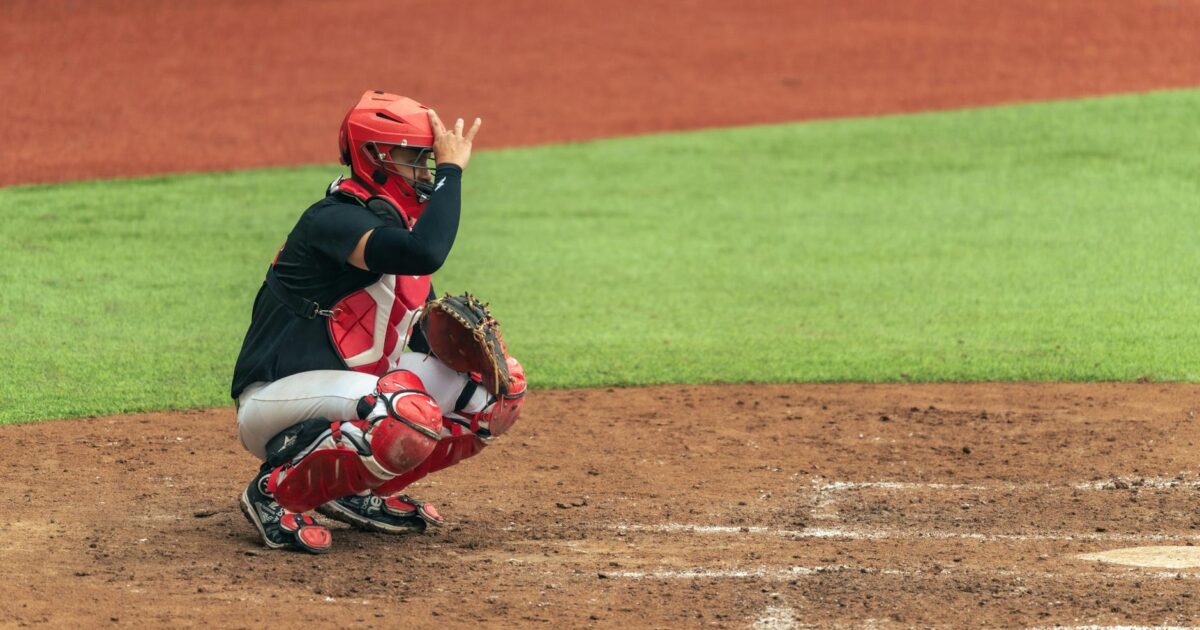
The most fundamental sign exchange in baseball happens between the catcher and pitcher. The catcher drops into a squat, positions his glove to shield his signals from the opposing first and third base coaches, and uses his throwing hand to flash fingers between his legs.
The standard numbering system used at virtually every level is straightforward:
| Number of Fingers | Pitch Type | Notes |
|---|---|---|
| 1 | Fastball | Most common pitch, so it gets the simplest sign |
| 2 | Curveball | Standard off-speed sign across all levels |
| 3 | Changeup | Third pitch for most pitchers at high school and above |
| 4 | Slider | Used when the pitcher has a fourth offering |
| Wiggle fingers | Knuckleball or splitter | Varies by team; often a specialty sign |
Location is typically communicated by where the catcher sets up, but some teams add a secondary sign for location. For example, after the pitch sign the catcher might flash one finger for inside, two for outside, or touch his left knee for a pitch on the inner half. At the MLB level, catchers now use electronic pitch-communication devices (PitchCom) that were introduced in 2022, eliminating visible finger signs entirely. But from travel ball through college, traditional finger signs remain the standard.
When a runner reaches second base, the catcher’s signs become vulnerable because the runner has a direct line of sight. This is where teams switch to a more complex sign sequence. I will cover that in detail below.
Signs with Runners on Second Base: Protecting Your Pitch Calls
With a runner on second, a simple one-finger-equals-fastball system is an open book. Every experienced base runner will relay pitch type to the hitter, and studies from MLB’s Statcast era show that hitters who know what pitch is coming have a slugging percentage roughly 150 points higher than when they do not. You must protect your signs.
There are several proven systems for doing this:
The Indicator System
The catcher runs through a sequence of three to five numbers. Only the number that follows the indicator counts. For example, if the indicator is “2,” and the catcher flashes 3-2-1-4, the live sign is “1” (the number after the indicator “2”), which means fastball. This is the most popular system at the high school level because it is easy to teach and remember under pressure.
The Pump System
The catcher shows a set number of signs (usually three or four), and the second sign in the sequence is always the live one. Some teams rotate which position is live based on the inning — first sign in odd innings, second sign in even innings. This adds complexity for the opposing team while staying manageable for your battery.
The Add-On System
The catcher flashes two or three numbers, and the pitcher adds them together. If the total is odd, fastball. If even, off-speed. The specific off-speed pitch might be determined by the last number shown. This system works well at the college and advanced travel ball level where pitchers can do quick math under pressure.
The best system is the one your pitcher can process without hesitation. I have seen college-level pitchers get crossed up on complex sequences because they were still doing arithmetic when they should have been starting their windup. Keep it as simple as your competition requires and no more complicated. If you are coaching 12U, the indicator system is almost always sufficient.
Third Base Coach Signs: The Offensive Playbook in Real Time
The third base coach is the quarterback of the offense. Every sign for bunting, stealing, hit-and-run, squeeze plays, and take signs flows through him. A good third base coach can deliver a sign in under three seconds while making it nearly impossible for the opposing team to decode.
Most sign systems from the third base coach use one of these frameworks:
The Indicator-Hot Spot System
This is the most widely used system in organized baseball. The coach has an indicator (a specific touch, like grabbing the bill of the cap) that tells the hitter and runners: the next touch is the live sign. Before and after the indicator, all touches are meaningless noise.
Here is an example setup:
| Touch Location | Meaning (When Live) |
|---|---|
| Right ear | Steal |
| Left ear | Bunt |
| Belt | Hit and run |
| Chest | Squeeze |
| Wipe across chest | Take (do not swing) |
| Clap hands | Indicator (next touch is live) |
So a sequence might look like: touch cap, touch left ear, clap hands (indicator), touch belt (live sign = hit and run), touch right ear, touch chest. The hitter sees the clap and knows the next touch, belt, is the play. Everything else is camouflage.
The Wipe-Off and Confirm System
Some coaches add a wipe-off sign that cancels whatever was just called. If the coach gives the steal sign but then wipes across his chest, the play is off. This is critical when a coach sees the defense adjusting — maybe the catcher is setting up for a pitchout, or the first baseman is holding the runner too tightly for a hit and run to work.
According to coaching data from Perfect Game events, teams that use a wipe-off sign reduce busted plays by approximately 35 percent compared to teams that rely on calling timeout to change the play. It is faster and keeps the defense guessing.
Umpire Signals Every Player and Coach Must Know
Umpire signals are the official language of the game. Unlike coaching signs, these are standardized and universal. Every player should know them instinctively. Misreading an umpire’s call can lead to baserunning disasters, and I have personally seen high school games where runners were doubled off because they misread a foul ball call as fair.
The essential umpire signals include:
- Strike: Right arm punches forward or to the side, often with a verbal call. The home plate umpire has full discretion on mechanics, but the raised fist is universal.
- Ball: No signal. A ball is indicated by the absence of a strike call. The umpire may verbally say “ball” but there is no required hand signal.
- Out: Right fist raised with a hammer motion. Used on tag plays, force outs, strikeouts, and fly outs.
- Safe: Both arms sweep outward in a horizontal motion, palms down.
- Fair ball: The umpire points toward fair territory. On close plays down the line, the field umpire will point decisively.
- Foul ball: Arms raised with verbal “foul ball” call. On fly balls, the umpire may wave the ball foul with both hands.
- Time: Both hands raised above the head, palms forward. Play is dead until the umpire calls “play.”
- Home run: The umpire rotates his right index finger in a circular motion above his head.
- Infield fly: Right arm raised with index finger pointed up. This is accompanied by a verbal call of “infield fly, batter is out.”
Understanding the infield fly rule and its corresponding signal is especially important. In Little League data, infield fly rule confusion accounted for a significant portion of all umpire protests at the district tournament level.
Defensive Signs: Positioning and Situational Adjustments
Signs are not just for offense. Defensive communication through signals is what separates a reactive defense from a proactive one. The middle infielders, catcher, and pitcher all use signs to coordinate before each pitch.
Middle Infield Coverage Signs
The shortstop and second baseman need to know who covers second base on a steal attempt. The standard system uses a closed glove (fist behind the glove) to indicate “I have got the bag” and an open glove to indicate “you take it.” This sign is exchanged before every pitch with a runner on first base.
Typically the shortstop covers against right-handed hitters (since the ball is more likely pulled to the left side, keeping the second baseman in position) and the second baseman covers against left-handed hitters. But the sign allows flexibility — if the pitcher is going to throw an off-speed pitch on the outer half, the defense might switch coverage because the hitter is more likely to go the other way.
Pick-Off Signs
Pick-off plays are coordinated through signs between the pitcher, catcher, and the fielder covering the bag. A common system uses a verbal trigger. The catcher might say “there” or use a specific word, and when the pitcher hears it, he knows the shortstop is breaking to second for a daylight pick-off attempt. Timing signs — like the pitcher counts to two after looking at the runner, then whips around — need to be drilled extensively.
MLB data from the 2025 season showed that teams with coordinated pick-off sign systems attempted 15 percent more pick-offs and caught runners at a 22 percent success rate, compared to a 14 percent rate for teams that relied on the pitcher freelancing his own move.
How to Build a Sign System for Your Team: Step by Step
If you are a coach installing a sign system for the first time, or upgrading an existing one, here is the process I recommend based on decades of coaching experience:
Step 1: Assess Your Level
The complexity of your signs should match the cognitive ability of your players and the sophistication of your opponents. Here is a general framework:
| Level | Recommended System | Number of Live Signs |
|---|---|---|
| 8U / Tee Ball | Verbal calls only (no signs needed) | 0 |
| 10U | Single indicator, 2-3 plays | 2-3 |
| 12U | Indicator with hot spot, 4-5 plays | 4-5 |
| 14U / Middle School | Indicator + wipe-off, 5-6 plays | 5-6 |
| High School | Full indicator system with runner-on-second sequences | 6-8 |
| Travel / College | Multiple indicator sets, rotation by game or inning | 8-10 |
At the tee ball level, signs are unnecessary and can confuse kids who are still learning which way to run. By 10U, players can handle a simple indicator. By high school, your system should be robust enough to withstand an opposing coach who is actively trying to steal your signs.
Step 2: Choose Your Indicator
Your indicator should be a natural-looking touch that does not stand out. Coaches who use dramatic gestures for their indicator make it easier for opponents to identify. I like using something subtle — touching the bill of the cap is classic and blends into the rest of the sequence. Some coaches prefer a verbal indicator (saying the batter’s first name, for example), which can be effective but harder to hear in loud environments.
Step 3: Assign Touches to Plays
Keep the assignment logical. Touches on the upper body for offensive actions involving the bat (swing away, bunt, take) and lower body for running plays (steal, delayed steal, hit and run) creates a natural mental map. Your players will internalize this faster than a random assignment.
Step 4: Add Noise
Before and after your indicator and live sign, the coach should run through four to six additional touches. These mean nothing, but they make it impossible for an opponent to isolate the live sign through pattern recognition. Vary the order, the speed, and the number of touches each time. If you always give exactly five touches before the indicator, a savvy coach will figure it out within a few innings.
Step 5: Install a Wipe-Off
The wipe-off is your emergency brake. If you give the steal sign but then see the catcher set up for a pitchout, you need a way to cancel the play instantly. A wipe across the chest or a specific verbal command works. Make sure every player knows that the wipe-off supersedes everything.
Drills to Improve Sign Recognition and Delivery
Knowing the signs is only half the battle. Your players need to receive and process signs quickly and accurately during the stress of a live game. Here are my favorite drills:
Drill 1: Rapid-Fire Sign Quiz
Line up your players facing you. Run through a full sign sequence and then point at a random player who must call out the play within two seconds. If they get it wrong or hesitate, they owe the team five push-ups. This simulates game pressure and builds automatic recognition. Run this drill at the start of every practice for five minutes. Within two weeks, your team will be razor sharp on signs.
Drill 2: Live Sign Scrimmage
During intrasquad scrimmages, use your full sign system. After every half-inning, quiz runners and hitters on what the sign was. If a player ran when the sign was take, or took when the sign was swing away, stop the scrimmage and review. The goal is 100 percent sign compliance — in games, a missed sign can cost you a run or an out.
Drill 3: Catcher Sign Shielding
Have your catcher get in his crouch and flash signs while a coach stands behind third base and another behind first base, trying to see the signs. The catcher must adjust his body angle, glove position, and hand placement until neither coach can read the signs. This is critical — a catcher who telegraphs signs with poor shielding is giving the other team free information.
Drill 4: Middle Infield Coverage Reps
Put runners on first base and have your shortstop and second baseman exchange coverage signs before each pitch. Then execute steal-attempt scenarios. After 20 reps, your middle infielders should be exchanging signs and breaking to the bag without thinking. Pair this with your double play work for maximum efficiency.
Drill 5: Sign Steal Defense
Put a runner on second base and have him actively try to decode and relay the catcher’s signs to a hitter. This forces the battery to use their runner-on-second system under realistic conditions. If the runner successfully relays the pitch and the hitter calls it out, the catcher and pitcher must adjust their sequence. This competitive drill sharpens both sides.
Common Sign Mistakes and How to Fix Them
After coaching thousands of games, I see the same sign-related errors repeatedly. Here are the most damaging ones and their fixes:
Mistake 1: The coach gives signs too fast. Players, especially at the youth level, need time to process. If you blast through a 10-touch sequence in four seconds, half your team will miss the live sign. Slow down. A good sequence takes six to eight seconds — fast enough to keep the game moving but slow enough for every player to follow.
Mistake 2: The catcher does not shield his signs. I have seen catchers flash signs with their hand completely visible to the first and third base coaches. The glove should be on the outside of the left knee, creating a wall. The fingers should be between the inner thighs, visible only to the pitcher. This is a fundamental that must be drilled from day one of catching instruction.
Mistake 3: Players look at the coach too early or too late. Hitters should look for signs while in the batter’s box, after the previous pitch and before they set their stance. Runners should look during their secondary lead return. If a player is looking for signs while the pitcher is in his windup, he is too late. Build sign timing into your baserunning routine.
Mistake 4: Using the same sign sequence every time. If you always touch five spots before the indicator, a coach charting your signs from the other dugout will crack the code by the third inning. Vary the length, rhythm, and speed of your sequences. Former MLB manager Joe Maddon was known for changing his team’s sign system every three games during the 2016 postseason.
Mistake 5: Not having a wipe-off sign. Without a cancel mechanism, you are locked into every play call even when circumstances change between the sign and the pitch. A runner might get a bad jump, or the pitcher might step off. The wipe-off gives you an escape route and prevents blown plays.
Sign Stealing: Rules, Ethics, and How to Protect Yourself
Sign stealing is one of the most controversial topics in baseball. Let me be clear about the rules: stealing signs through observation — a runner on second reading the catcher’s fingers, or a coach in the dugout picking up patterns — is legal and has been part of the game for over a century. What is illegal is using electronic devices, cameras, or technology to steal and relay signs.
MLB Rule 6.04(c) specifically prohibits the use of electronic equipment for sign stealing purposes. The penalties established after the 2017 Astros scandal include fines up to $2 million for organizations and suspensions for individuals involved. At the amateur level, most governing bodies (NFHS, NCAA, Little League) have similar prohibitions against electronic sign stealing.
But legal sign stealing — reading signs through observation and baseball IQ — is a skill you should develop and defend against. Here is how to protect your signs:
- Change your indicator every two to three innings. This is the minimum rotation frequency recommended by most college coaching manuals.
- Watch the opposing dugout. If a coach is writing down your sign sequences, he is trying to decode them. Change immediately.
- Monitor runner behavior on second base. If the runner is giving physical cues to the hitter — shifting weight, moving hands, or positioning his body differently based on the pitch — your signs are compromised. Switch to your backup system.
- Have a pre-planned backup system. Every team should have at least two complete sign sets ready to go. If your primary system gets cracked, you need to switch without calling a meeting.
PitchCom and Technology: The Future of Baseball Signs
In 2022, MLB introduced PitchCom, an electronic pitch-calling system that allows catchers to transmit pitch and location calls to the pitcher through a wearable receiver. The system uses encrypted audio signals, eliminating the need for traditional finger signs between the battery.
The impact has been significant. According to MLB data, the average time between pitches decreased by 2.3 seconds when PitchCom was used, because pitchers no longer needed to shake off signs or wait for complex sequences. Crossed-up pitches — where the pitcher throws one thing and the catcher expects another — dropped by an estimated 40 percent league-wide in the first full season of adoption.
However, PitchCom is only available at the MLB level. College, high school, and youth teams still rely entirely on traditional signs. And even in the big leagues, coaches still use physical signs for offensive plays like steals, bunts, and hit-and-runs. The third base coach is not going away anytime soon.
For players aspiring to reach higher levels, mastering traditional signs remains essential. You need to be fluent in both the old-school finger system and the modern electronic approach. Think of PitchCom as an addition to your communication toolkit, not a replacement for sign literacy.
Signs for Specific Offensive Plays
Let me walk through how signs work for the most common offensive plays. Understanding the mechanics of each sign-to-execution sequence will help you install these plays for your team.
The Steal Sign
The steal sign goes to the runner, not the hitter. The runner picks up the sign from the third base coach during his lead. On the next pitch, the runner goes. The hitter’s job is to not interfere — he should not swing on a steal play unless the pitch is perfect, because a swing-and-miss can put the catcher in better position to throw. Some coaches give a complementary “take” sign to the hitter on steal plays. Teaching your runners to steal bases effectively requires sign mastery as the foundation.
The Hit-and-Run Sign
The hit-and-run goes to both the runner and the hitter. The runner goes on the pitch (like a steal), and the hitter must swing regardless of pitch location. The goal is to put the ball in play behind the runner, ideally through the hole vacated by the shortstop or second baseman covering the bag. This play requires absolute sign compliance — if the hitter misses the sign and does not swing, the runner is hung out to dry.
The Sacrifice Bunt Sign
The bunt sign tells the hitter to square around and advance the runner. Some coaches differentiate between a sacrifice bunt (move the runner) and a bunt-for-hit (try to beat it out). Two different signs are needed. The runner should be given an aggressive secondary lead on bunt plays, but should not break early — if the bunt pops up, an early break means an easy double play.
The Squeeze Play Sign
The suicide squeeze is one of the most exciting plays in baseball, and it demands flawless sign execution. The runner on third breaks for home as the pitcher begins his delivery. The hitter must bunt the ball — any pitch, any location. A missed sign on either side is catastrophic. The runner will be out by 20 feet if the hitter does not bunt, and the hitter will be bunting for no reason if the runner does not go.
Because of the high stakes, many coaches use a separate indicator for squeeze plays. Instead of the normal sign system, the squeeze might be triggered by the coach calling the hitter by his jersey number, or by a specific verbal phrase. This adds an extra layer of security for your most dangerous play.
How to Teach Signs to Young Players
Teaching signs to players under 12 requires patience and repetition. Here are strategies that work:
Start with just two signs. At the 10U level, you need a bunt sign and a steal sign. That is it. Adding hit-and-run, squeeze, and take signs to 9-year-olds creates information overload. Build complexity as they mature.
Use a physical card. Print laminated wristband cards with the sign system. MLB hitters use them, and there is no reason youth players cannot. The card should list the indicator, the signs, and the wipe-off. Players can glance at it between pitches until they memorize the system. Several companies now make coach-to-player wristband sign systems specifically for youth baseball.
Quiz daily. Spend five minutes at every practice running through signs. This is not optional — it is as important as hitting drills or fielding work. A team that cannot execute signs will leave runs on the table all season.
Make it competitive. Split the team into two groups and run a sign recognition race. The group that correctly identifies the most signs in 60 seconds wins. Kids learn faster when there is competition and energy.
Reinforce with positive feedback. When a player nails a hit-and-run or executes a perfect bunt on the sign during a game, make a big deal of it. The mental game of sign execution is largely about confidence — a player who has been praised for sign compliance will keep delivering.
Expert Insights on Baseball Signs and Signals
I have spoken with coaches at every level about what makes a sign system work. Here are some of the best insights:
Former MLB manager Buck Showalter once said, “The best sign system is the one your worst player can execute under pressure.” This philosophy should guide every coaching decision about signs. Complexity is the enemy of execution at the amateur level.
College coach Tim Corbin of Vanderbilt has emphasized the importance of sign discipline in his program: “We practice signs more than most teams practice bunting. If you cannot communicate, you cannot compete.” Vanderbilt’s success — multiple College World Series titles — is built partly on this attention to the invisible details of the game.
At the MLB level, former catcher David Ross has spoken about the value of trust between battery mates: “When I was behind the plate, the sign was just the start of the conversation. The pitcher’s body language told me if he was comfortable with the call. If he shook me off, I trusted him. That trust is built in bullpen sessions, not during the game.”
These insights point to a common theme: signs are a relationship tool, not just a communication tool. The system only works when every player trusts the process and trusts each other.
Advanced Sign Strategies for Competitive Teams
If you are coaching at a high school, travel ball, or college level, here are advanced strategies to elevate your sign game:
Rotating indicators by inning. Change your indicator every inning. In the first inning, the indicator is touching the cap. In the second, it is touching the nose. Print the rotation on a wristband card so nobody has to memorize it. This makes your system nearly impossible to crack over the course of a game.
Dummy sign sequences. Occasionally, have the third base coach run through a full sign sequence that means nothing. This keeps the opposing team guessing about whether a play is on and forces them to waste mental energy trying to decode. The batting order can be part of this strategy — when you have your weakest hitter up, run dummy signs to keep the defense honest.
Multiple sign sets. Have a primary system and a secondary system that uses completely different indicators and touch assignments. If you suspect the other team has cracked your primary, switch to the secondary without any discussion. Brief your team on both systems during pre-game preparation.
Verbal decoys. Pair your physical signs with verbal chatter that means nothing. Some coaches yell “let us go” or “be ready” as filler. But if you assign meaning to a specific phrase — like “good eye” means the next sign is live — you add a layer that physical observation alone cannot decode.
Pre-pitch defensive calls. On defense, use signs to call cutoff and relay positioning before the pitch. If the scouting report says a hitter pulls everything, your outfield and infield can shift proactively through pre-arranged signals rather than verbal communication that the offense can hear.
Frequently Asked Questions About Baseball Signs and Signals
What are the basic catcher signs in baseball?
The basic catcher signs use fingers flashed between the legs while in a crouch. One finger means fastball, two fingers means curveball, three fingers means changeup, and four fingers means slider. The catcher shields these signs with his glove so the opposing coaches cannot see them. With a runner on second base, catchers use more complex sequences to prevent the runner from relaying the sign to the hitter.
How do third base coaches give signs?
Third base coaches use a system of touches on various body parts — hat, ears, nose, chest, belt, and arms — combined with an indicator touch that tells players which sign in the sequence is the live one. All other touches are camouflage designed to confuse the opposing team. The indicator-hot spot system is the most widely used method at all levels of organized baseball.
Is sign stealing legal in baseball?
Observational sign stealing — a base runner reading signs or a coach decoding the other team’s system through visual observation — is completely legal and has been part of baseball since the 1800s. Electronic sign stealing, using cameras, monitors, or any technology to capture and relay signs, is illegal under MLB Rule 6.04(c) and under the rules of most amateur governing bodies. The 2017 Houston Astros scandal resulted in significant penalties for violating this rule.
What is PitchCom in baseball?
PitchCom is an electronic pitch-communication system used in Major League Baseball since 2022. It allows the catcher to press a button on a wrist device to transmit the pitch call to the pitcher through a small receiver in his cap. This eliminates the need for traditional finger signs between the catcher and pitcher, reducing pitch-calling time and virtually eliminating the risk of sign stealing for the battery. PitchCom is not available at amateur levels.
At what age should you start using signs in baseball?
Most coaches begin introducing basic signs at the 10U level, starting with just a steal sign and a bunt sign. By 12U, players can handle a full indicator system with four to five plays. At the high school level and above, signs should be a core part of your team’s preparation. Younger players at the 8U or tee ball level should focus on learning the game before adding the complexity of signs.
How do you prevent the other team from stealing your signs?
Rotate your indicator every two to three innings, vary the length and rhythm of your sign sequences, use a backup sign system you can switch to at any time, make sure your catcher shields his signs properly, and monitor the opposing team’s dugout for coaches charting your sequences. If you suspect your signs are compromised, change everything immediately without calling a timeout that would confirm the other team’s suspicion.
What does it mean when a pitcher shakes off a sign?
When a pitcher shakes his head (a visible side-to-side head movement), he is telling the catcher he does not want to throw the pitch that was called. The catcher then puts down a new sign. This process continues until the pitcher agrees by nodding or beginning his windup. At the pitching level where the pitcher has full command of multiple offerings, shaking off signs is a normal part of pitch selection and reflects the pitcher’s confidence in each offering for that specific situation.
Final Thoughts: Signs Are the Language of Winning Baseball
Baseball signs and signals are not glamorous. Nobody highlights a perfectly executed sign sequence on SportsCenter. But every coach who has been around the game long enough knows that the teams that communicate best are the teams that win the most close games. A clean hit-and-run, a perfectly timed steal, a squeeze bunt that scores the go-ahead run — these plays only happen when the sign system works flawlessly.
Invest the time. Drill your signs at every practice. Quiz your players relentlessly. Build a system that matches your level and protect it from opponents who are trying to decode it. The payoff is not just more runs scored and fewer busted plays. It is a team that trusts each other, communicates under pressure, and plays the game the right way.
If you want to take your team’s communication to the next level, pair this sign work with dedicated practice planning and pre-game routines that reinforce sign discipline from the first minute of every session. The best teams I have coached did not have the best arms or the fastest runners. They had the best communication. And it all started with signs.