How to Pitch in Baseball: Mechanics, Strategy, and Development for Every Level
Last updated: March 15, 2026
I have spent years coaching pitchers at every level, from eight-year-olds throwing their first strikes to college arms chasing professional careers. Pitching is the single most impactful skill in baseball. A dominant pitcher can carry an entire team, and developing into one requires far more than just throwing hard. It takes mechanics, strategy, mental toughness, and a deliberate training plan. In this guide, I break down every element of learning how to pitch in baseball, from your very first bullpen session to advanced game management. Whether you are a beginner learning the basics or an experienced pitcher looking to sharpen your craft, this is the complete roadmap.
What You Need Before You Start Pitching
Before you throw your first pitch off a mound, you need the right equipment and the right physical foundation. Pitching places enormous stress on the arm, shoulder, and entire kinetic chain. Going into it without preparation is the fastest way to get hurt.
Essential Pitching Equipment
Here is everything you need to start pitching properly:
- Baseball glove — A pitcher’s glove should be 11.5 to 12 inches for most players. A closed web is preferred so hitters cannot see your grip. Check out our guide on glove care to keep it game-ready.
- Baseballs — Use regulation baseballs for practice. Weighted balls can supplement training but should never replace standard baseballs in mechanical work.
- Cleats — Metal cleats for high school and above, molded for youth. Proper traction on the mound rubber is non-negotiable. See our best baseball cleats roundup for recommendations.
- Pitching mound or flat ground area — If you do not have access to a regulation mound, a portable pitching mound works well. Much of your early mechanical work can happen on flat ground.
- Catcher or target net — A catcher is ideal, but a rebounder net with a strike zone target will get the job done during solo sessions.
- Resistance bands — Essential for arm care and warm-up routines. J-bands or similar products are the industry standard for arm care programs.
- Radar gun (optional) — A pocket radar gun helps track velocity development over time, but it should never become the primary focus of your training.
Physical Prerequisites
Pitching demands total body fitness. Before ramping up your throwing volume, make sure you have a baseline level of core strength, lower body stability, and shoulder mobility. Research from the American Sports Medicine Institute shows that pitchers with weak hip abductors are 80 percent more likely to experience arm injuries. Your legs and core do the heavy lifting in a proper pitching delivery, not your arm. A solid baseball strength training program is the foundation everything else is built on.
Understanding the Pitching Delivery: The Six Phases
Every pitch follows six biomechanical phases. Understanding each one gives you a framework for diagnosing problems and making adjustments. Major League pitchers who maintain consistent mechanics across all six phases show significantly lower injury rates and higher command percentages.
Phase 1: The Windup or Stretch
The delivery begins from either a windup or stretch position. The windup is used with no runners on base and allows for maximum momentum. The stretch is a shorter, quicker delivery used with runners on to control the running game. Both positions should put you in a balanced, athletic stance with your pivot foot on the rubber. Your weight should be centered, and your eyes locked on the catcher’s target.
Phase 2: The Leg Lift
Lift your lead leg to at least hip height while maintaining balance on your posting leg. The higher the lift, the more potential energy you create, but only if you can stay balanced. A good checkpoint: you should be able to hold the top of your leg lift for two full seconds without wobbling. If you cannot, your core is not strong enough yet. The leg lift is where timing begins. Rush it, and everything that follows falls apart.
Phase 3: Stride and Separation
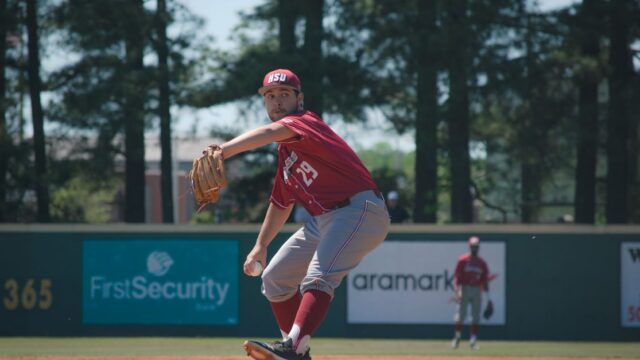
This is where power is generated. As your lead leg drives toward the plate, your hips should open before your shoulders. This hip-to-shoulder separation is the biggest velocity driver in the entire delivery. Studies from Driveline Baseball found that elite pitchers average 40 to 60 degrees of hip-to-shoulder separation, while average pitchers fall in the 25 to 35 degree range. Your stride length should be approximately 77 to 87 percent of your height. Land on a firm, slightly flexed front leg with your foot pointing toward home plate or slightly closed.
Phase 4: Arm Acceleration
Once your front foot lands and your hips have opened, your throwing arm accelerates from the cocked position toward the plate. The arm moves at speeds exceeding 7,000 degrees per second during this phase, making it one of the fastest human movements ever recorded. Your elbow should be at or slightly above shoulder height at the moment your foot lands. A common term you will hear is “arm slot,” which describes the angle of your arm relative to your body at release. Most pitchers fall into three-quarter or high three-quarter slots, though over-the-top and sidearm deliveries also work depending on body type and comfort.
Phase 5: Ball Release
Release the ball out in front of your body, as far toward the plate as possible while maintaining control. The further out front you release, the less time the hitter has to react. Major League data shows that for every foot closer to the plate at release, perceived velocity increases by roughly 1.5 miles per hour. Your wrist should snap forward naturally through the release point. The specific wrist and finger action at release is what determines pitch type, spin, and movement. Our complete pitching grips guide covers every grip in detail.
Phase 6: Follow-Through and Deceleration
After release, your arm must decelerate from peak speed to zero. This is where many injuries occur if the posterior shoulder and rotator cuff muscles are not strong enough to handle the forces involved. A proper follow-through involves your throwing hand finishing past your opposite hip, your back leg coming through naturally, and your body squaring up into a fielding position. Cutting the follow-through short increases stress on the elbow and shoulder by up to 30 percent.
Common Pitching Mistakes and How to Fix Them
I have seen these mistakes thousands of times on mounds at every level. Most mechanical issues can be traced back to one of these problems. Here is a complete breakdown of the most common pitching errors, what causes them, and how to correct each one.
| Mistake | What It Looks Like | Root Cause | How to Fix It |
|---|---|---|---|
| Opening too early | Shoulders fly open before hips rotate, ball runs arm side, velocity drops | Weak core, rushing the delivery, poor timing between lower and upper half | Separation drills on flat ground. Focus on leading with the hip while keeping the glove-side shoulder closed until foot strike. |
| Short striding | Stride length under 70% of height, pitches stay up in the zone, loss of extension | Fear of the landing, weak posterior chain, balance issues at leg lift | Mark stride length on the ground. Use stride measurement drills. Strengthen glutes and hamstrings. |
| Arm dragging | Arm lags behind the torso at foot strike, increased elbow stress, late release point | Disconnected arm action, rushing the lower half, improper break from glove | Slow-motion walk-throughs focusing on arm timing. The arm should be in the cocked position when the front foot lands. |
| Landing open | Front foot points toward the pull side, ball cuts across the zone, hip energy leaks | Directional issues in the stride, hip tightness, improper posting leg drive | Use a chalk line from mound to plate. Land on or slightly closed to the line. Hip mobility work daily. |
| Falling off to the glove side | Body drifts toward first base (for righties), cannot field position, inconsistent release point | Improper weight transfer, throwing across the body, weak front side | Finish drills where you hold your follow-through position. Plant your back foot on the landing and check your alignment. |
| Pushing the ball | Short, stiff arm action with little whip, below-average velocity despite physical strength | Over-muscling the throw, tension in the arm and shoulder, poor arm path | Long toss to rebuild free arm action. Connection ball drills. Focus on loose, whippy arm speed. |
| Not using the lower half | All-arm delivery, fatigue by the third inning, inconsistent command | Weak legs, learned bad habits, not enough flat ground work | Towel drills emphasizing leg drive. Weighted ball hip-to-shoulder separation drills. Lower body strength training. |
| Inconsistent release point | Pitches scatter across the zone, cannot repeat location within an at-bat | Mechanical variation pitch to pitch, fatigue, trying to throw too hard | Slow the game down. Focused bullpen sessions targeting one location for 20 pitches. Video review for mechanical consistency. |
Essential Pitching Drills for Every Level
Drills are the building blocks of pitching development. These are the exercises I use with every pitcher I coach, from youth all the way up to college-level arms. Start with the fundamentals and progress to advanced drills as your mechanics become consistent.
Beginner Drills
Balance Drill: Stand on your posting leg with your lead leg at the top of the leg lift. Hold for five seconds. Repeat 10 times. This builds the stability you need for a controlled delivery. If you cannot hold this position without wobbling, you are not ready for full-speed pitching yet.
Knee Drill: Start on one knee with your throwing-side knee on the ground. Throw to a partner or net from this position, focusing on arm action, release point, and follow-through. This isolates the upper body and removes the complexity of the lower half. Throw 20 to 30 pitches per session.
Walk-Through Drill: Stand about 15 feet behind the mound. Walk toward the plate, transitioning into your pitching motion as you reach the rubber. This teaches momentum and directional energy. The goal is a smooth, fluid delivery with no stop points.
Intermediate Drills
Towel Drill: Hold a small towel in your throwing hand instead of a baseball. Go through your full delivery and snap the towel toward a target. If your mechanics are right, the towel will snap at full extension out in front. This drill reinforces extension, follow-through, and stride length without the stress of actually releasing a ball. Aim for 15 to 20 reps per session.
Rocker Drill: Start with your feet in your stride position, then rock back and forth, building momentum before throwing. This teaches you to use your body’s natural weight transfer to generate velocity rather than muscling the ball with your arm alone.
Flat Ground Pitching: Throw full-effort bullpen sessions on flat ground. This reduces mound stress on the arm while allowing you to work on mechanics at game intensity. Many professional pitchers do the majority of their between-start work on flat ground. Pair this with your long toss program for maximum arm development.
Advanced Drills
Pitch Tunneling Drill: Throw sequences where a fastball and off-speed pitch travel on the same path until the last possible moment before diverging. Set up a hula hoop or target at a point roughly 20 feet in front of the plate. Both pitches should pass through the same window. This is how elite pitchers make 93 mph look like 100 and a changeup look unhittable. MLB data shows pitchers who tunnel effectively hold opponents to a .190 batting average or lower on secondary pitches.
Command Mapping: Divide the strike zone into nine boxes. Throw five pitches to each box during a bullpen session. Track your hit rate. Elite college pitchers hit their target zone roughly 60 to 65 percent of the time. High school pitchers with good command are in the 45 to 55 percent range. This drill pairs perfectly with our in-depth pitching command drills article.
Velocity Holds: Throw five pitches at 80 percent effort, then five at 90 percent, then five at full effort, and repeat. This teaches you to change speeds intentionally and understand the effort-to-velocity relationship. It also builds arm stamina for deep outings.
Building Your Pitch Arsenal
Every pitcher needs a plan for developing their pitch mix. Do not try to learn six pitches at once. Build sequentially, mastering each pitch before adding the next one. Here is a recommended progression based on age and development stage.
| Age/Level | Recommended Pitches | Priority Focus | Notes |
|---|---|---|---|
| 8 to 10 (Youth) | Four-seam fastball only | Mechanics, throwing strikes, fielding position after delivery | No breaking balls. Arm is still developing. Focus entirely on fastball command and proper mechanics. |
| 11 to 12 (Travel/Rec) | Four-seam fastball, changeup | Speed differential, arm speed on changeup matching fastball | The changeup is the safest secondary pitch for young arms. Same arm action as the fastball with a different grip. |
| 13 to 14 (Middle School) | Four-seam, changeup, curveball | Breaking ball command, pitch sequencing basics | Introduce the curveball only after the fastball and changeup are consistent. Proper curveball mechanics do not hurt the arm; bad mechanics do. |
| 15 to 16 (JV/Varsity) | Fastball (four-seam and two-seam), changeup, curveball or slider | Two-pitch command in every count, pitching backwards | Add the two-seam for ground ball outs. Choose slider or curveball based on arm slot and comfort. See our slider guide and curveball guide. |
| 17 to 18 (Varsity/Travel) | Full arsenal: 3 to 4 pitches | Pitch tunneling, sequencing, situational usage | Master three pitches before adding a fourth. A dominant three-pitch mix beats a mediocre five-pitch mix every time. |
| College and Beyond | Fastball variants, 2 to 3 secondaries | Advanced sequencing, analytics-driven development, pitch design | Use spin rate and movement data to optimize your existing pitches. Consider adding a cutter or splitter for added deception. |
If you want the complete breakdown of how to grip every pitch type, our baseball pitching grips guide covers everything with photos and detailed instructions.
Pitching Strategy and Game Management
Mechanics get you to the mound. Strategy keeps you there. The best pitchers in baseball are not always the hardest throwers. They are the ones who understand how to attack hitters, manage counts, and adapt mid-game.
Working the Count
The single most important pitching concept is getting ahead in the count. MLB data consistently shows that pitchers who throw first-pitch strikes have dramatically better results. When the count starts 0-1, Major League hitters bat around .180. When it starts 1-0, they hit closer to .280. That 100-point swing is the entire difference between dominance and damage.
First-pitch strikes should be your obsession. At the youth and high school levels, simply throwing strike one consistently puts you ahead of 80 percent of your competition. You do not need a 95 mph fastball to dominate. You need a 0-1 count.
Sequencing Pitches
Great pitchers think in sequences, not individual pitches. The concept is simple: every pitch should set up the next one. A fastball up in the zone makes a changeup down look unhittable. A slider backdoor to a lefty sets up a fastball inside. The best way to develop sequencing instincts is to study hitter tendencies and work backward from the pitch you want to get a swing-and-miss on.
A practical framework I teach every pitcher is the “3-2-1 approach”: in a three-pitch at-bat, the first pitch establishes location, the second changes the hitter’s eye level or speed expectation, and the third finishes in the opposite quadrant of the zone. This does not work every time, but it gives you a starting framework for every at-bat.
Pitching with Runners On
The stretch delivery changes your rhythm and timing. Many young pitchers lose significant velocity and command when working from the stretch because they have not practiced it enough. A good rule: 40 percent of your bullpen work should come from the stretch. In games, you will pitch with runners on base roughly one-third of the time, and those are the highest-leverage situations where command matters most.
Controlling the running game is about time to the plate. A pitcher with a delivery time of 1.3 seconds or less from the stretch makes it extremely difficult for runners to steal. The MLB average time to the plate is approximately 1.35 seconds. Vary your timing with slide steps, different holds, and occasional pickoff attempts to keep runners guessing.
The Mental Side of Pitching
Pitching is the most mentally demanding position in all of sports. You are involved in every single play, you are alone on the mound, and every mistake is visible. Developing mental toughness is not optional — it is a core skill that separates good pitchers from great ones.
Developing a Pre-Pitch Routine
Every elite pitcher has a pre-pitch routine they repeat before every single delivery. This routine anchors you to the present moment and prevents your mind from drifting to the last pitch or the scoreboard. A simple routine might look like: get the ball back, take a breath on the back of the mound, step to the rubber, get the sign, and deliver. The specific routine does not matter as much as the consistency of doing it.
Handling Adversity on the Mound
Bad innings happen to every pitcher. The difference between a one-run inning and a five-run inning often comes down to how the pitcher handles the first sign of trouble. My go-to mental framework is the “next pitch” mentality. The last pitch is gone. The only pitch that matters is the next one. If you need a reset, step off the rubber, take a deep breath, and visualize the pitch you want to execute before stepping back on. For a deeper dive into building mental resilience, check out our baseball mental game tips guide.
Arm Care and Injury Prevention for Pitchers
Nothing derails pitching development faster than an arm injury. Tommy John surgery rates have increased by over 50 percent among youth pitchers in the last two decades, according to the American Sports Medicine Institute. The vast majority of these injuries are preventable with proper arm care, pitch count management, and rest.
Pitch Count Guidelines
Follow these pitch count recommendations based on USA Baseball and the Pitch Smart guidelines:
- Ages 7 to 8: 50 pitches per game, 1 to 2 appearances per week
- Ages 9 to 10: 75 pitches per game, 2 appearances per week maximum
- Ages 11 to 12: 85 pitches per game, with required rest days based on pitch count
- Ages 13 to 14: 95 pitches per game
- Ages 15 to 18: 105 pitches per game
- College and professional: Managed by coaching staff and typically 100 to 120 pitches
These are maximums, not targets. If a 12-year-old is reaching 85 pitches regularly, something is wrong with the game plan. Most youth outings should fall well below these limits. Pair smart pitch counts with a dedicated arm care routine that includes band work, shoulder exercises, and proper cool-down protocols.
Warning Signs of Arm Trouble
Stop throwing immediately and see a sports medicine professional if you experience:
- Sharp pain on the inside of the elbow during or after throwing
- Decreased velocity without explanation
- Pain that persists more than 24 hours after pitching
- Numbness or tingling in the fingers
- Inability to fully extend the arm
- Swelling around the elbow or shoulder
Arm soreness after a start is normal. Pain is not. Teach young pitchers the difference early, and never let a player pitch through pain. The long toss article covers proper throwing programs that build arm strength safely over time.
How to Run an Effective Bullpen Session
Bullpen sessions are where pitchers develop. But throwing 50 aimless pitches in the bullpen is worse than throwing none. Every bullpen should have a plan, a focus, and a structure. Here is how I set up bullpen sessions for the pitchers I coach.
Pre-Bullpen Warm-Up
Start with a full warm-up routine including band work, arm circles, and a progressive long toss that gets you to throwing distance gradually. Never walk straight to the mound and start throwing at full effort. A 15 to 20 minute warm-up is standard for most levels.
Bullpen Structure
A good bullpen for a high school or college pitcher looks like this:
- Fastball command (15 pitches): Throw fastballs to different locations. Focus on arm side, glove side, up, and down. Do not worry about velocity — just hit spots.
- Secondary pitch development (15 pitches): Throw your off-speed pitches. Work on consistency of shape, release point, and landing zone.
- Pitch sequences (10 pitches): Simulate at-bats. Throw a three-pitch sequence to an imaginary hitter. Fastball away, curveball down, changeup away — whatever your game plan dictates.
- Situational pitches (5 to 10 pitches): Practice specific situations. A 3-2 pitch with a runner on second. A first-pitch strike with the bases loaded. An 0-2 waste pitch followed by a put-away pitch.
Total pitch count for a between-start bullpen should be 35 to 50 pitches. For a day-before-start touch session, keep it to 15 to 20 pitches of fastballs only.
Pitching Velocity Development
Every pitcher wants to throw harder. The good news is that velocity is a trainable attribute, even into your early twenties. The approach matters, though. Chasing velocity without a plan leads to injury. Here is a structured approach to gaining and maintaining velocity.
The Velocity Equation
Velocity comes from three sources: lower body force production, rotational efficiency, and arm speed. Research from the American Sports Medicine Institute shows that approximately 50 percent of pitching velocity is generated by the lower half, 30 percent from the trunk, and only 20 percent from the arm itself. This is why the most effective velocity programs focus on leg strength and rotational power, not arm exercises.
Key areas to train for velocity:
- Hip-to-shoulder separation: Increase this through medicine ball rotational throws, cable chops, and flexibility work.
- Posterior chain strength: Deadlifts, RDLs, hip thrusts, and lunges build the engine of the delivery.
- Stride power: Single-leg bounds, lateral jumps, and sled pushes develop explosive stride force.
- Arm speed and whip: Long toss, weighted ball pulldowns, and plyometric ball drills increase arm speed safely when implemented correctly.
For a complete velocity training breakdown with specific programs, see our detailed guide on how to throw harder in baseball.
Advanced Tips for Experienced Pitchers
Once you have solid mechanics and a reliable pitch arsenal, the next level of development involves fine-tuning your craft. These advanced concepts are what separate competent high school pitchers from college-level arms and beyond.
Use Spin Rate and Movement Data
If you have access to a Rapsodo or TrackMan unit, use the data to understand your pitch profiles. Spin rate alone does not tell the whole story — spin axis and spin efficiency matter more. A curveball with 2800 RPM of spin but poor spin efficiency will not break as much as one with 2400 RPM and perfect top-spin orientation. Learn what your natural spin tendencies are and design your pitch mix around your strengths rather than fighting your arm slot.
Develop a Ground Ball or Fly Ball Identity
Not every pitcher needs to strike everyone out. Some of the most effective pitchers in MLB history have been ground ball specialists who generate weak contact consistently. If your natural sinker or two-seam gets heavy ground ball action, lean into it. Pitch to contact with the infield behind you. If you are a high-spin, four-seam pitcher with ride, attack the top of the zone and challenge hitters to elevate. Knowing your identity lets you play to your strengths instead of trying to be something you are not.
Study Hitter Tendencies
At the varsity and college levels, scouting reports become a real advantage. Study opposing lineups for tendencies: who chases sliders down and away, who cannot catch up to fastballs up, who sits on first-pitch fastballs. Even without advanced data, you can pick up tendencies during a game by watching how hitters react to your first couple of pitches. If a hitter swings late on your fastball, keep throwing it. If he fouls off two straight changeups, stop throwing changeups and challenge him with velocity.
Develop a Pickoff Move
A deceptive pickoff move does more than catch runners. It disrupts baserunner timing and allows you to slow the tempo of the game when you need a reset. Left-handed pitchers have a natural advantage with the pickoff move to first base, but right-handers can develop effective moves with practice. The key is varying your look time and making your move to the plate and your move to first look identical for as long as possible.
Sample Weekly Pitching Development Program
Consistency is everything in pitching development. Here is a sample in-season weekly program for a starting pitcher at the high school or college level who pitches once per week.
- Day 1 (Game Day): Full warm-up, game start, cool-down with light band work and stretching.
- Day 2 (Recovery): Light jog or bike, band work, foam rolling, no throwing.
- Day 3 (Light Throw): Flat ground long toss up to 120 feet, 25 to 30 throws. Light core and lower body mobility work.
- Day 4 (Bullpen): Structured bullpen session, 35 to 50 pitches. Work on command and pitch development. Followed by arm care routine.
- Day 5 (Recovery): Light toss only, 15 to 20 throws at short distance. Full body lift focusing on lower body and core.
- Day 6 (Pre-Game): Light bullpen or touch session, 15 to 20 fastballs. Mental preparation and scouting review.
- Day 7 (Game Day): Repeat cycle.
This schedule ensures adequate recovery while maintaining development throughout the season. Adjust based on your body’s feedback and your coaching staff’s preferences. During the off-season, replace game days with higher-volume throwing and strength training sessions.
Frequently Asked Questions About Pitching
How fast should I throw for my age?
Velocity benchmarks vary widely, but general guidelines for average fastball speeds are: 10 to 12 years old, 45 to 55 mph; 13 to 14, 55 to 68 mph; 15 to 16, 65 to 78 mph; 17 to 18, 72 to 86 mph; college, 82 to 93 mph. These are ranges. Being at the lower end does not mean you cannot compete — command and pitch mix matter more than raw velocity at every level below professional baseball.
When should my kid start throwing breaking balls?
The research is clear: a properly thrown curveball is no more dangerous than a fastball. The injury risk comes from poor mechanics, high volume, and year-round throwing without rest. That said, I recommend waiting until age 13 to 14 to introduce a curveball, and the changeup should always come first as a secondary pitch because it uses the same arm action as the fastball.
How many days of rest do I need between pitching outings?
The Pitch Smart guidelines recommend: 1 to 20 pitches requires no mandatory rest. 21 to 35 pitches require one day of rest. 36 to 50 pitches require two days. 51 to 65 pitches require three days. 66 or more pitches require four days of rest. These guidelines apply to youth and high school pitchers. College and professional schedules are managed by coaching and training staffs with access to workload monitoring tools.
Should I throw every day?
Light tossing and catch play can be done daily. Full-effort pitching should not. Your arm needs recovery time between intense throwing sessions. A good rule is to never throw full-effort bullpen sessions or game-intensity pitches on back-to-back days. Active recovery like light toss, band work, and conditioning on off days keeps the arm healthy without adding stress.
How do I add velocity without getting hurt?
Focus on your lower half and core through a structured strength training program. Implement a progressive long toss program. Use weighted balls under the guidance of a qualified instructor. And above all, be patient. Velocity development happens over months and years, not days and weeks. Trying to add five mph in a single off-season is a recipe for injury.
What is the most important pitch to master?
The four-seam fastball. It is the foundation of every pitch arsenal. If you cannot command your fastball, nothing else matters. Master locating your fastball to both sides of the plate and up and down in the zone before spending significant time on secondary pitches. A pitcher who can put a fastball anywhere in the zone at will is dangerous at every level of baseball.
Do pitchers need to do long toss?
Yes. Long toss is one of the most effective arm development tools available. It builds arm strength, improves arm speed, and reinforces free and easy throwing mechanics. Our complete long toss guide has distance charts and programs for every level. Start with a moderate program and build gradually.
Final Thoughts on Becoming a Better Pitcher
Pitching is a craft that takes years to develop and a lifetime to master. The best pitchers I have coached all share three traits: they are obsessively consistent with their mechanics, they study the game constantly, and they prioritize their arm health above everything else. You do not need to throw 95 to be a dominant pitcher. You need to throw strikes, change speeds, and compete on every pitch.
Start with the fundamentals in this guide. Master the basic delivery before chasing velocity or complex pitch types. Build your arm strength progressively through a smart arm care program, long toss, and structured bullpen work. Develop your mental game alongside your physical skills. And never stop learning.
The mound is the loneliest and most powerful place on a baseball field. When you own it — when you control the pace, the location, and the hitter’s timing — there is no better feeling in the sport. Put in the work, trust the process, and go compete.